
News Extra
Refugees in Libya marque cinq années de lutte avec un événement à Berlin

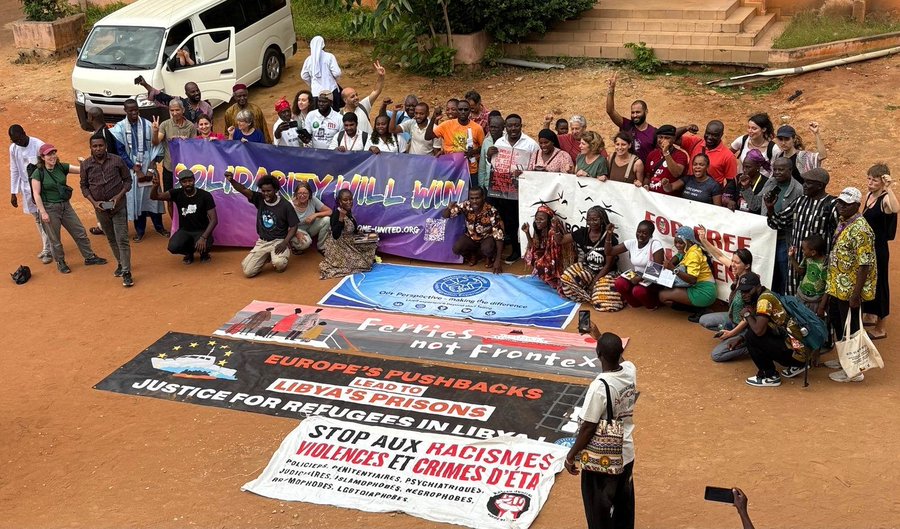
Cinq ans après le lancement par des réfugiés et migrants en Libye de la manifestation des « 100 jours » à la suite d’arrestations massives à Tripoli, Refugees in Libya réunira à Berlin des militants, des survivants, des avocats et des organisations dirigées par des migrants afin de revenir sur cette lutte et sur la quête de justice et de responsabilité.
L’événement, intitulé « Des rues de Tripoli à la CPI : cinq années de lutte et de solidarité avec les réfugiés en Libye », se tiendra le 3 octobre 2026 à la Spore Initiative, à Berlin.
La manifestation a débuté le 1er octobre 2021, après des descentes massives dans le quartier de Gargaresh, à Tripoli, au cours desquelles des milliers de réfugiés et de migrants ont été arrêtés. Alors que certains ont été conduits dans des centres de détention, d’autres se sont rassemblés devant le bureau du HCR, où ils sont restés pendant plus de trois mois pour réclamer protection, évacuation, liberté et la fin des violences et des abus en Libye.
Selon Refugees in Libya, cette protestation est devenue un moment déterminant pour l’organisation menée par des migrants et a continué de façonner son travail au cours des cinq années suivantes.
La rencontre de Berlin intervient alors que les procédures engagées contre Khaled El Hishri, ancien responsable de la prison de Mitiga, progressent devant la Cour pénale internationale (CPI).
La CPI a confirmé les 17 chefs d’accusation retenus contre El Hishri, portant notamment sur des crimes présumés contre l’humanité et des crimes de guerre, et a renvoyé l’affaire devant la chambre de première instance pour son procès.
Refugees in Libya a déclaré que cette affaire revêt une importance particulière pour les survivants ayant subi ou été témoins d’actes présumés de torture, de violences sexuelles, d’esclavage, de disparitions forcées et de meurtres à Mitiga et dans d’autres centres de détention.
L’organisation estime toutefois que l’affaire soulève également des questions plus larges sur le système de détention et de contrôle migratoire en Libye.
Elle affirme que, depuis des années, les réfugiés et les migrants sont confrontés à la détention, à l’exploitation et aux violences à travers la Libye, tandis que les personnes qui tentent de traverser la Méditerranée sont interceptées et renvoyées dans le pays.
Refugees in Libya s’interroge également sur le rôle des gouvernements et institutions européens dans le soutien aux structures impliquées dans l’interception et le confinement des migrants, estimant que les mécanismes de responsabilité devraient examiner l’ensemble du système plutôt que de se concentrer exclusivement sur les auteurs individuels.
L’événement examinera la procédure concernant El Hishri, la participation des survivants ainsi que les limites et les possibilités de la justice internationale.
Parmi les intervenants figureront David Yambio, de Refugees in Libya, et Allison West, du European Center for Constitutional and Human Rights (ECCHR). La discussion sera animée par Viola Castellano.
Les organisateurs ont indiqué que la rencontre cherchera également à déterminer comment les survivants peuvent participer aux processus judiciaires et politiques sans être réduits au simple rôle de témoins, et comment les procédures judiciaires peuvent contribuer à des actions collectives et à une mobilisation plus large.
Une deuxième session réunira des organisations dirigées par des migrants, des groupes de la diaspora africaine, des mouvements antiracistes, des avocats, des journalistes, des chercheurs, des artistes et d’autres acteurs afin de discuter de solidarité, de plaidoyer juridique et d’action collective.
Une exposition multimédia présentant des photographies, des témoignages et des documents issus de la manifestation des « 100 jours » accompagnera l’événement.
Refugees in Libya a précisé que cette rencontre ne vise pas seulement à commémorer la manifestation de 2021, mais aussi à examiner les conditions auxquelles les réfugiés et migrants continuent d’être confrontés en Libye.
Le programme débutera par une exposition à 15 h 30, suivie à 16 h d’une discussion consacrée aux cinq années d’organisation de Refugees in Libya. La session consacrée à l’affaire El Hishri devant la CPI est prévue à 16 h 45, avant un repas, des échanges informels et des discussions en petits groupes à partir de 18 h 45.
L’événement se déroulera en anglais, avec une entrée gratuite, à la Spore Initiative, Hermannstraße 86, Berlin-Neukölln.




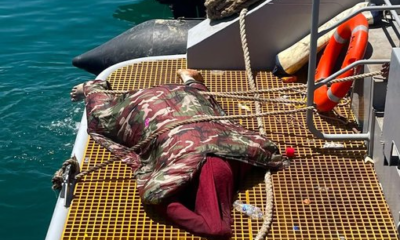



Dozens of Egyptian and other migrants are feared dead or missing after a boat carrying them sank off the Libyan coast while attempting to cross the Mediterranean to Europe, according to Egyptian media reports.
The vessel reportedly departed from the eastern Libyan city of Tobruk on Thursday evening but began sinking just a few kilometres into the journey, prompting passengers to send distress signals.
Sources cited by Egypt’s Al-Masry Al-Youm newspaper said strong winds and darkness hampered rescue operations. Six people were rescued, while the fate of the other passengers remained unknown.
Search teams continued operations along the Libyan coast in an effort to locate survivors, find missing migrants and recover bodies.
The exact number of passengers aboard the boat and the confirmed death toll were not immediately known.
According to the report, the migrants had allegedly travelled to Libya through human trafficking networks, which reportedly held them in warehouses before arranging sea crossings to Europe in exchange for money.
Residents of Sindbis village in Egypt’s Qalyubia Governorate told Al-Masry Al-Youm that between 22 and 27 young men from their community were believed to have been aboard the vessel. Young men from neighbouring villages were also reportedly among those who joined the journey.
One resident said the group had left the village about a month earlier, travelling by bus to Alexandria before proceeding towards Libya by sea. Their families reportedly lost contact with them several hours after they boarded the boat.
Most of the missing young men were reportedly under the age of 20 and had been seeking employment opportunities abroad, the resident added.
The latest shipwreck underscores the continuing dangers faced by migrants attempting to reach Europe through irregular Mediterranean crossings from Libya, where dangerous sea journeys and trafficking networks continue to expose migrants to exploitation and loss of life.
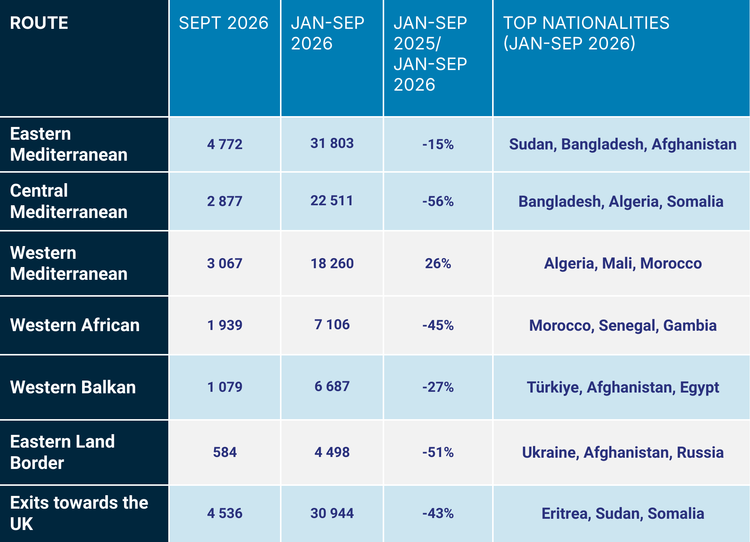
Irregular migration to the European Union declined on most major migratory routes in the first nine months of 2026, although crossings along the Western Mediterranean route increased by 26 per cent, according to figures released by the European Border and Coast Guard Agency (Frontex).
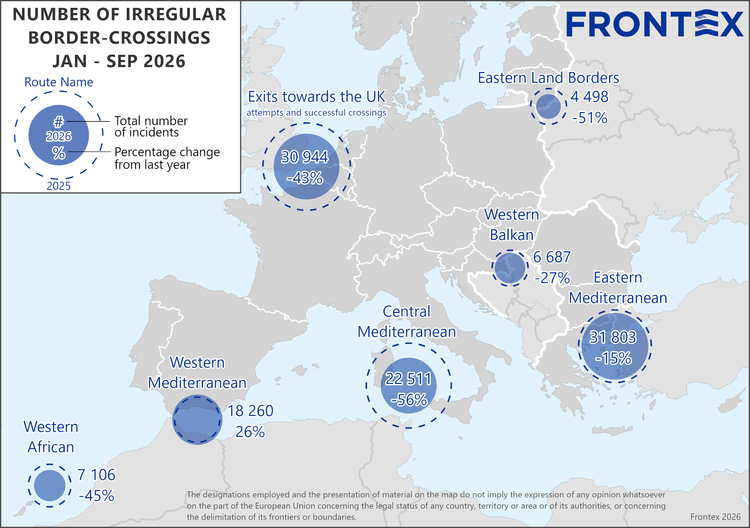
Data covering January to September 2026 showed that the Eastern Mediterranean route recorded the highest number of irregular border crossings, with 31,803 detections, representing a 15 per cent decrease compared with the same period in 2025.
The Central Mediterranean route followed with 22,511 detections, marking a 56 per cent decline, while the Western Mediterranean route recorded 18,260 crossings, an increase of 26 per cent.
The Western African route registered 7,106 crossings, down 45 per cent, while the Western Balkans recorded 6,687, representing a 27 per cent decrease.
Meanwhile, detections along the Eastern Land Border fell by 51 per cent to 4,498.
Exits towards the United Kingdom also declined, with 30,944 detections recorded during the nine-month period, a 43 per cent decrease compared with the corresponding period in 2025.
September figures
In September alone, the Eastern Mediterranean route recorded 4,772 irregular crossings, the highest among the routes monitored by Frontex.
The Western Mediterranean followed with 3,067 crossings, while the Central Mediterranean recorded 2,877.
The Western African route registered 1,939 crossings, compared with 1,079 along the Western Balkans and 584 at the Eastern Land Border.
Meanwhile, 4,536 exits towards the United Kingdom were recorded during the month.
Top nationalities
Sudanese, Bangladeshi and Afghan nationals were the leading nationalities detected along the Eastern Mediterranean route during the first nine months of 2026.
Bangladeshis, Algerians and Somalis topped the list along the Central Mediterranean route, while Algerians, Malians and Moroccans were the most frequently detected nationalities along the Western Mediterranean route.
On the Western African route, the leading nationalities were Moroccans, Senegalese and Gambians.
Turkish, Afghan and Egyptian nationals were the most frequently detected along the Western Balkans route, while Ukrainians, Afghans and Russians topped the list at the Eastern Land Border.
For exits towards the United Kingdom, Eritreans, Sudanese and Somalis were the leading nationalities.
The figures highlight the varying migration trends across Europe’s external borders, with most routes recording substantial declines while the Western Mediterranean experienced an increase during the period under review.
The number of irregular border crossings into the European Union (EU) fell by almost one-third in the first nine months of 2026 compared with the same period last year, according to preliminary data released by the European Border and Coast Guard Agency (Frontex).
The agency said just over 91,000 irregular crossings were detected between January and September, attributing the decline across most major migration routes to sustained cooperation with partner countries and preventive measures in key departure states.
In September alone, approximately 14,300 crossings were recorded, representing a 28 per cent decrease compared with September 2025, although the figure was 11 per cent higher than in August.
According to Frontex, the period also marked the first full summer under the EU Pact on Migration and Asylum, which introduces a standardised screening process at the bloc’s external borders.
Frontex officers are supporting member states with key aspects of the new system, including identifying the nationalities of arrivals, collecting biometric information and verifying travel documents.
Frontex Executive Director Hans Leijtens said fewer people were attempting to reach Europe through most migration routes, although he warned that the situation could change rapidly.
“On most routes into Europe, fewer people are attempting the journey, and that has held through the summer and into the autumn. But things can turn quickly,” Leijtens said.
He cited the Atlantic route towards the Canary Islands, where detections in September were four times higher than in August, warning that human smuggling networks remained active despite the overall decline in crossings.
The Eastern and Central Mediterranean routes remained the busiest corridors, accounting for almost 60 per cent of all irregular entries into the EU during the nine-month period.
The Central Mediterranean recorded the sharpest decline, with crossings falling by 56 per cent, while the Western Mediterranean was the only major route to register an increase, with detections rising by 26 per cent.
On the Eastern Mediterranean route, approximately 31,800 crossings were recorded, representing a 15 per cent decline compared with the same period in 2025.
The corridor from Libya to Crete was the busiest section, followed by the eastern Aegean islands and the land border with Türkiye. Sudanese, Bangladeshi and Afghan nationals were the main nationalities detected.
The Central Mediterranean recorded approximately 22,500 arrivals, down by 56 per cent year-on-year. Libya remained the main departure point, accounting for about three-quarters of crossings along the route, followed by Tunisia and Algeria.
Bangladeshi, Algerian and Somali nationals were the main groups detected on the route.
Meanwhile, the Western Mediterranean recorded around 18,300 crossings, an increase of 26 per cent compared with the first nine months of 2025.
The increase was mainly driven by crossings at land borders, where detections more than doubled, while sea arrivals rose by eight per cent.
Algeria remained the principal departure country for sea crossings, with the Balearic Islands and mainland Spain serving as the main destinations. Algerian, Malian and Moroccan nationals accounted for the largest groups detected.
On the Western African route, approximately 7,100 crossings were recorded, representing a 45 per cent decline.
Frontex attributed the reduction to preventive measures introduced by Mauritania and, more recently, Senegal and The Gambia, in cooperation with Spain and the EU.
However, the agency warned that migration movements along the route remained unpredictable, with detections rising sharply to approximately 1,900 in September, four times the August figure.
Departures were reported from Morocco and The Gambia towards the Canary Islands, while Moroccan, Senegalese and Gambian nationals were the main groups detected.
Attempts to cross the English Channel towards the United Kingdom also declined, falling by 43 per cent to approximately 30,900 during the nine-month period. The figure includes both people who reached the UK and those prevented from departing.
Around 4,500 attempts were recorded in September, with Eritrean, Sudanese and Somali nationals accounting for the main nationalities detected.
Frontex noted that smuggling networks increasingly relied on larger inflatable boats, known as mega dinghies. In August, a record 230 people, including more than 20 children, reportedly reached the UK in a single inflatable boat.
The agency said an agreement signed between the UK and France in April was expected to strengthen patrols along the French coast in the coming months.
Despite the overall decline in irregular crossings, Frontex warned that the human cost of migration remained high.
Citing the International Organization for Migration (IOM), the agency said nearly 2,000 people had died in the Mediterranean so far in 2026, highlighting the dangers faced by migrants travelling in overcrowded and unseaworthy boats.
It added that developments outside the EU’s borders, including the large-scale return of Afghan nationals from Iran and Pakistan and instability across the Sahel, could influence future migration movements towards Europe.
Although these developments had not yet resulted in a significant change in arrivals at the EU’s external borders, Frontex said it was closely monitoring the situation.
The agency added that approximately 3,800 officers were currently deployed at the EU’s external borders to support national authorities in border management and search-and-rescue operations.

Des migrants égyptiens et d’autres nationalités portés disparus ou présumés morts après le naufrage d’une embarcation au large de la Libye

Egyptian migrants, others feared dead, missing after boat sinks off Libya

Les traversées en Méditerranée occidentale augmentent de 26 %

Western Mediterranean crossings rise by 26%
Frontex se félicite de la baisse des franchissements irréguliers aux frontières de l’UE
-

 News Extra2 weeks ago
IOM’s Displacement Tracking Matrix monitors 97.2 million people in 2025
-
 News Extra1 week ago
SOS Humanity accuses Frontex of aiding migrant pushbacks to Libya
-

 News2 weeks ago
Libya repatriates hundreds of migrants, deploys reinforcements to Tobruk
-
News2 weeks ago
Libye : des centaines de migrants rapatriés, des renforts déployés à Tobrouk
-
 News2 weeks ago
Ebola:DRC confirms 10,000 cases, NRC seeks scale-up
-
 News Extra2 weeks ago
La Matrice de suivi des déplacements de l’OIM a suivi 97,2 millions de personnes en 2025
-
 News21 hours ago
Sea-Watch condemns proposed EU plan to expand Frontex powers
-
 Features2 weeks ago
League of Arab States, IOM launch Arab Migration Data Network