
News Extra
La Matrice de suivi des déplacements de l’OIM a suivi 97,2 millions de personnes en 2025

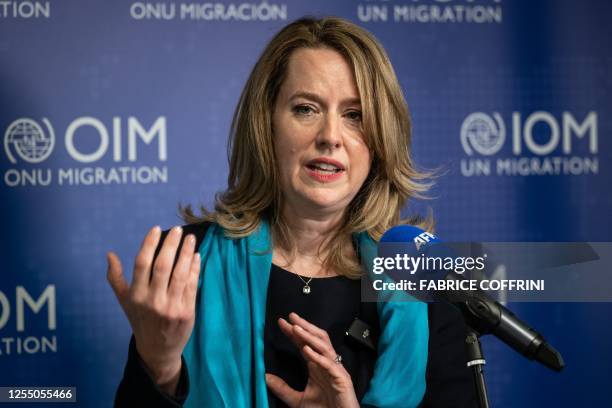
La Matrice de suivi des déplacements (DTM) de l’Organisation internationale pour les migrations (OIM) a suivi un total de 97,2 millions de personnes dans le monde en 2025, fournissant des données destinées à soutenir les interventions humanitaires, la recherche de solutions aux déplacements et les voies de migration régulière.
Selon les priorités stratégiques de la DTM pour la période 2026-2028, le programme a réalisé 706 386 entretiens auprès de ménages et collaboré avec 791 141 informateurs clés au cours de l’année.
Le rapport indique également que 95 % des Plans de réponse aux besoins humanitaires (HNRP), soit 19 plans sur 20, ont été élaborés sur la base des données et des analyses de la DTM.
À la fin de l’année 2025, la DTM comptait 76 opérations actives, après avoir mené des activités dans 91 pays au début de l’année. Les populations suivies comprenaient des personnes déplacées internes (PDI), des personnes de retour, des migrants et d’autres groupes de population.
Depuis plus de 20 ans, la DTM fournit des données et des analyses aux gouvernements ainsi qu’aux acteurs humanitaires, de la paix et du développement afin de favoriser une prise de décision fondée sur des données probantes lors des situations d’urgence, des phases de relèvement après une crise et des opérations migratoires.
Le Comité permanent interorganisations a officiellement reconnu la DTM en 2024 comme l’un des principaux fournisseurs de données nationales sur les personnes déplacées internes.
Dans sa stratégie pour la période 2026-2028, le programme a défini trois objectifs principaux : sauver des vies et protéger les personnes en déplacement, favoriser la recherche de solutions aux déplacements et faciliter les voies de migration régulière.
Dans le cadre de ses priorités en matière de réponse humanitaire, la DTM prévoit de renforcer la collecte et l’analyse des données, d’améliorer la coordination entre les acteurs humanitaires et de promouvoir une gestion sûre et éthique de l’information.
Le programme entend également améliorer l’interopérabilité des systèmes de données afin de faciliter le partage des informations entre les différentes plateformes et organisations. Il estime que le renforcement des structures opérationnelles permettra de soutenir aussi bien les interventions d’urgence rapides que la planification stratégique à long terme.
Priorité aux solutions durables aux déplacements
La DTM prévoit d’élargir ses activités en faveur de solutions durables pour les populations déplacées, en fournissant des données permettant aux gouvernements et à leurs partenaires de mieux comprendre les besoins, les vulnérabilités et les conditions de vie des personnes déplacées.
Cette stratégie s’appuie sur l’Indice des solutions et de la mobilité (SMI) de l’OIM, lancé en 2022 et mis en œuvre dans plus de 20 pays depuis son lancement.
Cet indice fournit des données et des analyses adaptées aux contextes locaux afin de soutenir des interventions à long terme dans les communautés touchées par les crises, notamment en matière de stabilisation, de relèvement et de solutions durables.
La DTM prévoit également de renforcer ses méthodologies de mesure des progrès vers des solutions durables, d’aider les autorités nationales à élaborer des réponses conçues et pilotées localement, et d’approfondir ses analyses sur l’emploi et les moyens de subsistance.
Le programme entend en outre renforcer ses partenariats avec les établissements universitaires, les banques multilatérales de développement et le secteur privé afin d’améliorer la collecte et l’analyse des données.
En partenariat avec l’Institut pour l’étude des migrations internationales de l’Université de Georgetown, l’OIM a lancé en 2023 le Rapport mondial périodique sur l’état des solutions aux déplacements internes (PROGRESS).
L’édition 2026 devrait devenir le premier rapport biennal interinstitutions couvrant l’ensemble du système des Nations unies sur les solutions aux déplacements internes. Sa coordination sera assurée avec le Centre de suivi des déplacements internes (IDMC), le Programme des Nations unies pour le développement (PNUD) et l’Agence des Nations unies pour les réfugiés (HCR).
Renforcer le suivi des routes migratoires
Afin de soutenir les voies de migration régulière, la DTM prévoit de renforcer son approche fondée sur les routes migratoires pour mieux comprendre les mouvements de population entre les pays et les régions.
Le programme souligne que les parcours migratoires sont souvent interconnectés et influencés par les conditions dans les pays d’origine et de transit, ainsi que par les évolutions géopolitiques plus générales.
Les activités de suivi des flux migratoires et les recherches ciblées visent à fournir des informations plus complètes sur les tendances migratoires, les caractéristiques des migrants, leurs vulnérabilités et leurs besoins en matière de protection.
La DTM prévoit également d’améliorer la qualité des données, de produire des analyses plus détaillées des routes migratoires et de renforcer la collaboration avec ses partenaires tout au long des parcours des migrants.
Son portail Global Overview of Migration Routes (Vue d’ensemble mondiale des routes migratoires) rassemble des informations sur le nombre de migrants, leurs caractéristiques démographiques, leurs nationalités, les tendances des déplacements, ainsi que les décès et les disparitions. Ces données aident les décideurs et les chercheurs à mieux comprendre les dynamiques migratoires.
Mobilité liée au climat et innovation technologique
La stratégie souligne également l’importance de comprendre les effets du changement climatique et des catastrophes sur la mobilité humaine.
Les évaluations climatiques et environnementales de la DTM visent à fournir des données probantes avant, pendant et après les catastrophes, afin d’aider les gouvernements et leurs partenaires à planifier des mesures anticipées, à renforcer la préparation aux catastrophes et à soutenir les communautés touchées.
Ces évaluations portent notamment sur les conditions climatiques de référence, les conséquences des situations d’urgence et la vulnérabilité aux risques tels que les sécheresses, les inondations et les cyclones.
Parallèlement, la DTM prévoit de moderniser ses systèmes de données et d’améliorer l’accessibilité et l’utilisation des informations grâce à l’innovation technologique.
En 2025, le programme comptait 496 experts techniques répartis entre des équipes nationales, régionales et mondiales. Ses opérations comprenaient le suivi des flux migratoires, le suivi des déplacements internes, l’évaluation des solutions durables et des situations post-crise, ainsi que la collecte de données sur la transhumance.
La stratégie définit trois priorités transversales pour la période 2026-2028 : développer des systèmes de données résilients et adaptatifs, améliorer l’accessibilité et l’utilisabilité des données de la DTM, et diversifier sa base de donateurs afin de garantir un financement durable.
Elle insiste également sur la nécessité de renforcer la coordination et de promouvoir des actions fondées sur des données probantes aux niveaux national, régional et mondial.
La DTM estime que des investissements soutenus dans les capacités du personnel, les systèmes techniques et l’appui organisationnel seront essentiels pour préserver sa capacité à répondre à l’évolution des besoins humanitaires et migratoires.







Dozens of Egyptian and other migrants are feared dead or missing after a boat carrying them sank off the Libyan coast while attempting to cross the Mediterranean to Europe, according to Egyptian media reports.
The vessel reportedly departed from the eastern Libyan city of Tobruk on Thursday evening but began sinking just a few kilometres into the journey, prompting passengers to send distress signals.
Sources cited by Egypt’s Al-Masry Al-Youm newspaper said strong winds and darkness hampered rescue operations. Six people were rescued, while the fate of the other passengers remained unknown.
Search teams continued operations along the Libyan coast in an effort to locate survivors, find missing migrants and recover bodies.
The exact number of passengers aboard the boat and the confirmed death toll were not immediately known.
According to the report, the migrants had allegedly travelled to Libya through human trafficking networks, which reportedly held them in warehouses before arranging sea crossings to Europe in exchange for money.
Residents of Sindbis village in Egypt’s Qalyubia Governorate told Al-Masry Al-Youm that between 22 and 27 young men from their community were believed to have been aboard the vessel. Young men from neighbouring villages were also reportedly among those who joined the journey.
One resident said the group had left the village about a month earlier, travelling by bus to Alexandria before proceeding towards Libya by sea. Their families reportedly lost contact with them several hours after they boarded the boat.
Most of the missing young men were reportedly under the age of 20 and had been seeking employment opportunities abroad, the resident added.
The latest shipwreck underscores the continuing dangers faced by migrants attempting to reach Europe through irregular Mediterranean crossings from Libya, where dangerous sea journeys and trafficking networks continue to expose migrants to exploitation and loss of life.
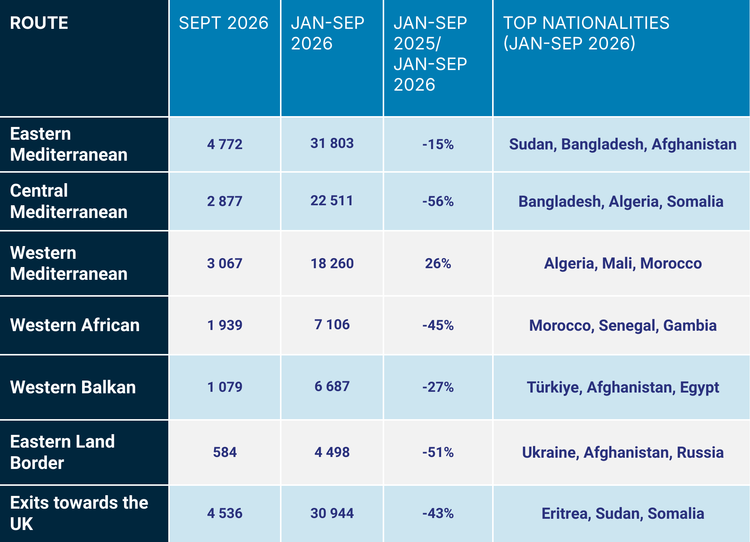
Irregular migration to the European Union declined on most major migratory routes in the first nine months of 2026, although crossings along the Western Mediterranean route increased by 26 per cent, according to figures released by the European Border and Coast Guard Agency (Frontex).
Data covering January to September 2026 showed that the Eastern Mediterranean route recorded the highest number of irregular border crossings, with 31,803 detections, representing a 15 per cent decrease compared with the same period in 2025.
The Central Mediterranean route followed with 22,511 detections, marking a 56 per cent decline, while the Western Mediterranean route recorded 18,260 crossings, an increase of 26 per cent.
The Western African route registered 7,106 crossings, down 45 per cent, while the Western Balkans recorded 6,687, representing a 27 per cent decrease.
Meanwhile, detections along the Eastern Land Border fell by 51 per cent to 4,498.
Exits towards the United Kingdom also declined, with 30,944 detections recorded during the nine-month period, a 43 per cent decrease compared with the corresponding period in 2025.
September figures
In September alone, the Eastern Mediterranean route recorded 4,772 irregular crossings, the highest among the routes monitored by Frontex.
The Western Mediterranean followed with 3,067 crossings, while the Central Mediterranean recorded 2,877.
The Western African route registered 1,939 crossings, compared with 1,079 along the Western Balkans and 584 at the Eastern Land Border.
Meanwhile, 4,536 exits towards the United Kingdom were recorded during the month.
Top nationalities
Sudanese, Bangladeshi and Afghan nationals were the leading nationalities detected along the Eastern Mediterranean route during the first nine months of 2026.
Bangladeshis, Algerians and Somalis topped the list along the Central Mediterranean route, while Algerians, Malians and Moroccans were the most frequently detected nationalities along the Western Mediterranean route.
On the Western African route, the leading nationalities were Moroccans, Senegalese and Gambians.
Turkish, Afghan and Egyptian nationals were the most frequently detected along the Western Balkans route, while Ukrainians, Afghans and Russians topped the list at the Eastern Land Border.
For exits towards the United Kingdom, Eritreans, Sudanese and Somalis were the leading nationalities.
The figures highlight the varying migration trends across Europe’s external borders, with most routes recording substantial declines while the Western Mediterranean experienced an increase during the period under review.
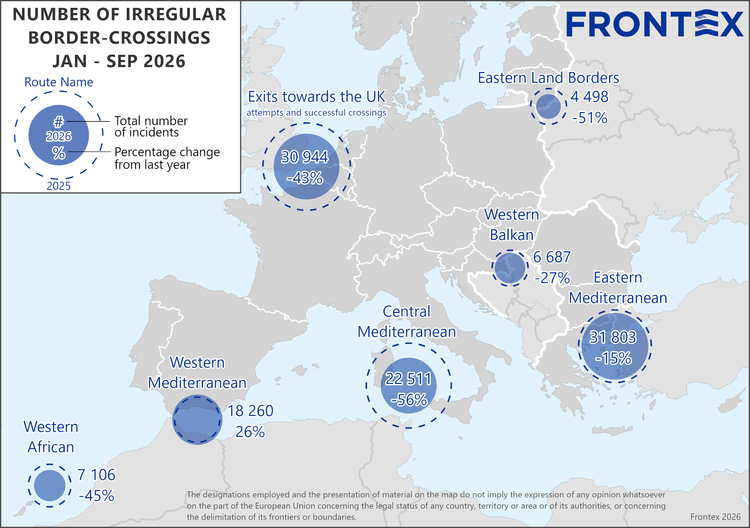
The number of irregular border crossings into the European Union (EU) fell by almost one-third in the first nine months of 2026 compared with the same period last year, according to preliminary data released by the European Border and Coast Guard Agency (Frontex).
The agency said just over 91,000 irregular crossings were detected between January and September, attributing the decline across most major migration routes to sustained cooperation with partner countries and preventive measures in key departure states.
In September alone, approximately 14,300 crossings were recorded, representing a 28 per cent decrease compared with September 2025, although the figure was 11 per cent higher than in August.
According to Frontex, the period also marked the first full summer under the EU Pact on Migration and Asylum, which introduces a standardised screening process at the bloc’s external borders.
Frontex officers are supporting member states with key aspects of the new system, including identifying the nationalities of arrivals, collecting biometric information and verifying travel documents.
Frontex Executive Director Hans Leijtens said fewer people were attempting to reach Europe through most migration routes, although he warned that the situation could change rapidly.
“On most routes into Europe, fewer people are attempting the journey, and that has held through the summer and into the autumn. But things can turn quickly,” Leijtens said.
He cited the Atlantic route towards the Canary Islands, where detections in September were four times higher than in August, warning that human smuggling networks remained active despite the overall decline in crossings.
The Eastern and Central Mediterranean routes remained the busiest corridors, accounting for almost 60 per cent of all irregular entries into the EU during the nine-month period.
The Central Mediterranean recorded the sharpest decline, with crossings falling by 56 per cent, while the Western Mediterranean was the only major route to register an increase, with detections rising by 26 per cent.
On the Eastern Mediterranean route, approximately 31,800 crossings were recorded, representing a 15 per cent decline compared with the same period in 2025.
The corridor from Libya to Crete was the busiest section, followed by the eastern Aegean islands and the land border with Türkiye. Sudanese, Bangladeshi and Afghan nationals were the main nationalities detected.
The Central Mediterranean recorded approximately 22,500 arrivals, down by 56 per cent year-on-year. Libya remained the main departure point, accounting for about three-quarters of crossings along the route, followed by Tunisia and Algeria.
Bangladeshi, Algerian and Somali nationals were the main groups detected on the route.
Meanwhile, the Western Mediterranean recorded around 18,300 crossings, an increase of 26 per cent compared with the first nine months of 2025.
The increase was mainly driven by crossings at land borders, where detections more than doubled, while sea arrivals rose by eight per cent.
Algeria remained the principal departure country for sea crossings, with the Balearic Islands and mainland Spain serving as the main destinations. Algerian, Malian and Moroccan nationals accounted for the largest groups detected.
On the Western African route, approximately 7,100 crossings were recorded, representing a 45 per cent decline.
Frontex attributed the reduction to preventive measures introduced by Mauritania and, more recently, Senegal and The Gambia, in cooperation with Spain and the EU.
However, the agency warned that migration movements along the route remained unpredictable, with detections rising sharply to approximately 1,900 in September, four times the August figure.
Departures were reported from Morocco and The Gambia towards the Canary Islands, while Moroccan, Senegalese and Gambian nationals were the main groups detected.
Attempts to cross the English Channel towards the United Kingdom also declined, falling by 43 per cent to approximately 30,900 during the nine-month period. The figure includes both people who reached the UK and those prevented from departing.
Around 4,500 attempts were recorded in September, with Eritrean, Sudanese and Somali nationals accounting for the main nationalities detected.
Frontex noted that smuggling networks increasingly relied on larger inflatable boats, known as mega dinghies. In August, a record 230 people, including more than 20 children, reportedly reached the UK in a single inflatable boat.
The agency said an agreement signed between the UK and France in April was expected to strengthen patrols along the French coast in the coming months.
Despite the overall decline in irregular crossings, Frontex warned that the human cost of migration remained high.
Citing the International Organization for Migration (IOM), the agency said nearly 2,000 people had died in the Mediterranean so far in 2026, highlighting the dangers faced by migrants travelling in overcrowded and unseaworthy boats.
It added that developments outside the EU’s borders, including the large-scale return of Afghan nationals from Iran and Pakistan and instability across the Sahel, could influence future migration movements towards Europe.
Although these developments had not yet resulted in a significant change in arrivals at the EU’s external borders, Frontex said it was closely monitoring the situation.
The agency added that approximately 3,800 officers were currently deployed at the EU’s external borders to support national authorities in border management and search-and-rescue operations.

Des migrants égyptiens et d’autres nationalités portés disparus ou présumés morts après le naufrage d’une embarcation au large de la Libye

Egyptian migrants, others feared dead, missing after boat sinks off Libya

Les traversées en Méditerranée occidentale augmentent de 26 %

Western Mediterranean crossings rise by 26%
Frontex se félicite de la baisse des franchissements irréguliers aux frontières de l’UE
-

 News Extra2 weeks ago
IOM’s Displacement Tracking Matrix monitors 97.2 million people in 2025
-
 News Extra1 week ago
SOS Humanity accuses Frontex of aiding migrant pushbacks to Libya
-

 News2 weeks ago
Libya repatriates hundreds of migrants, deploys reinforcements to Tobruk
-
News2 weeks ago
Libye : des centaines de migrants rapatriés, des renforts déployés à Tobrouk
-
 News2 weeks ago
Ebola:DRC confirms 10,000 cases, NRC seeks scale-up
-
 News2 days ago
Sea-Watch condemns proposed EU plan to expand Frontex powers
-

 Features2 weeks ago
League of Arab States, IOM launch Arab Migration Data Network
-
 News Extra1 week ago
Alarm Phone signale des appels de détresse de migrants au large de la Crète et le sauvetage de 53 personnes