
News Extra
IOM’s Displacement Tracking Matrix monitors 97.2 million people in 2025


The International Organization for Migration’s (IOM) Displacement Tracking Matrix (DTM) monitored a total of 97.2 million people worldwide in 2025, providing data to support humanitarian responses, displacement solutions and regular migration pathways.
According to the DTM Strategic Priorities for 2026–2028, the programme conducted 706,386 household interviews and worked with 791,141 key informants during the year.
The report also said 95 per cent of Humanitarian Needs Response Plans (HNRPs), representing 19 out of 20 plans, were informed by DTM data and analysis.
At the end of 2025, DTM had 76 active operations, following activities in 91 countries at the beginning of the year. The population monitored included internally displaced persons (IDPs), returnees, migrants and other population groups.
For more than 20 years, DTM has provided data and analysis to governments and humanitarian, peace and development actors to support evidence-based decision-making during emergencies, post-crisis recovery and migration operations.
The Inter-Agency Standing Committee formally recognised DTM in 2024 as a leading provider of country-level data on internally displaced persons.
In its 2026–2028 strategy, the programme identified three main objectives: saving lives and protecting people on the move, driving solutions to displacement, and facilitating pathways for regular migration.
Under its humanitarian response priorities, DTM plans to strengthen data collection and analysis, improve coordination among humanitarian actors and promote the safe and ethical management of information.
The programme also intends to improve the interoperability of data systems, enabling information to be shared more efficiently across platforms and organisations. It said stronger operational structures would support both rapid emergency responses and longer-term strategic planning.
Focus on durable solutions to displacement
DTM plans to expand its work on durable solutions for displaced populations by providing data to help governments and partners understand the needs, vulnerabilities and circumstances of displaced people.
The strategy builds on IOM’s Solutions and Mobility Index (SMI), launched in 2022 and implemented in more than 20 countries since then.
The index provides context-specific data and analysis to support long-term responses in crisis-affected communities, including stabilisation, recovery and durable solutions.
DTM also plans to strengthen its methodologies for measuring progress towards solutions, support national authorities in developing locally owned responses and expand analysis of employment and livelihoods.
The programme further intends to deepen partnerships with academic institutions, multilateral development banks and the private sector to improve data collection and analysis.
In partnership with Georgetown University’s Institute for the Study of International Migration, IOM launched the Periodic Global Report on the State of Solutions to Internal Displacement (PROGRESS) in 2023.
The 2026 edition is expected to become the first biennial, inter-agency, United Nations system-wide report on solutions to internal displacement. It will be coordinated with the Internal Displacement Monitoring Centre, the United Nations Development Programme and the UN refugee agency, UNHCR.
Strengthening migration route monitoring
To support regular migration pathways, DTM plans to strengthen its route-based approach to understanding migration movements across countries and regions.
The programme said migration journeys are often interconnected and shaped by conditions in countries of origin and transit, as well as wider geopolitical developments.
Its Flow Monitoring activities and targeted research aim to provide more comprehensive information on migration patterns, migrants’ characteristics, vulnerabilities and protection needs.
DTM also plans to improve data quality, produce more detailed analysis of migration routes and strengthen collaboration with partners throughout migrants’ journeys.
Its Global Overview of Migration Routes portal brings together information on migrant numbers, demographics, nationalities, movement trends, deaths and disappearances to help policymakers and researchers understand migration dynamics.
Climate mobility and technological innovation
The strategy also highlights the importance of understanding how climate change and disasters affect human mobility.
DTM’s climate and environmental assessments are designed to provide evidence before, during and after hazards, helping governments and partners plan early action, strengthen disaster preparedness and support affected communities.
The assessments cover climate baselines, emergency impacts and vulnerability to hazards such as droughts, floods and cyclones.
Meanwhile, DTM plans to modernise its data systems and improve the accessibility and use of information through technological innovation.
In 2025, the programme had 496 technical experts across country, regional and global teams. Its operations included monitoring migration flows, tracking internal displacement, assessing durable solutions and post-crisis contexts, and collecting data on transhumance.
The strategy identifies three cross-cutting priorities for 2026–2028: building resilient and adaptive data systems, improving the accessibility and usability of DTM data, and diversifying its donor base to ensure sustainable funding.
It also emphasises stronger coordination and evidence-based action at national, regional and global levels.
DTM said sustained investment in staff capacity, technical systems and organisational support would be essential to maintaining its ability to respond to changing humanitarian and migration needs.



Dozens of Egyptian and other migrants are feared dead or missing after a boat carrying them sank off the Libyan coast while attempting to cross the Mediterranean to Europe, according to Egyptian media reports.
The vessel reportedly departed from the eastern Libyan city of Tobruk on Thursday evening but began sinking just a few kilometres into the journey, prompting passengers to send distress signals.
Sources cited by Egypt’s Al-Masry Al-Youm newspaper said strong winds and darkness hampered rescue operations. Six people were rescued, while the fate of the other passengers remained unknown.
Search teams continued operations along the Libyan coast in an effort to locate survivors, find missing migrants and recover bodies.
The exact number of passengers aboard the boat and the confirmed death toll were not immediately known.
According to the report, the migrants had allegedly travelled to Libya through human trafficking networks, which reportedly held them in warehouses before arranging sea crossings to Europe in exchange for money.
Residents of Sindbis village in Egypt’s Qalyubia Governorate told Al-Masry Al-Youm that between 22 and 27 young men from their community were believed to have been aboard the vessel. Young men from neighbouring villages were also reportedly among those who joined the journey.
One resident said the group had left the village about a month earlier, travelling by bus to Alexandria before proceeding towards Libya by sea. Their families reportedly lost contact with them several hours after they boarded the boat.
Most of the missing young men were reportedly under the age of 20 and had been seeking employment opportunities abroad, the resident added.
The latest shipwreck underscores the continuing dangers faced by migrants attempting to reach Europe through irregular Mediterranean crossings from Libya, where dangerous sea journeys and trafficking networks continue to expose migrants to exploitation and loss of life.
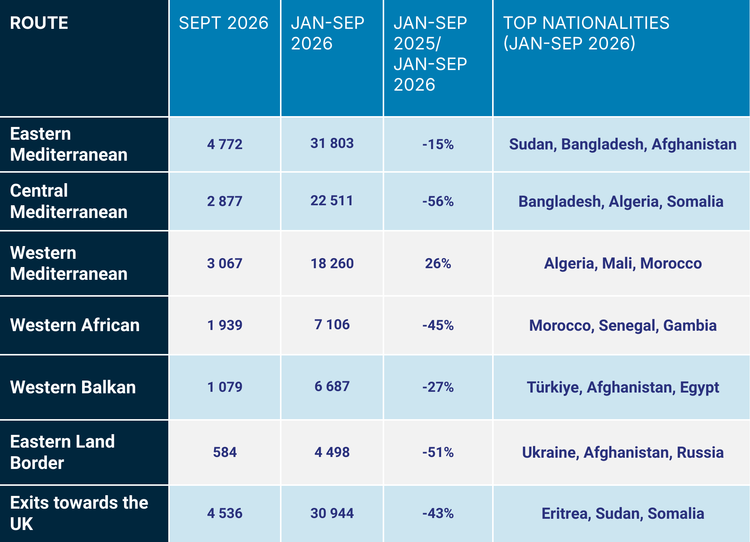
Irregular migration to the European Union declined on most major migratory routes in the first nine months of 2026, although crossings along the Western Mediterranean route increased by 26 per cent, according to figures released by the European Border and Coast Guard Agency (Frontex).
Data covering January to September 2026 showed that the Eastern Mediterranean route recorded the highest number of irregular border crossings, with 31,803 detections, representing a 15 per cent decrease compared with the same period in 2025.
The Central Mediterranean route followed with 22,511 detections, marking a 56 per cent decline, while the Western Mediterranean route recorded 18,260 crossings, an increase of 26 per cent.
The Western African route registered 7,106 crossings, down 45 per cent, while the Western Balkans recorded 6,687, representing a 27 per cent decrease.
Meanwhile, detections along the Eastern Land Border fell by 51 per cent to 4,498.
Exits towards the United Kingdom also declined, with 30,944 detections recorded during the nine-month period, a 43 per cent decrease compared with the corresponding period in 2025.
September figures
In September alone, the Eastern Mediterranean route recorded 4,772 irregular crossings, the highest among the routes monitored by Frontex.
The Western Mediterranean followed with 3,067 crossings, while the Central Mediterranean recorded 2,877.
The Western African route registered 1,939 crossings, compared with 1,079 along the Western Balkans and 584 at the Eastern Land Border.
Meanwhile, 4,536 exits towards the United Kingdom were recorded during the month.
Top nationalities
Sudanese, Bangladeshi and Afghan nationals were the leading nationalities detected along the Eastern Mediterranean route during the first nine months of 2026.
Bangladeshis, Algerians and Somalis topped the list along the Central Mediterranean route, while Algerians, Malians and Moroccans were the most frequently detected nationalities along the Western Mediterranean route.
On the Western African route, the leading nationalities were Moroccans, Senegalese and Gambians.
Turkish, Afghan and Egyptian nationals were the most frequently detected along the Western Balkans route, while Ukrainians, Afghans and Russians topped the list at the Eastern Land Border.
For exits towards the United Kingdom, Eritreans, Sudanese and Somalis were the leading nationalities.
The figures highlight the varying migration trends across Europe’s external borders, with most routes recording substantial declines while the Western Mediterranean experienced an increase during the period under review.
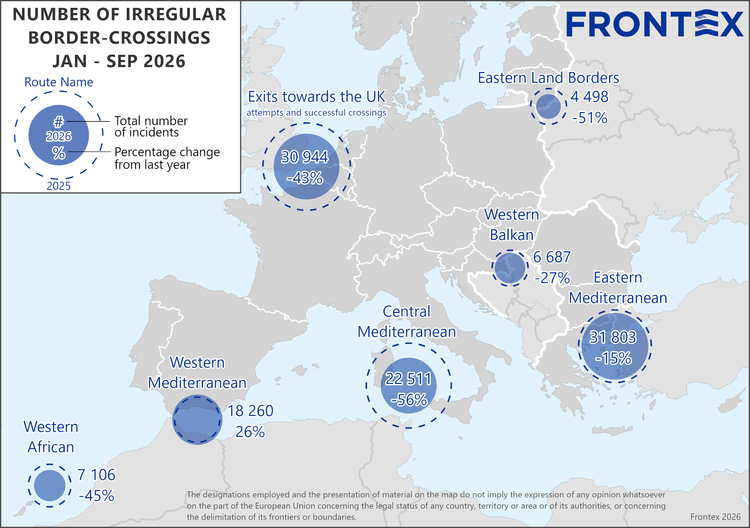
The number of irregular border crossings into the European Union (EU) fell by almost one-third in the first nine months of 2026 compared with the same period last year, according to preliminary data released by the European Border and Coast Guard Agency (Frontex).
The agency said just over 91,000 irregular crossings were detected between January and September, attributing the decline across most major migration routes to sustained cooperation with partner countries and preventive measures in key departure states.
In September alone, approximately 14,300 crossings were recorded, representing a 28 per cent decrease compared with September 2025, although the figure was 11 per cent higher than in August.
According to Frontex, the period also marked the first full summer under the EU Pact on Migration and Asylum, which introduces a standardised screening process at the bloc’s external borders.
Frontex officers are supporting member states with key aspects of the new system, including identifying the nationalities of arrivals, collecting biometric information and verifying travel documents.
Frontex Executive Director Hans Leijtens said fewer people were attempting to reach Europe through most migration routes, although he warned that the situation could change rapidly.
“On most routes into Europe, fewer people are attempting the journey, and that has held through the summer and into the autumn. But things can turn quickly,” Leijtens said.
He cited the Atlantic route towards the Canary Islands, where detections in September were four times higher than in August, warning that human smuggling networks remained active despite the overall decline in crossings.
The Eastern and Central Mediterranean routes remained the busiest corridors, accounting for almost 60 per cent of all irregular entries into the EU during the nine-month period.
The Central Mediterranean recorded the sharpest decline, with crossings falling by 56 per cent, while the Western Mediterranean was the only major route to register an increase, with detections rising by 26 per cent.
On the Eastern Mediterranean route, approximately 31,800 crossings were recorded, representing a 15 per cent decline compared with the same period in 2025.
The corridor from Libya to Crete was the busiest section, followed by the eastern Aegean islands and the land border with Türkiye. Sudanese, Bangladeshi and Afghan nationals were the main nationalities detected.
The Central Mediterranean recorded approximately 22,500 arrivals, down by 56 per cent year-on-year. Libya remained the main departure point, accounting for about three-quarters of crossings along the route, followed by Tunisia and Algeria.
Bangladeshi, Algerian and Somali nationals were the main groups detected on the route.
Meanwhile, the Western Mediterranean recorded around 18,300 crossings, an increase of 26 per cent compared with the first nine months of 2025.
The increase was mainly driven by crossings at land borders, where detections more than doubled, while sea arrivals rose by eight per cent.
Algeria remained the principal departure country for sea crossings, with the Balearic Islands and mainland Spain serving as the main destinations. Algerian, Malian and Moroccan nationals accounted for the largest groups detected.
On the Western African route, approximately 7,100 crossings were recorded, representing a 45 per cent decline.
Frontex attributed the reduction to preventive measures introduced by Mauritania and, more recently, Senegal and The Gambia, in cooperation with Spain and the EU.
However, the agency warned that migration movements along the route remained unpredictable, with detections rising sharply to approximately 1,900 in September, four times the August figure.
Departures were reported from Morocco and The Gambia towards the Canary Islands, while Moroccan, Senegalese and Gambian nationals were the main groups detected.
Attempts to cross the English Channel towards the United Kingdom also declined, falling by 43 per cent to approximately 30,900 during the nine-month period. The figure includes both people who reached the UK and those prevented from departing.
Around 4,500 attempts were recorded in September, with Eritrean, Sudanese and Somali nationals accounting for the main nationalities detected.
Frontex noted that smuggling networks increasingly relied on larger inflatable boats, known as mega dinghies. In August, a record 230 people, including more than 20 children, reportedly reached the UK in a single inflatable boat.
The agency said an agreement signed between the UK and France in April was expected to strengthen patrols along the French coast in the coming months.
Despite the overall decline in irregular crossings, Frontex warned that the human cost of migration remained high.
Citing the International Organization for Migration (IOM), the agency said nearly 2,000 people had died in the Mediterranean so far in 2026, highlighting the dangers faced by migrants travelling in overcrowded and unseaworthy boats.
It added that developments outside the EU’s borders, including the large-scale return of Afghan nationals from Iran and Pakistan and instability across the Sahel, could influence future migration movements towards Europe.
Although these developments had not yet resulted in a significant change in arrivals at the EU’s external borders, Frontex said it was closely monitoring the situation.
The agency added that approximately 3,800 officers were currently deployed at the EU’s external borders to support national authorities in border management and search-and-rescue operations.

Des migrants égyptiens et d’autres nationalités portés disparus ou présumés morts après le naufrage d’une embarcation au large de la Libye

Egyptian migrants, others feared dead, missing after boat sinks off Libya

Les traversées en Méditerranée occidentale augmentent de 26 %

Western Mediterranean crossings rise by 26%
Frontex se félicite de la baisse des franchissements irréguliers aux frontières de l’UE
-
 News Extra1 week ago
SOS Humanity accuses Frontex of aiding migrant pushbacks to Libya
-

 News2 weeks ago
Libye : des centaines de migrants rapatriés, des renforts déployés à Tobrouk
-
News2 weeks ago
Libya repatriates hundreds of migrants, deploys reinforcements to Tobruk
-
 News2 weeks ago
Ebola:DRC confirms 10,000 cases, NRC seeks scale-up
-

 News Extra2 weeks ago
La Matrice de suivi des déplacements de l’OIM a suivi 97,2 millions de personnes en 2025
-
 News2 days ago
Sea-Watch condemns proposed EU plan to expand Frontex powers
-

 Features2 weeks ago
League of Arab States, IOM launch Arab Migration Data Network
-
 News Extra1 week ago
Alarm Phone signale des appels de détresse de migrants au large de la Crète et le sauvetage de 53 personnes