
News Extra
NACTAL faults US trafficking report, demands recognition of Nigerian CSOs’ contributions


The Network Against Child Trafficking, Abuse and Labour (NACTAL) Nigeria has called on the United States Department of State to review its 2026 Trafficking in Persons (TIP) Report, alleging that the assessment failed to adequately recognise the contributions of civil society organisations (CSOs) to the fight against human trafficking in Nigeria.
The National President-elect of NACTAL, Comrade Osita Osemene, made the call in a press statement expressing concern over what the organisation described as the inadequate representation of frontline civil society interventions in the report.
Osemene argued that Nigeria’s anti-trafficking response extends beyond government institutions, stressing that any assessment that fails to capture the contributions of non-governmental organisations, community-based groups and international development partners risks presenting an incomplete picture of the country’s efforts.
He said civil society organisations have remained at the forefront of efforts to prevent trafficking, identify vulnerable persons, rescue victims, provide shelter and psychosocial support, and facilitate the rehabilitation and reintegration of survivors.
According to him, many organisations undertake these responsibilities despite limited funding and other operational challenges.
“These contributions are not incidental. They are integral to the prevention of trafficking, the protection of survivors and the reduction of vulnerability to further exploitation,” Osemene stated.
He expressed concern that the report, in NACTAL’s assessment, did not sufficiently reflect the protection capacity, shelter services, prevention activities and survivor-support interventions undertaken by frontline organisations.
“A national response cannot be fully understood by examining government activities alone while giving inadequate attention to the organisations providing services directly to affected individuals and communities,” he said.
The NACTAL leader identified Patriotic Citizen Initiatives (PCI) and other member organisations as examples of groups providing protection, psychosocial support and reintegration assistance to vulnerable persons and returning migrants.
He explained that many CSOs work directly with communities, families, schools, religious institutions, vulnerable children, women and returning migrants to address trafficking-related risks.
Their interventions, he noted, include awareness campaigns, victim identification and referral, temporary accommodation, family tracing, vocational training, livelihood assistance and long-term reintegration support.
Osemene particularly emphasised the importance of recognising the contributions of non-governmental organisations to victim protection and shelter services.
He maintained that protecting trafficking survivors goes beyond rescue operations, noting that victims often require sustained assistance to recover from exploitation and avoid being trafficked again.
“Protection does not end when a victim is identified, rescued or referred to an authority. Survivors may require safe accommodation, food, healthcare, psychosocial care, legal assistance, family tracing, vocational training, economic support and sustained follow-up to rebuild their lives and reduce the risk of re-trafficking,” he said.
He added that organisations operating shelters bear significant financial and operational responsibilities, including maintaining appropriate facilities, employing trained personnel and providing specialised care.
According to him, these contributions should be properly documented in international assessments, while gaps in funding, shelter capacity and specialised services should also be highlighted.
The NACTAL president-elect further criticised what he described as insufficient attention to community-level trafficking prevention initiatives.
He observed that CSOs frequently undertake sensitisation programmes in schools, religious institutions and local communities to educate vulnerable populations about deceptive recruitment, fraudulent employment offers and exploitative migration arrangements.
Although such interventions may not produce immediately visible outcomes comparable to arrests, prosecutions and convictions, he insisted that they remain essential to preventing trafficking.
“An assessment that concentrates predominantly on government enforcement activities without adequately documenting community-level prevention risks overlooking an important dimension of the national response,” he stated.
Osemene also called for greater recognition of the contributions of international development partners supporting anti-trafficking and migration-related interventions in Nigeria.
He identified the European Union, International Organization for Migration (IOM), International Centre for Migration Policy Development (ICMPD), FIAP, Expertise France and the United Nations Office on Drugs and Crime (UNODC) among organisations involved in supporting prevention, protection, capacity-building and reintegration programmes.
He maintained that assessments of international partnerships should not focus exclusively on institutional agreements and government engagements but should also capture the contributions of local implementing organisations responsible for delivering services to vulnerable populations.
Speaking on Nigeria’s placement on Tier 2 and Ghana’s reported elevation to Tier 1 in the 2026 TIP Report, Osemene said the development raised questions about whether the full scope of Nigeria’s anti-trafficking interventions had been adequately considered.
He, however, acknowledged that the classifications are based on the US government’s assessment of countries’ compliance with minimum standards for eliminating trafficking and their efforts towards meeting those standards.
He clarified that NACTAL was not demanding an automatic upgrade of Nigeria’s ranking merely because civil society organisations were active in combating trafficking.
Rather, he said, the organisation wanted a comprehensive and evidence-based assessment that recognised both progress and existing challenges.
“Our concern is not that Nigeria should automatically receive a higher classification because CSOs are active. Neither are we suggesting that the country has no outstanding challenges,” he said.
Osemene acknowledged that human trafficking remained a serious concern in Nigeria, requiring stronger investigations, prosecutions, victim identification, access to justice, protection services and sustainable reintegration programmes.
He stressed that recognising civil society contributions should complement, rather than replace, accountability for government performance.
Consequently, NACTAL urged the US Department of State to review Nigeria’s assessment and determine whether the contributions of civil society organisations and other non-state actors were adequately documented and considered.
The organisation also requested direct engagement with NACTAL members, specialist anti-trafficking organisations, shelter operators, survivor-support providers and reintegration practitioners to obtain additional evidence of their interventions.
It called for improved recognition of CSO activities in victim protection, community awareness, public education, advocacy, capacity-building and engagement with vulnerable populations.
NACTAL further urged the US authorities to strengthen stakeholder consultations and provide opportunities for supplementary submissions from Nigerian organisations whose interventions might not have been adequately captured in the report.
Osemene maintained that such measures would provide a more comprehensive understanding of Nigeria’s anti-trafficking response and help identify areas requiring additional resources, coordination and institutional support.
He also encouraged Nigerian stakeholders to improve documentation, data collection and coordination to ensure that their contributions could be independently verified and appropriately reflected in international assessments.
The NACTAL president-elect emphasised that the organisation was not seeking to shield Nigeria from international scrutiny but was advocating fairness, transparency and inclusiveness in evaluating the country’s anti-trafficking efforts.
“NACTAL Nigeria is not calling for the exemption of Nigeria from scrutiny. We are calling for an assessment that is comprehensive, evidence-based and reflective of the full range of relevant interventions,” he declared.
He described the fight against human trafficking as a collective responsibility requiring effective collaboration among government agencies, civil society organisations, development partners and local communities.
“Civil society organisations are not spectators in the fight against human trafficking. They are active participants in prevention, protection, partnership and reintegration. Their work deserves to be properly documented, considered and recognised,” Osemene said.
He reaffirmed NACTAL’s commitment to collaborating with relevant stakeholders to strengthen Nigeria’s anti-trafficking response, protect vulnerable persons, uphold survivors’ dignity and ensure that perpetrators of human trafficking are brought to justice.







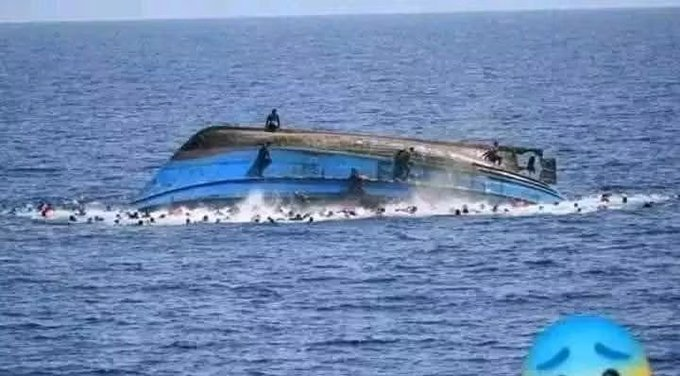
Dozens of Egyptian and other migrants are feared dead or missing after a boat carrying them sank off the Libyan coast while attempting to cross the Mediterranean to Europe, according to Egyptian media reports.
The vessel reportedly departed from the eastern Libyan city of Tobruk on Thursday evening but began sinking just a few kilometres into the journey, prompting passengers to send distress signals.
Sources cited by Egypt’s Al-Masry Al-Youm newspaper said strong winds and darkness hampered rescue operations. Six people were rescued, while the fate of the other passengers remained unknown.
Search teams continued operations along the Libyan coast in an effort to locate survivors, find missing migrants and recover bodies.
The exact number of passengers aboard the boat and the confirmed death toll were not immediately known.
According to the report, the migrants had allegedly travelled to Libya through human trafficking networks, which reportedly held them in warehouses before arranging sea crossings to Europe in exchange for money.
Residents of Sindbis village in Egypt’s Qalyubia Governorate told Al-Masry Al-Youm that between 22 and 27 young men from their community were believed to have been aboard the vessel. Young men from neighbouring villages were also reportedly among those who joined the journey.
One resident said the group had left the village about a month earlier, travelling by bus to Alexandria before proceeding towards Libya by sea. Their families reportedly lost contact with them several hours after they boarded the boat.
Most of the missing young men were reportedly under the age of 20 and had been seeking employment opportunities abroad, the resident added.
The latest shipwreck underscores the continuing dangers faced by migrants attempting to reach Europe through irregular Mediterranean crossings from Libya, where dangerous sea journeys and trafficking networks continue to expose migrants to exploitation and loss of life.
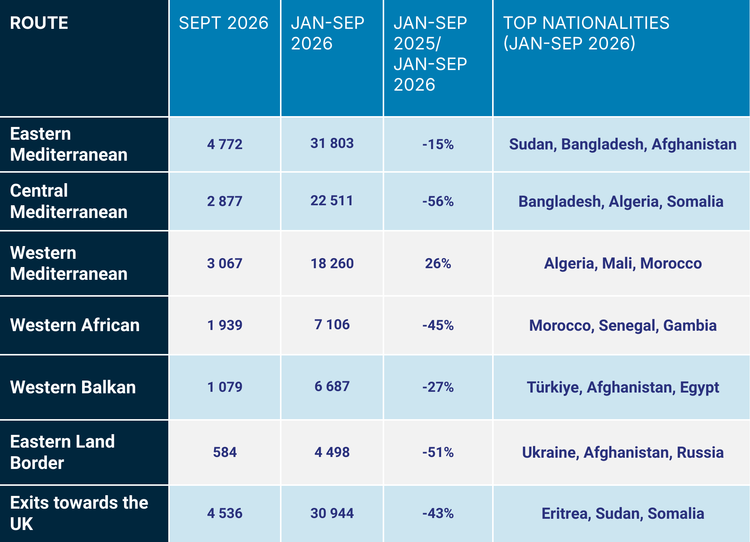
Irregular migration to the European Union declined on most major migratory routes in the first nine months of 2026, although crossings along the Western Mediterranean route increased by 26 per cent, according to figures released by the European Border and Coast Guard Agency (Frontex).
Data covering January to September 2026 showed that the Eastern Mediterranean route recorded the highest number of irregular border crossings, with 31,803 detections, representing a 15 per cent decrease compared with the same period in 2025.
The Central Mediterranean route followed with 22,511 detections, marking a 56 per cent decline, while the Western Mediterranean route recorded 18,260 crossings, an increase of 26 per cent.
The Western African route registered 7,106 crossings, down 45 per cent, while the Western Balkans recorded 6,687, representing a 27 per cent decrease.
Meanwhile, detections along the Eastern Land Border fell by 51 per cent to 4,498.
Exits towards the United Kingdom also declined, with 30,944 detections recorded during the nine-month period, a 43 per cent decrease compared with the corresponding period in 2025.
September figures
In September alone, the Eastern Mediterranean route recorded 4,772 irregular crossings, the highest among the routes monitored by Frontex.
The Western Mediterranean followed with 3,067 crossings, while the Central Mediterranean recorded 2,877.
The Western African route registered 1,939 crossings, compared with 1,079 along the Western Balkans and 584 at the Eastern Land Border.
Meanwhile, 4,536 exits towards the United Kingdom were recorded during the month.
Top nationalities
Sudanese, Bangladeshi and Afghan nationals were the leading nationalities detected along the Eastern Mediterranean route during the first nine months of 2026.
Bangladeshis, Algerians and Somalis topped the list along the Central Mediterranean route, while Algerians, Malians and Moroccans were the most frequently detected nationalities along the Western Mediterranean route.
On the Western African route, the leading nationalities were Moroccans, Senegalese and Gambians.
Turkish, Afghan and Egyptian nationals were the most frequently detected along the Western Balkans route, while Ukrainians, Afghans and Russians topped the list at the Eastern Land Border.
For exits towards the United Kingdom, Eritreans, Sudanese and Somalis were the leading nationalities.
The figures highlight the varying migration trends across Europe’s external borders, with most routes recording substantial declines while the Western Mediterranean experienced an increase during the period under review.
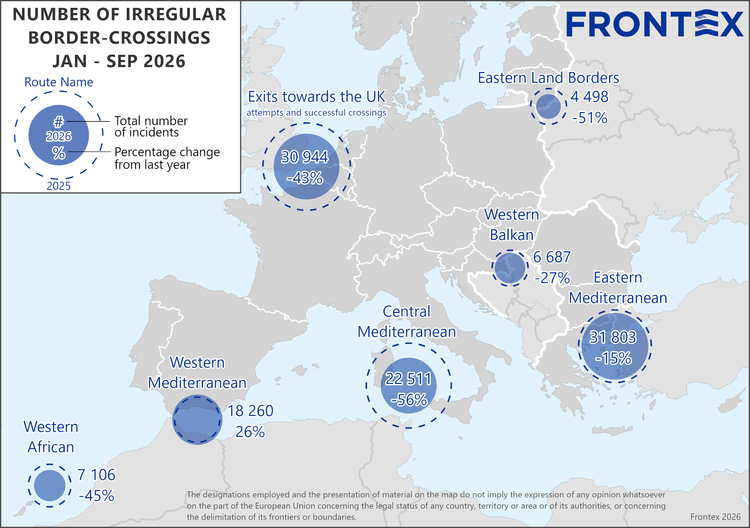
The number of irregular border crossings into the European Union (EU) fell by almost one-third in the first nine months of 2026 compared with the same period last year, according to preliminary data released by the European Border and Coast Guard Agency (Frontex).
The agency said just over 91,000 irregular crossings were detected between January and September, attributing the decline across most major migration routes to sustained cooperation with partner countries and preventive measures in key departure states.
In September alone, approximately 14,300 crossings were recorded, representing a 28 per cent decrease compared with September 2025, although the figure was 11 per cent higher than in August.
According to Frontex, the period also marked the first full summer under the EU Pact on Migration and Asylum, which introduces a standardised screening process at the bloc’s external borders.
Frontex officers are supporting member states with key aspects of the new system, including identifying the nationalities of arrivals, collecting biometric information and verifying travel documents.
Frontex Executive Director Hans Leijtens said fewer people were attempting to reach Europe through most migration routes, although he warned that the situation could change rapidly.
“On most routes into Europe, fewer people are attempting the journey, and that has held through the summer and into the autumn. But things can turn quickly,” Leijtens said.
He cited the Atlantic route towards the Canary Islands, where detections in September were four times higher than in August, warning that human smuggling networks remained active despite the overall decline in crossings.
The Eastern and Central Mediterranean routes remained the busiest corridors, accounting for almost 60 per cent of all irregular entries into the EU during the nine-month period.
The Central Mediterranean recorded the sharpest decline, with crossings falling by 56 per cent, while the Western Mediterranean was the only major route to register an increase, with detections rising by 26 per cent.
On the Eastern Mediterranean route, approximately 31,800 crossings were recorded, representing a 15 per cent decline compared with the same period in 2025.
The corridor from Libya to Crete was the busiest section, followed by the eastern Aegean islands and the land border with Türkiye. Sudanese, Bangladeshi and Afghan nationals were the main nationalities detected.
The Central Mediterranean recorded approximately 22,500 arrivals, down by 56 per cent year-on-year. Libya remained the main departure point, accounting for about three-quarters of crossings along the route, followed by Tunisia and Algeria.
Bangladeshi, Algerian and Somali nationals were the main groups detected on the route.
Meanwhile, the Western Mediterranean recorded around 18,300 crossings, an increase of 26 per cent compared with the first nine months of 2025.
The increase was mainly driven by crossings at land borders, where detections more than doubled, while sea arrivals rose by eight per cent.
Algeria remained the principal departure country for sea crossings, with the Balearic Islands and mainland Spain serving as the main destinations. Algerian, Malian and Moroccan nationals accounted for the largest groups detected.
On the Western African route, approximately 7,100 crossings were recorded, representing a 45 per cent decline.
Frontex attributed the reduction to preventive measures introduced by Mauritania and, more recently, Senegal and The Gambia, in cooperation with Spain and the EU.
However, the agency warned that migration movements along the route remained unpredictable, with detections rising sharply to approximately 1,900 in September, four times the August figure.
Departures were reported from Morocco and The Gambia towards the Canary Islands, while Moroccan, Senegalese and Gambian nationals were the main groups detected.
Attempts to cross the English Channel towards the United Kingdom also declined, falling by 43 per cent to approximately 30,900 during the nine-month period. The figure includes both people who reached the UK and those prevented from departing.
Around 4,500 attempts were recorded in September, with Eritrean, Sudanese and Somali nationals accounting for the main nationalities detected.
Frontex noted that smuggling networks increasingly relied on larger inflatable boats, known as mega dinghies. In August, a record 230 people, including more than 20 children, reportedly reached the UK in a single inflatable boat.
The agency said an agreement signed between the UK and France in April was expected to strengthen patrols along the French coast in the coming months.
Despite the overall decline in irregular crossings, Frontex warned that the human cost of migration remained high.
Citing the International Organization for Migration (IOM), the agency said nearly 2,000 people had died in the Mediterranean so far in 2026, highlighting the dangers faced by migrants travelling in overcrowded and unseaworthy boats.
It added that developments outside the EU’s borders, including the large-scale return of Afghan nationals from Iran and Pakistan and instability across the Sahel, could influence future migration movements towards Europe.
Although these developments had not yet resulted in a significant change in arrivals at the EU’s external borders, Frontex said it was closely monitoring the situation.
The agency added that approximately 3,800 officers were currently deployed at the EU’s external borders to support national authorities in border management and search-and-rescue operations.

Des migrants égyptiens et d’autres nationalités portés disparus ou présumés morts après le naufrage d’une embarcation au large de la Libye

Egyptian migrants, others feared dead, missing after boat sinks off Libya

Les traversées en Méditerranée occidentale augmentent de 26 %

Western Mediterranean crossings rise by 26%
Frontex se félicite de la baisse des franchissements irréguliers aux frontières de l’UE
-

 News Extra2 weeks ago
IOM’s Displacement Tracking Matrix monitors 97.2 million people in 2025
-
 News Extra1 week ago
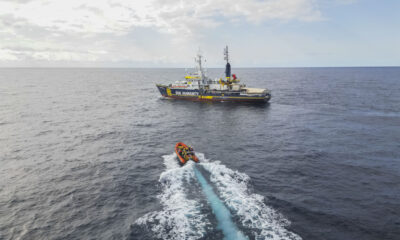
SOS Humanity accuses Frontex of aiding migrant pushbacks to Libya
-
 News2 weeks ago
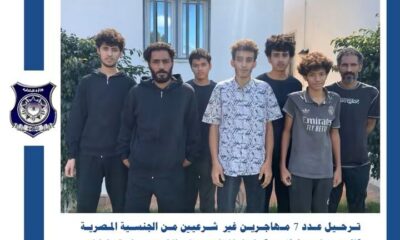
Libye : des centaines de migrants rapatriés, des renforts déployés à Tobrouk
-
News2 weeks ago
Libya repatriates hundreds of migrants, deploys reinforcements to Tobruk
-
 News Extra2 weeks ago
La Matrice de suivi des déplacements de l’OIM a suivi 97,2 millions de personnes en 2025
-
 News2 weeks ago
Ebola:DRC confirms 10,000 cases, NRC seeks scale-up
-
 News3 days ago
Sea-Watch condemns proposed EU plan to expand Frontex powers
-
 News2 weeks ago
Ebola : la RDC confirme 10 000 cas, le NRC appelle à un renforcement urgent de la réponse