
News Extra
Europe’s “shield”: Hundreds presumed to have drowned off Greece


Off the coast of Greece, a large fishing boat has capsized. We fear that hundreds of people have drowned. Yesterday, 13 June 2023, we had alerted the Hellenic Coast Guard at 16:53 CEST to this boat in distress, as the people had called us for help. The Greek authorities, reportedly also Italy and Malta, had already been alerted several hours earlier. Greek and other European authorities were thus well aware of this overcrowded and unseaworthy vessel. A rescue operation was not launched. In the early hours of today, 14 June 2023, the boat capsized.
Already in the hours following this disaster at sea, the Hellenic Coast Guard has begun to justify their failure to assist by arguing that the people in distress had not wanted to be rescued to Greece.
We ask: Why are people at sea so afraid to encounter Greek forces?
It is because people on the move know about the horrible and systematic pushback practices carried out by the Greek authorities, practices that are sanctioned by the EU. Greece has become “Europe’s shield”, as European Commision president von der Leyen once noted, violently deterring people on the move.
People on the move know that thousands have been shot at, beaten, and abandoned at sea by these Greek forces. They know that encountering the Hellenic Coast Guard, the Hellenic Police or the Hellenic Border Guards often means violence and suffering. It is due to systematic pushbacks that boats are trying to avoid Greece, navigating much longer routes, and risking lives at sea.
As Alarm Phone, we have documented innumerable cases of pushbacks and also of cases where overcrowded boats capsized because they took longer routes, trying to avoid Greek forces. One of the most recent examples is a boat that was in distress on 22 May 2023, south of Methoni and pushed back 524 km into Turkish waters. Some of the people from this case are still imprisoned in Turkey.
In addition, Alarm Phone has documented how the passengers of another large boat that had also left from Tobruk, Libya, were abducted from deep within the Maltese Search and Rescue zone and towed back to Libya on 23 May 2023, where they were imprisoned. People on the move know that they need to travel as far as they can to heighten their chances to avoid pushbacks or pushbacks by proxy.
After the fishing boat capsized, Greek authorities were quick to publicly justify their failure to rescue. The reality is that they had been alerted many hours before the vessel capsized and had been informed by different sources that this was a boat in distress. Reportedly, assets of the Hellenic Coast Guard and a Frontex aircraft were on scene. European authorities could have sent out adequate rescue resources without delay. They failed to do so because their desire to prevent arrivals was stronger than the need to rescue hundreds of lives.
Stop blaming people on the move for trying to escape your violence!
Stop blaming people on the move for their own death!
Stop pushbacks, end death at sea, tear down Europe’s borders!
ALARM PHONE TIMELINE OF THE DISTRESS CASE – 13/14 JUNE 2023
In the morning of 13 June, from 9:35h CEST, the Twitter user Nawal Soufi alerts about a large boat in distress, carrying, according to them, 750 people. Over the following hours, Nawal Soufi adds further information, including the GPS position of the boat in distress and that authorities in Italy, Greece, and Malta have been alerted.
14:17 CEST: Alarm Phone receives the first call from the boat in distress. It is difficult to communicate with the distressed. They say that they cannot survive the night, that they are in heavy distress. Alarm Phone tries to receive their current GPS coordinates in order to be able to alert authorities – but the call cuts. We try to reconnect with them.
14:30 CEST: The distressed call again, telling Alarm Phone that they would send their location. However, they do not.
15:52 CEST: The distressed called Alarm Phone twice but it was impossible to understand them.
16:04 CEST: We speak to the distressed again. They say that they would send their GPS position.
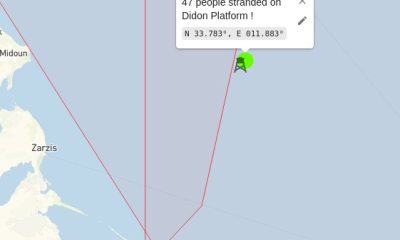
16:13 CEST: We receive the position from the people in distress: N 36 15, 21 02. We try to gather further information but we cannot reconnect with them.
16:53 CEST: We alert the Greek authorities per email as well as other actors, including Frontex and UNHCR Greece.
17:13 CEST: We reestablish contact to the people in distress. We hear “hello, hello”, then the call drops. We try to reconnect, which is not possible.
17:14 CEST: We receive a call from the boat in distress but cannot hear anything.
17:20 CEST: We speak to the distressed and they report that the boat is not moving. They say: “The captain left on a small boat. Please, any solution.” They say they need food and water.
17:34 CEST: We receive another call from the boat in distress and their updated position: 36 18, 21 04 – very close to the previous position. They say that the boat is overcrowded and that the boat is moving from side to side.
18:00 CEST: We call the company of the merchant vessel “Lucky Sailor”, informing them about the boat in distress. They say that they only act under the authority of the Greek coastguards.
Over the following hours, Alarm Phone tries to re-establish contact to the distressed but either calls are not connected or it is impossible to understand one another.
20:05 CEST: Alarm Phone is informed by the distressed that they received water from the merchant vessel Lucky Sailor and that they have been in contact with the “police”. Alarm Phone also notices that a second merchant vessel, the “Faithful Warrior”, is close to the distressed.
Over the following hours, Alarm Phone tries to reestablish contact to the distressed but either calls are not connected or it is impossible to understand one another.
00:46 CEST on 14/06/2023: Last contact to the boat in distress. All we hear is: “Hello my friend. …. The ship you send is …”. The call cuts.
Credit: AlarmPhone.org




Nigerian has the highest number of West African migrants set to be repatriated from the US.
The United States Department of Homeland Security (DHS) confirmed the removal of 110 Nigerians as part of a wider crackdown that will see 355 nationals from the sub-region returned home.
The DHS yesterday published names and photographs of all 355 individuals listed for deportation under its “WOW” West Africa Operations Watch initiative, reports The Guardian.
Nigeria accounts for 110 of those listed, second only to Liberia with 94, and far ahead of Ghana’s 30 and Senegal’s 19.
The list also includes 15 Cameroonians, 14 Gambians, 14 Ivorians, 12 Mauritanians, 11 Cape Verdeans, nine Burkinabes, eight Nigeriens, six Guineans, six Togolese, five Malians, and 1 each from Benin and Guinea-Bissau.

As diaspora remittances now outpace both official development assistance and foreign direct investment combined, the International Organization for Migration (IOM) today published a new paper showing how stronger engagement with diaspora communities can enhance humanitarian response and support recovery efforts worldwide.
The paper highlights how diaspora communities mobilize resources rapidly, reach affected populations through trusted networks, and deliver locally informed, culturally attuned solutions, yet remain only partially integrated into formal humanitarian systems.
“Diaspora communities are some of the most agile and trusted partners in crisis response,” said Ugochi Daniels, IOM Deputy Director General for Operations. “This paper shows how we can move beyond spontaneous solidarity to real, structured partnerships that strengthen local responses before, during and after crises. By connecting diaspora communities with humanitarian efforts, IOM helps ensure support gets to people quickly, effectively and with trust.”
Drawing on case studies from Haiti, Lebanon, the Philippines, Somalia and Ukraine, the report documents concrete results: the Ukrainian diaspora raised USD 283 million in the first year of the conflict, while over 100 diaspora organizations mobilized within days of Haiti’s 2021 earthquake.
These examples reflect a broader trend: in 2024, diaspora remittances to low- and middle-income countries reached an estimated USD 700 billion, surpassing official development assistance and foreign direct investment combined.
The report shows how structured diaspora engagement has supported preparedness, enabled lifesaving response and accelerated recovery through early warning systems, safer shelter and health services, innovative financing mechanisms and community-led recovery efforts.
The paper also outlines practical priorities for donors and partners, including flexible funding mechanisms, digital coordination tools, strengthened data partnerships, and tailored capacity-building support. It contributes to IOM’s broader efforts and informs a forthcoming IOM Diaspora Strategy that positions diaspora engagement as a core pillar across the Organization’s work.

Leaders across West and Central Africa are calling for more funding to help communities deal with climate change as floods, droughts and environmental degradation force more people to leave their homes, reshaping migration patterns and displacement across the region.
“Climate change is already affecting where and how people live. The challenge now is moving fast enough to deliver practical solutions and funding to vulnerable communities,” said Sylvia Ekra, IOM Regional Director for West and Central Africa. “Our region has shown leadership by including migration in climate policies. Now we must ensure climate funding reaches the communities most affected, so migration is a safe and informed choice – not a last resort.”
At a regional conference in Lagos, Nigeria, on 12–13 May, governments and partners developed a roadmap outlining practical ways to protect livelihoods and help communities adapt to climate impacts.
Climate shocks are already altering where and how people live across West and Central Africa. Floods, droughts and storms are damaging homes, roads and essential services across the region. By the end of 2024, about 2 million people in West and Central Africa had been displaced by disasters – around one fifth of the global total.
Environmental damage, desertification, and rising sea levels are also increasing pressure on communities and cities. The World Bank estimates that by 2050, up to 32 million people in the region could be forced to move within their own countries because of climate change.
The conference also highlighted growing action across the region. Most countries that recently updated their national climate plans now include migration and displacement issues. Côte d’Ivoire and Mauritania also joined the Kampala Ministerial Declaration on Migration, Environment and Climate Change, bringing the number of supporting African countries to 33.
“Climate-related human mobility is no longer a peripheral issue; it is an adaptation and resilience priority that must be negotiated, planned and financed accordingly,” said Nana Dr. Antwi‑Boasiako Amoah, Chair of the African Group of Negotiators. “The next step is to match that policy progress with credible data and accessible finance; so governments and partners can invest in solutions that reduce risk, protect livelihoods and expand safe options for people on the frontlines.”
Participants called for stronger early warning systems, more support for local adaptation efforts and better access to climate funding for affected communities, as part of a series of recommendations ahead of major global climate negotiations, including the United Nations Framework Convention on Climate Change (UNFCCC) and COP31, which will take place in Türkiye later this year.
The Lagos Conference was co-hosted by the Government of Nigeria with support from the Ministry of Foreign Affairs of Denmark through the Climate Change and Migration Data (CCMD) Programme.

Rights group reports rise in abuses, hate speech against migrants in Libya

New rescue vessel Aurora 2: Sea-Watch’s response to political blockades of civilian sea rescue
Sea-Watch strongly criticises EU response following attack on Sea-Watch 5

Court annuls 20-day administrative detention imposed on Ocean Viking

Neglect deepens as DRC appears on NRC’s list of top neglected displacement for 10 years
-
 News1 week ago
War has devastated life for millions of refugees, displaced
-
 Features1 week ago
Netherlands, IOM reaffirm partnership including new multi-year funding commitment
-
 Features1 week ago
Stabilization gains open pathway to development in Central African Republic: IOM Chief of Staff
-
 News Extra1 week ago
West and Central Africa urges more climate funding as displacement rises
-
 Features3 days ago
Ebola: Border closures alone risk driving movement underground and increasing transmission risks
-
 News Extra1 week ago
Diaspora remittances point to untapped potential in crisis response: New IOM report
-
 News Extra5 days ago
Nigeria leads Liberia, Ghana, others as US set to deport migrants
-
 Features5 days ago
Haiti hosts over 1million displaced persons