
Features
Netherlands, IOM reaffirm partnership including new multi-year funding commitment


The Government of the Netherlands today reaffirmed its long-standing commitment to the International Organization for Migration (IOM) by announcing a new unearmarked financial contribution of EUR 16 million over four years, underscoring continued trust in the Organization’s mandate and support for safe, orderly, and regular migration.
“Migration challenges are becoming more complex, while humanitarian needs continue to rise,” said IOM Director General Amy Pope. “The Netherlands has long been a strong and trusted partner of IOM, and this contribution will enhance IOM’s capacity to support its Member States and vulnerable people on the move.”
The pledge followed high-level meetings between IOM Director General, Amy Pope and the Netherlands’ Minister for Foreign Trade and Development Cooperation, Sjoerd Sjoerdsma, and Minister for Asylum and Migration, Bart van den Brink, during which they discussed shared priorities on migration governance and international cooperation.
The contribution will strengthen IOM’s effectiveness and efficiency to ensure that the organization can continue to provide timely support for those in need while strengthening systems that support safe and orderly migration, including protection and long-term solutions. It also highlights the Netherlands’ continued role as a key and reliable partner of IOM and reflects a shared commitment to international cooperation, evidence-based migration governance and people-centred solutions.
As one of IOM’s founding Member States, the Netherlands has long championed well-managed migration as a shared responsibility and a driver of resilience and sustainable development. Through this contribution, it continues to support approaches that reduce vulnerabilities, strengthen protection, and uphold dignity.


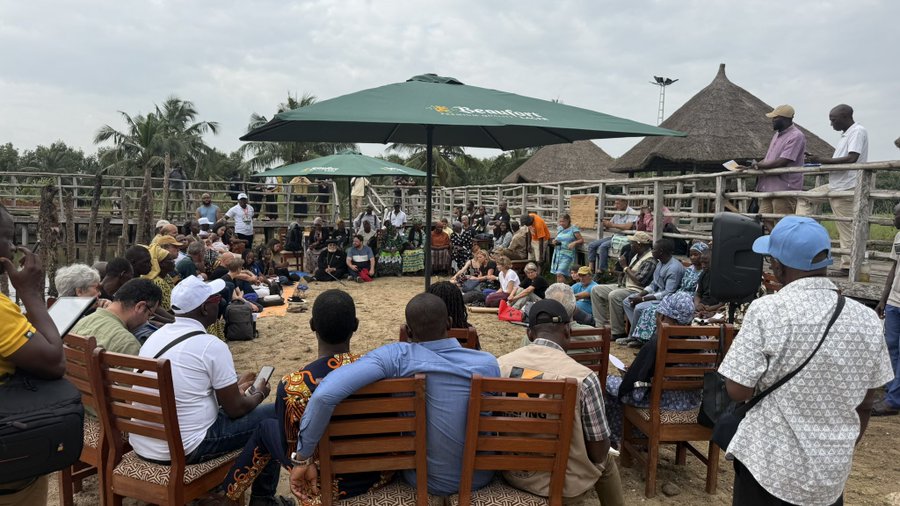
For many of the Nigerians who attended the just-concluded World Social Forum (WSF) in Cotonou, Benin, the experience was more than an international gathering of activists, civil society organisations, researchers and migration advocates.
It was a moment of questioning.
It was an opportunity to listen to voices from different parts of the world and, perhaps most importantly, to question some of the assumptions they had previously held about migration, migrants and the policies designed to control human mobility.
Across conversations on deportation, border externalisation, criminalisation, trafficking, climate change, reintegration and migrants’ rights, participants encountered a broader understanding of migration — one that placed human dignity and lived experience at the centre.
For some, it was an affirmation of what they already believed. For others, it was an uncomfortable but necessary shift in perspective.
From statistics to people
One of the strongest lessons emerging from the participants’ experiences was that migrants must be understood as human beings rather than statistics, policy subjects or security concerns.
Purity Franca Onikoliase, an advocate working on the rights and well-being of migrants and returnees, described the Forum as a “meaningful and transformative experience.”
She said the discussions helped her understand that migration is not simply about movement from one country to another.
It is also about human rights, dignity, protection, family, livelihoods and social justice.
The Forum, she noted, brought together migrants, returnees, survivors, civil society organisations, advocates and other stakeholders, allowing participants to encounter experiences that are often missing from official statistics and policy documents.
That same principle resonated with Alia Joke Oreoluwa, who returned from Cotonou with a stronger conviction that migrants should not merely be discussed by others.
“Migrants must be involved in designing policies, programmes and solutions that affect their lives,” she said, stressing that solutions should be informed by the real experiences and needs of affected people.
For her, the message was simple: nothing about migrants should happen without migrants.
Rethinking the meaning of “irregular migration”
For some participants, perhaps the most significant impact of the Forum was the challenge it posed to conventional narratives around irregular migration.
Rita Abu came to the Forum with an understanding shaped largely by her work with returning migrants. Her focus had often been on sensitising people about the dangers of irregular migration — trafficking, exploitation, death in the desert or at sea and other risks encountered along migration routes.
She encouraged people to use safer and regular pathways whenever they were available.
But Cotonou prompted a different question.
Why are people taking dangerous routes in the first place?
The question shifted the focus from the migrant’s decision to the conditions surrounding that decision.
Abu said she began to recognise that migration itself is not necessarily the problem. People have always moved in search of work, education, family reunification, safety and better opportunities.
What requires deeper examination, she realised, are the policies and border-control systems that can make migration increasingly difficult and, in some circumstances, more dangerous.
The experience left her with a question that continues to occupy her:
Why has safe migration become so difficult that people are willing to risk their lives to move?
Looking beyond Europe’s definition
Ejike Ezeonyido similarly described the Forum as an opportunity to move beyond what he had previously understood as the dominant European interpretation of migration.
The experience broadened his knowledge of migration and migrants’ rights, exposing him to experts and activists from different parts of the world.
He also encountered a range of migration working groups examining issues including externalisation, criminalisation, deportation, death and disappearance, and climate change and migration.
Perhaps most revealingly, he came to a personal realisation: he had, unknowingly, been promoting what he described as “migration MADE IN EUROPE.”
The Forum, he said, equipped him to participate in migration conversations from different contexts and perspectives.
That shift — from accepting dominant narratives to interrogating them — was echoed by Chylian Ify Azuh.
Azuh said the Forum provided “critical knowledge, transnational connections and solidarity,” while deepening her understanding of the power dynamics surrounding migration.
She encountered perspectives that went beyond familiar discussions of safe and irregular migration, trafficking, return and reintegration.
Conversations around freedom of movement, border externalisation and the criminalisation of migration challenged her previous understanding.
More importantly, she began asking difficult questions about how migration narratives are constructed.
Who and what is responsible for migrants’ vulnerabilities?
Who defines the problem and the solution?
And what are the consequences of those solutions?
For Azuh, the Forum was therefore not simply an educational experience. It became a moment of reflection on her own role in shaping migration narratives and a challenge to become more deliberate about confronting misinformation and what she described as corruption within the migration sector.
When borders move beyond borders
The issue of externalisation emerged repeatedly in participants’ reflections.
Yaramola Blessing arrived at the Forum with a perception that the struggle over migration was largely a confrontation between Europe and Africa — or between white people and Black people.
Cotonou changed that understanding.
She encountered people from different countries, communities and backgrounds who were also organising around migrant rights and justice.
That discovery gave her a sense that the struggle was not isolated to Africa or to individual activists. It was part of a wider global movement.
The discussions also helped her make sense of questions she had carried for years about migration policies, border controls and the European Union’s approach to migration.
Sessions on borders, frontiers and externalisation provided a framework for understanding how migration-control systems operate beyond Europe’s geographical borders and how their effects are felt in African countries.
She also developed a deeper understanding of xenophobia, recognising that hostility towards migrants is not driven solely by individual prejudice but can also be influenced by politics, policy, misinformation and fear.
The result was a stronger sense of purpose.
Blessing said she returned with better knowledge, language and confidence to advocate for migration justice, reintegration and survivors’ rights.
Deportation, return and the question of dignity
The Forum also forced participants to confront the experiences of people who have already made the journey and returned — voluntarily or through deportation.
For Udekwe Kennedy Obinna, one of the most eye-opening aspects of the Forum was learning more about deportation structures in Europe and the role of agencies such as Frontex.
He said the discussions exposed gaps that require greater engagement from civil society organisations and government actors in affected countries.
Such engagement, he argued, is necessary to identify loopholes, support local organisations and increase visibility for the experiences of victims, potential migrants and survivors.
But perhaps the most important lesson for him was the need to challenge the portrayal of deportees and returnees as criminals.
Returnees, he stressed, should not be automatically viewed through the lens of failure, illegality or criminality.
Their dignity and confidence must be restored.
That requires psychosocial support, stronger reintegration programmes and a broader recognition that returning migrants are people whose lives, aspirations and experiences continue beyond the end of a migration journey.
Knowledge, networks and renewed inspiration
Beyond the policy debates and critical conversations, the Forum also created something equally important: relationships.
Aah Esther said she returned with three major gains — knowledge, new networks and inspiration.
Listening to movements from different parts of the world broadened her understanding of how people are fighting for justice and supporting reintegration.
The Forum also introduced her to organisations with which partnerships could potentially be developed.
But the most personal takeaway was the reminder that the work of migration advocates matters.
“Beyond the stereotype of storytelling lies our expertise,” she reflected.
That sense of solidarity was shared by other participants who described meeting activists and organisations that had spent years challenging policies they considered harmful to migrants.
For many, seeing that this work was being undertaken across countries transformed what could otherwise have been an overwhelming struggle into a shared one.
Migration requires regional solutions
Tobi Ayediran brought the conversation back to a fundamental reality: migration does not stop at national borders.
His major lesson from the Forum was that migration cannot be addressed by one country alone.
It is a regional issue requiring cooperation across borders, particularly in West Africa.
Migration is intertwined with unemployment, poverty, insecurity, climate change, trafficking, exploitation and the search for better opportunities. Consequently, responses must go beyond border enforcement and address the circumstances that shape people’s decisions to move.
Ayediran also emphasised the need for safe migration pathways, protection of migrants’ rights, prevention of trafficking and sustainable reintegration for returnees.
At the centre of all these interventions, he said, should be the person.
Behind every migration statistic is a human being with a story, dignity and aspirations.
From Cotonou to action
The most significant outcome of the World Social Forum may ultimately not be what participants learned in Cotonou, but what they do with that knowledge after returning home.
Their reflections reveal a common movement from simply discussing migration to questioning how migration is discussed.
They returned with new language for examining externalisation and border controls. They encountered international networks of solidarity. They were challenged to rethink assumptions about irregular migration, deportation and return. And they were reminded that migrants themselves must have a voice in the policies that shape their lives.
For some, the Forum confirmed existing convictions. For others, it disrupted long-held assumptions.
But across their experiences was a shared realisation: migration is too complex to be reduced to borders, statistics or warnings about dangerous journeys.
It is about people.
People who move in search of opportunity, safety, family and dignity.
People who face risks along the way.
People who are returned and must rebuild their lives.
And people whose voices must be heard when governments and organisations design the policies that determine how, where and under what conditions they can move.
The conversations in Cotonou may have ended, but the questions they generated remain.
If migration is a human reality, can migration policies be truly effective without putting people at their centre?
And if the challenges migrants face cross borders, can the solutions remain confined within them?
For the participants who gathered in Cotonou, the answer appears increasingly clear: migration does not stop at borders, so neither should solidarity, responsibility or the search for justice.
Features
Un militant des droits humains tire à nouveau la sonnette d’alarme face à la prolongation de la protestation et aux préoccupations relatives aux droits à Agadez
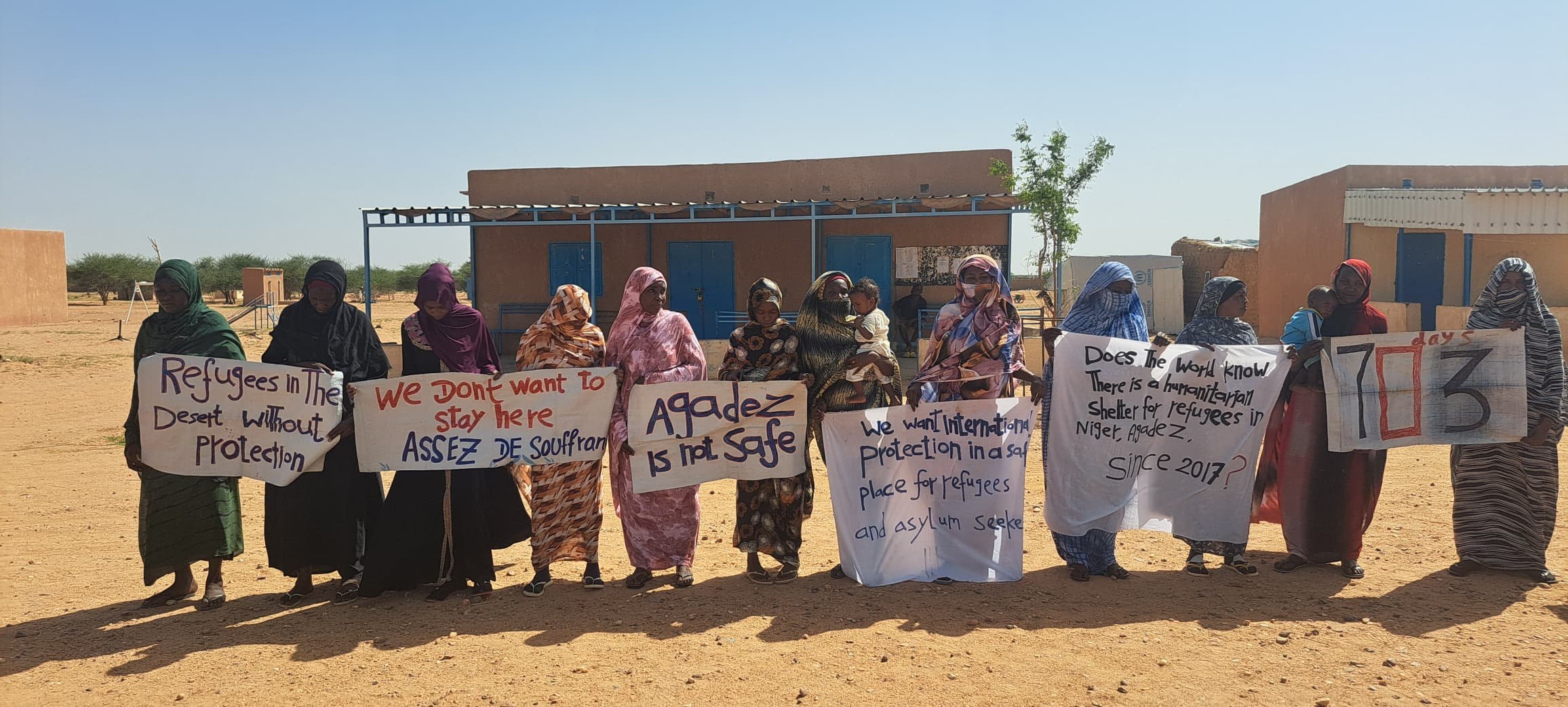
Yousef Ismail, membre de Refugees in Niger, a de nouveau alerté sur la situation humanitaire prolongée des réfugiés du camp humanitaire d’Agadez, au Niger, affirmant que leur manifestation pacifique se poursuit depuis plus d’un an et demeure sans solution.
Dans une série de publications, Ismail a indiqué que les réfugiés du camp manifestaient pacifiquement depuis 703 jours, réclamant une meilleure protection, la reconnaissance de leurs droits et l’accès à la protection internationale.
« La protection internationale est notre priorité », a déclaré Ismail, appelant la communauté internationale et les organisations de défense des droits humains à intervenir.
Il a décrit la situation dans le camp d’Agadez comme étant de plus en plus préoccupante et a accusé les organisations humanitaires ainsi que la communauté internationale de ne pas répondre suffisamment aux besoins des réfugiés qui, selon lui, ont fui leurs foyers à la recherche de sécurité et d’une nouvelle vie.
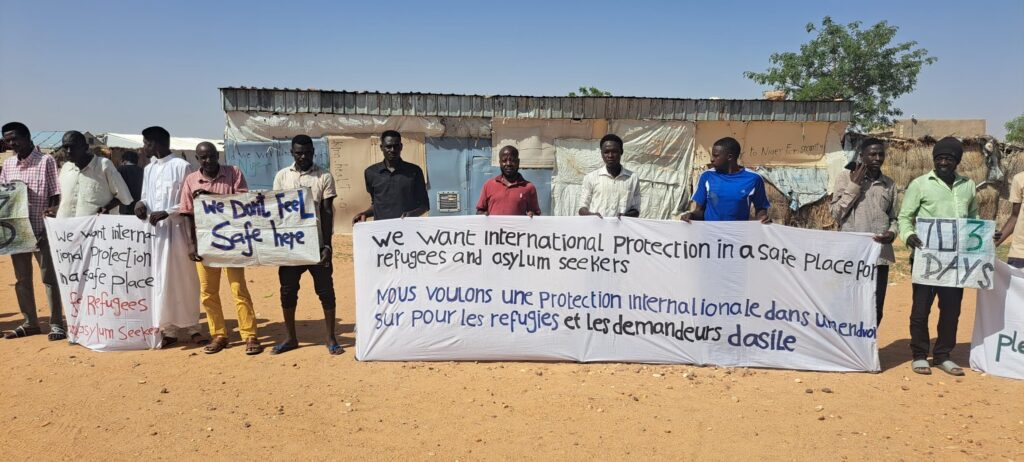
Ismail a exhorté les organisations internationales et de défense des droits humains à se rendre dans le camp afin d’évaluer directement la situation.
« La communauté internationale et les organisations de défense des droits humains doivent se rendre au centre humanitaire d’Agadez, où les réfugiés protestent depuis plus d’un an », a-t-il déclaré, avertissant que les réfugiés ont besoin d’une intervention urgente.
Il a également remis en question l’exactitude des déclarations faites par certaines organisations humanitaires concernant leur prise en charge des réfugiés vulnérables, affirmant que ceux bloqués à Agadez avaient, dans les faits, été abandonnés.
« N’abandonnez pas des personnes innocentes », a-t-il déclaré, soulignant que les réfugiés qui fuient des situations dangereuses devraient bénéficier d’une protection plutôt que d’être laissés dans une incertitude prolongée.
Six réfugiés auraient été expulsés vers la frontière tchadienne
Dans une autre publication, Ismail a commémoré ce qu’il a décrit comme une violation des droits humains survenue le 21 août 2025 au camp humanitaire d’Agadez.
Selon son récit, six réfugiés auraient été arrêtés puis expulsés vers la frontière avec le Tchad après avoir, selon les allégations, été déchus de leur statut de réfugié.
Il a présenté cet incident comme faisant partie de préoccupations plus larges concernant le traitement et la protection des réfugiés dans le camp.
Ismail a également attiré l’attention sur ce qu’il décrit comme la dégradation des conditions humanitaires à Agadez, réitérant son appel en faveur d’une protection et d’une intervention internationales.
Les publications ne fournissent pas de documents indépendants ni de réactions officielles des autorités nigériennes ou des organisations mises en cause par Ismail. Les allégations n’ont donc pas pu être vérifiées de manière indépendante sur la base des informations disponibles.
La prolongation de la protestation met en lumière des préoccupations plus larges concernant la protection des réfugiés et des migrants bloqués au Niger, notamment ceux qui recherchent une réinstallation, l’asile ou d’autres formes de protection internationale.
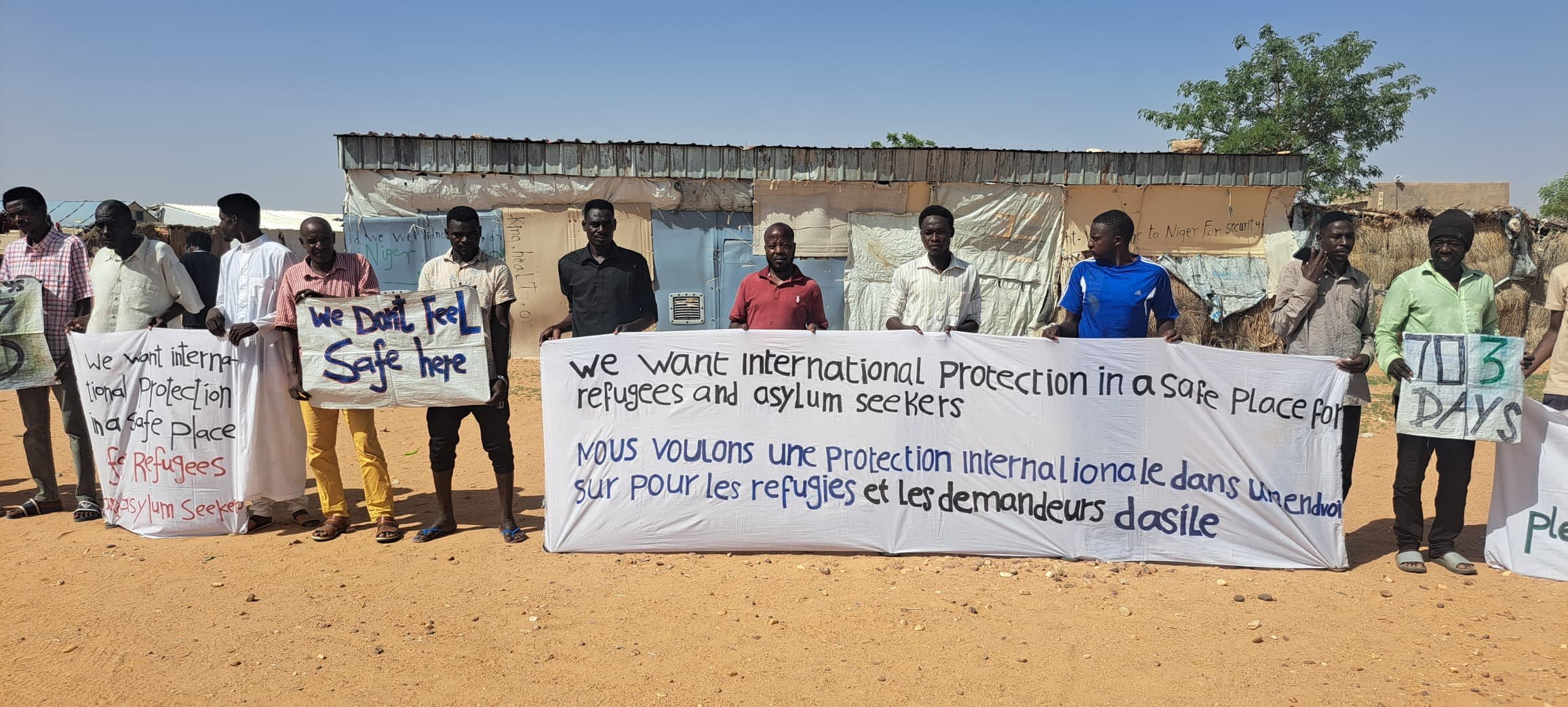
A member of Refugees in Niger, Yousef Ismail, has raised fresh concerns over the prolonged humanitarian situation facing refugees at the Agadez humanitarian camp in Niger, saying their peaceful protest has continued for more than a year and remains unresolved.
In a series of posts, Ismail said refugees at the camp had been demonstrating peacefully for 703 days, demanding greater protection, recognition of their rights and access to international protection.
“International protection is our priority,” Ismail said, while calling on the international community and human rights organisations to intervene.
He described the situation at the Agadez camp as increasingly dire and accused humanitarian organisations and the international community of failing to adequately respond to the needs of refugees who, according to him, fled their homes in search of safety and a new life.
Ismail urged international and human rights organisations to visit the camp and assess the situation directly.
“The international community and human rights organizations must go to the Agadez humanitarian center, where refugees have been protesting for over a year,” he said, warning that the refugees urgently need intervention.
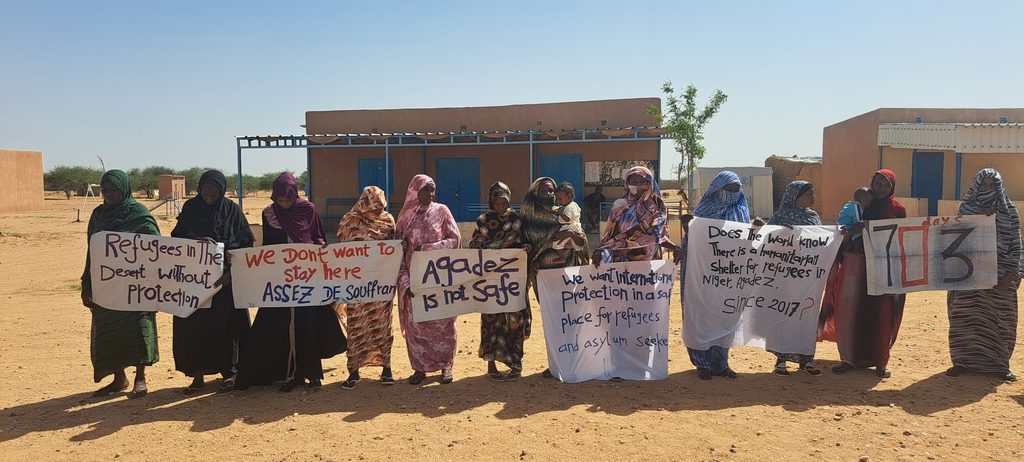
He also questioned the accuracy of statements made by humanitarian organisations about their treatment of vulnerable refugees, alleging that those stranded in Agadez had effectively been abandoned.
“Do not abandon innocent people,” he said, stressing that refugees fleeing danger should receive protection rather than being left in prolonged uncertainty.
Six refugees allegedly expelled to Chad border
In another post, Ismail commemorated what he described as a human rights violation that occurred on August 21, 2025, at the Agadez Humanitarian Camp.
According to his account, six refugees were arrested and subsequently expelled to the border with Chad after allegedly being stripped of their refugee status.
He presented the incident as part of broader concerns over the treatment and protection of refugees in the camp.
Ismail also called attention to what he described as the deteriorating humanitarian conditions in Agadez, reiterating his demand for international protection and intervention.
The posts did not provide independent documentation or official responses from Nigerien authorities or the organisations criticised by Ismail. The allegations therefore could not be independently verified from the information provided.
The prolonged protest highlights wider concerns surrounding the protection of refugees and migrants stranded in Niger, particularly those seeking resettlement, asylum or other forms of international protection.

How WSF changed ways participants see migration

Défendre les plus vulnérables :

Fighting for the vulnerable: How Udekwe Kennedy Obinna Is giving migrants a voice and a chance at safer futures

Une militante sénégalaise transforme la mort de son frère sur la route migratoire de l’Atlantique en combat pour le changement
Senegalese activist turns brother’s death on Atlantic migration route into campaign for change
-
 News Extra2 weeks ago
Des manifestations éclatent après la mort de migrants dans le naufrage d’un bateau
-
News Extra3 weeks ago
La Libye intercepte 87 migrants alors que trois personnes meurent et que plusieurs autres sont portées disparues
-
 News3 weeks ago
La Méditerranée transformée en « cimetière par politique » — Chercheur
-
News3 weeks ago
Libya Intercepts 87 migrants as three die, several others missing
-
News3 weeks ago
Mediterranean turned to cemetery by policy – Researcher
-
 News Extra2 weeks ago
Alarm Phone rend hommage aux migrants morts en Méditerranée et exige des voies de passage sûres
-
News2 weeks ago
Alarm Phone pays tribute to migrants who died crossing Mediterranean, demands safe passage
-
 Uncategorized2 weeks ago
Refugees in Libya raises alarm over alleged sexual harassment of minor