
News
Twenty victims trafficked from Republic of Equatorial Guinea, Togo to Nigeria rescued by NAPTIP, DIA


The National Agency for the Prohibition of Trafficking in Persons (NAPTIP) and the Defence Intelligence Agency (DIA) have busted an organised criminal network operating in Nigeria.
Three suspects were arrested during the operation.
NAPTIP noted that the well-coordinated operation, which was carried out in the Federal Capital Territory (FCT), Osun and Nasarawa states, targeting the criminal cells and their kingpins, led to the rescue of 20 victims trafficked from the Republic of Equatorial Guinea and Togo to Nigeria for various forms of labour exploitation.
The agency, in a statement by its Press Officer Vincent Adekoye yesterday, stated that following the directive of the Director General of NAPTIP, Binta Adamu Bello, the agency increased surveillance within border communities across the country to halt the activities of some suspected crime syndicates who are believed to have infiltrated Nigeria from certain African countries.
The agency also added that it strengthened collaboration with sister law enforcement agencies and partners to halt the unwholesome activities of the criminal gangs.
The victims, according to the statement by the agency, said they were deceived by members of the syndicate with promises of high-paying jobs in Nigeria, while they processed documentation for onward journeys to different locations in Europe.
Contrary to the promises made to them, they were subjected to sundry labour exploitation upon arrival in Nigeria.
Meanwhile, NAPTIP, in partnership with the Nigerian Embassy in Senegal, has rescued a middle-aged Nigerian victim of human trafficking from Dakar.
The unnamed victim arrived at the NAPTIP Lagos Command, Ikeja, after a close shave with death in the hands of mindless traffickers in one of the remote villages of Senegal.
According to the agency, she was deceived into travelling to Senegal with promises of a job as a hairstylist and make-up artist, only to discover that there was more, as her boss, whom she referred to as ‘Madam Rose’, was into the business of child/sex trafficking.
She was forced into prostitution and when she refused to comply, her employer confiscated her identification documents and threw her out, leaving her unable to move freely or return home.
In a petition by her relation to the Agency, it was stated: “She was left stranded somewhere in Kidira, Senegal.
“She reported that her trafficker is diabolical and has been tormenting her mentally and emotionally to the point where her sanity is at risk.
“She is extremely distressed, and we fear for her life”.
The Agency immediately reached out to the Nigerian Embassy in Dakar and other relevant partners, and she was immediately rescued and brought to Nigeria.
Read Also: You lack good taste, Wike replies critics, defends ₦39bn conference centre renovation
The NAPTIP boss attributed the successful operations that led to the rescue of all the victims and arrest of the suspects to the synergy between the agency and other relevant authorities in Nigeria.
She said: “The operation was strategic and targeted at the transnational organized criminal elements that are now making Nigeria an attractive human trafficking destination.
“This is just the beginning of our planned onslaught on them. These unpatriotic individuals move from one neighbouring country to the other, deceiving victims with promises of gainful employment in Nigeria.
“As soon as they bring the victims to Nigeria, they subject them to various forms of exploitation after collecting all their means of identification and preventing them from having access to any form of communication.
“These operations will be a continuous exercise, and we are also focusing on other parts of the country to rid the nation of all activities of these criminal syndicates.”
She thanked the Chief of Defence Intelligence (CDI), Major General Emmanuel Undiandeye, for his sustained support to NAPTIP in its activities, the Office of the National Security Adviser (ONSA) for providing the necessary platform for strengthening inter-agency collaboration in Nigeria, and all other stakeholders who assisted in the operation.”








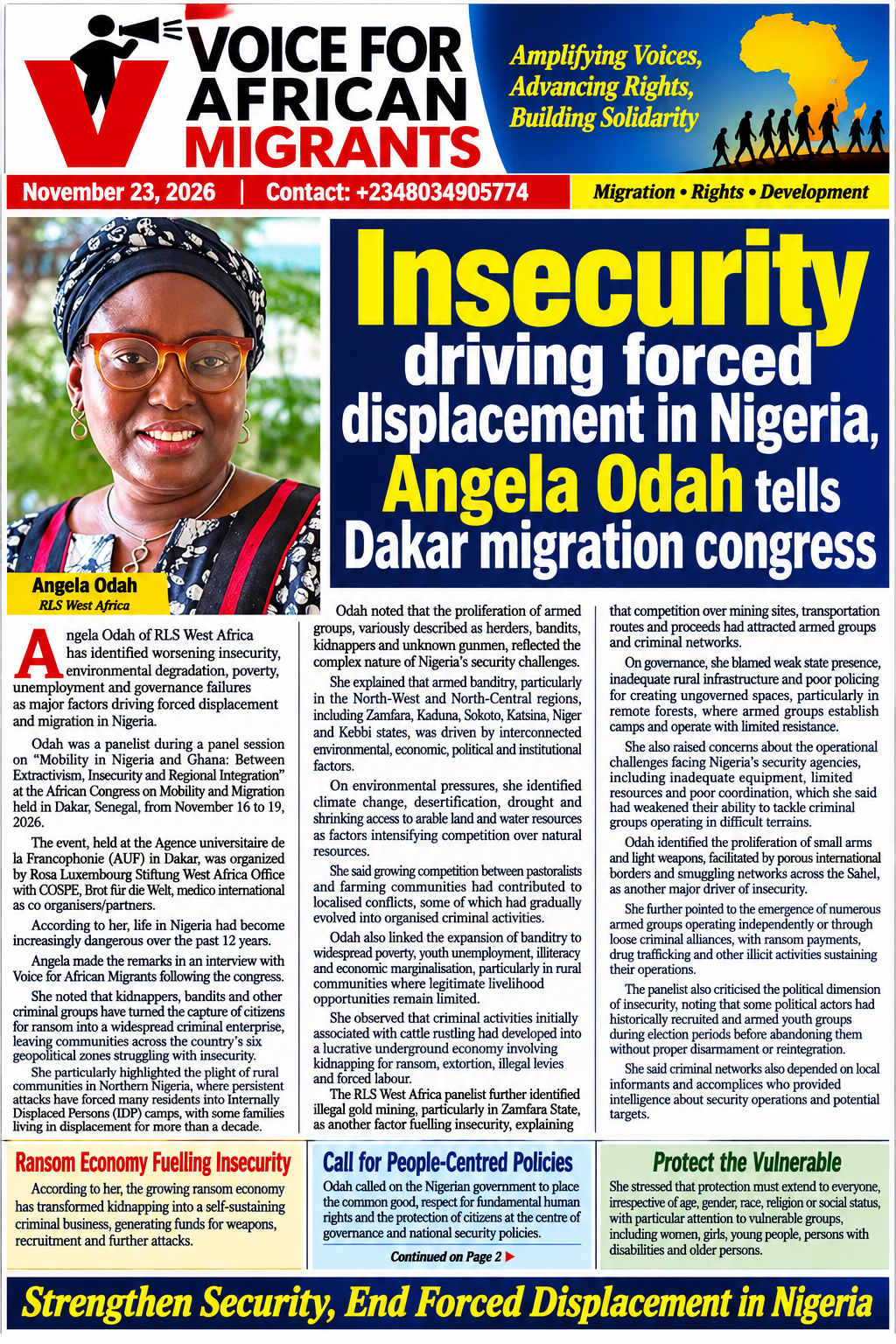
Angela Odah of RLS West Africa has identified worsening insecurity, environmental degradation, poverty, unemployment and governance failures as major factors driving forced displacement and migration in Nigeria.
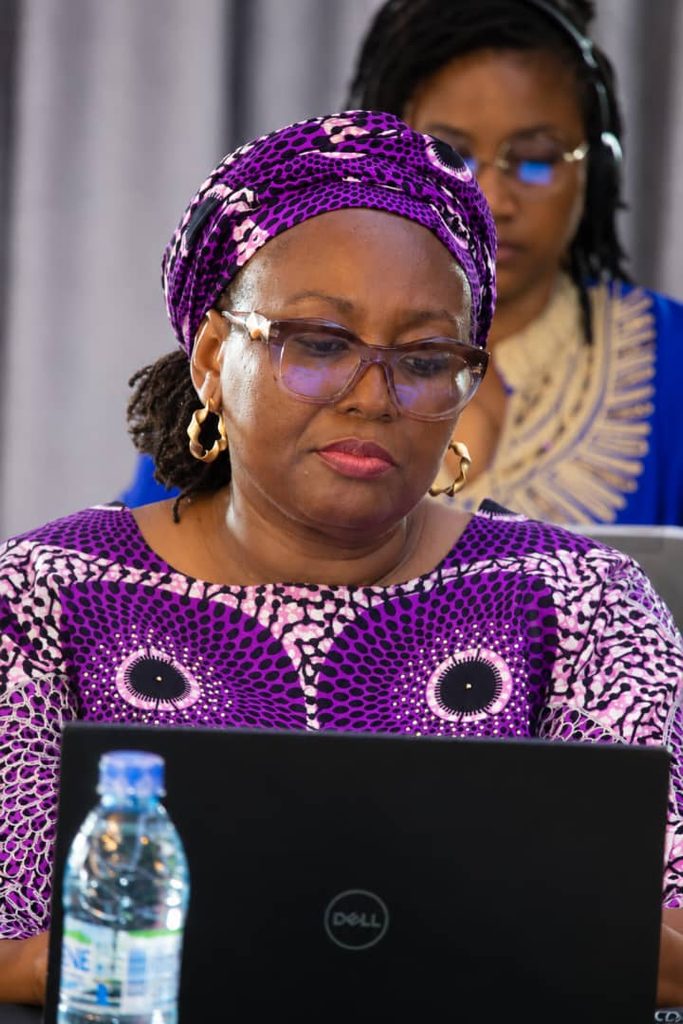
Odah was a panelist during a panel session on “Mobility in Nigeria and Ghana: Between Extractivism, Insecurity and Regional Integration” at the African Congress on Mobility and Migration held in Dakar, Senegal, from November 16 to 19, 2026.
The event, held at the Agence universitaire de la Francophonie (AUF) in Dakar, was organized by Rosa Luxembourg Stiftung West Africa Office with COSPE, Brot für die Welt, medico international as co organisers/partners.
According to her, life in Nigeria had become increasingly dangerous over the past 12 years.
Angela made the remarks in an interview with Voice for African Migrants following the congress.
She noted that kidnappers, bandits and other criminal groups have turned the capture of citizens for ransom into a widespread criminal enterprise, leaving communities across the country’s six geopolitical zones struggling with insecurity.
She particularly highlighted the plight of rural communities in Northern Nigeria, where persistent attacks have forced many residents into Internally Displaced Persons (IDP) camps, with some families living in displacement for more than a decade.
Odah noted that the proliferation of armed groups, variously described as herders, bandits, kidnappers and unknown gunmen, reflected the complex nature of Nigeria’s security challenges.
She explained that armed banditry, particularly in the North-West and North-Central regions, including Zamfara, Kaduna, Sokoto, Katsina, Niger and Kebbi states, was driven by interconnected environmental, economic, political and institutional factors.
On environmental pressures, she identified climate change, desertification, drought and shrinking access to arable land and water resources as factors intensifying competition over natural resources.
She said growing competition between pastoralists and farming communities had contributed to localised conflicts, some of which had gradually evolved into organised criminal activities.
Odah also linked the expansion of banditry to widespread poverty, youth unemployment, illiteracy and economic marginalisation, particularly in rural communities where legitimate livelihood opportunities remain limited.
She observed that criminal activities initially associated with cattle rustling had developed into a lucrative underground economy involving kidnapping for ransom, extortion, illegal levies and forced labour.
The RLS West Africa panelist further identified illegal gold mining, particularly in Zamfara State, as another factor fuelling insecurity, explaining that competition over mining sites, transportation routes and proceeds had attracted armed groups and criminal networks.
On governance, she blamed weak state presence, inadequate rural infrastructure and poor policing for creating ungoverned spaces, particularly in remote forests, where armed groups establish camps and operate with limited resistance.
She also raised concerns about the operational challenges facing Nigeria’s security agencies, including inadequate equipment, limited resources and poor coordination, which she said had weakened their ability to tackle criminal groups operating in difficult terrains.
Odah identified the proliferation of small arms and light weapons, facilitated by porous international borders and smuggling networks across the Sahel, as another major driver of insecurity.
She further pointed to the emergence of numerous armed groups operating independently or through loose criminal alliances, with ransom payments, drug trafficking and other illicit activities sustaining their operations.
The panelist also criticised the political dimension of insecurity, noting that some political actors had historically recruited and armed youth groups during election periods before abandoning them without proper disarmament or reintegration.
She said criminal networks also depended on local informants and accomplices who provided intelligence about security operations and potential targets.
According to her, the growing ransom economy has transformed kidnapping into a self-sustaining criminal business, generating funds for weapons, recruitment and further attacks.
Odah called on the Nigerian government to place the common good, respect for fundamental human rights and the protection of citizens at the centre of governance and national security policies.
She stressed that protection must extend to everyone, irrespective of age, gender, race, religion or social status, with particular attention to vulnerable groups, including women, girls, young people, persons with disabilities and older persons.
She also urged the government to strengthen the capacity, professionalism, accountability and operational effectiveness of security institutions to address terrorism, banditry and other security threats.
Odah further called for the prioritisation of the resettlement, reintegration and protection of displaced communities, stressing that addressing insecurity must go beyond military operations to include restoring livelihoods, rebuilding affected communities and guaranteeing the rights and safety of displaced persons.
Her intervention highlighted the links between insecurity, resource competition, economic exclusion and forced mobility, underscoring the need for rights-based governance and sustainable solutions to displacement in Nigeria.
News
Des migrants égyptiens et d’autres nationalités portés disparus ou présumés morts après le naufrage d’une embarcation au large de la Libye

Des dizaines de migrants égyptiens et d’autres nationalités sont présumés morts ou portés disparus après le naufrage d’une embarcation au large des côtes libyennes, alors qu’ils tentaient de traverser la Méditerranée pour rejoindre l’Europe, selon des médias égyptiens.
L’embarcation aurait quitté la ville de Tobrouk, dans l’est de la Libye, jeudi soir, mais aurait commencé à sombrer quelques kilomètres seulement après son départ, poussant les passagers à lancer des appels de détresse.
Des sources citées par le journal égyptien Al-Masry Al-Youm ont indiqué que des vents violents et l’obscurité avaient entravé les opérations de sauvetage. Six personnes ont été secourues, tandis que le sort des autres passagers demeure inconnu.
Les équipes de recherche ont poursuivi leurs opérations le long des côtes libyennes afin de retrouver d’éventuels survivants, de localiser les migrants portés disparus et de récupérer les corps.
Le nombre exact de passagers à bord de l’embarcation ainsi que le bilan humain confirmé n’étaient pas immédiatement connus.
Selon le média, les migrants auraient rejoint la Libye par l’intermédiaire de réseaux de traite des êtres humains, qui les auraient retenus dans des entrepôts avant d’organiser leur traversée maritime vers l’Europe en échange d’argent.
Des habitants du village de Sindbis, situé dans le gouvernorat égyptien de Qalyubia, ont déclaré à Al-Masry Al-Youm qu’entre 22 et 27 jeunes hommes de leur localité auraient été à bord de l’embarcation. Des jeunes originaires de villages voisins auraient également participé à cette traversée.
Un habitant a indiqué que le groupe avait quitté le village environ un mois auparavant, en prenant un bus pour Alexandrie avant de poursuivre son voyage vers la Libye par voie maritime. Leurs familles auraient perdu tout contact avec eux plusieurs heures après leur embarquement.
La plupart des jeunes hommes portés disparus auraient moins de 20 ans et étaient à la recherche d’opportunités d’emploi à l’étranger, a ajouté cet habitant.
Ce nouveau naufrage met en évidence les dangers persistants auxquels sont confrontés les migrants qui tentent de rejoindre l’Europe par les voies migratoires irrégulières en Méditerranée depuis la Libye, où les traversées maritimes périlleuses et les réseaux de traite des êtres humains continuent d’exposer les migrants à l’exploitation et aux pertes en vies humaines.
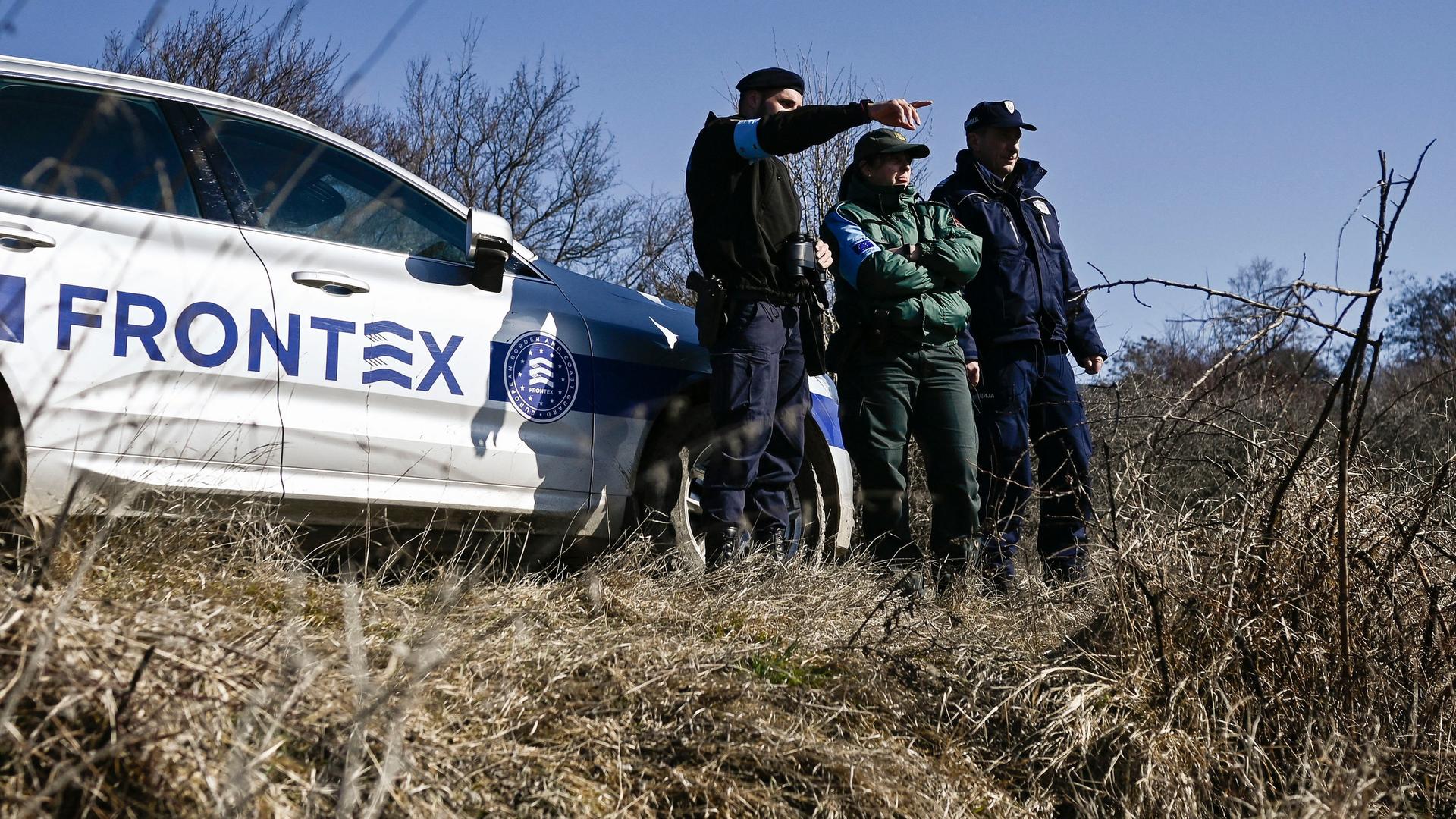
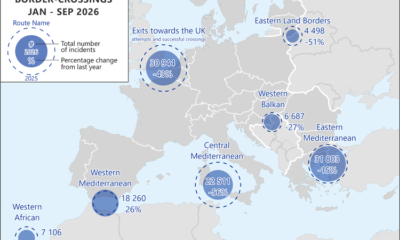
Les arrivées irrégulières dans l’Union européenne ont diminué sur la plupart des principales routes migratoires au cours des neuf premiers mois de 2026, bien que les traversées sur la route de la Méditerranée occidentale aient augmenté de 26 %, selon les chiffres publiés par l’Agence européenne de garde-frontières et de garde-côtes (Frontex).
Les données couvrant la période de janvier à septembre 2026 montrent que la route de la Méditerranée orientale a enregistré le plus grand nombre de franchissements irréguliers des frontières, avec 31 803 détections, soit une baisse de 15 % par rapport à la même période en 2025.
La route de la Méditerranée centrale arrive en deuxième position avec 22 511 détections, marquant une baisse de 56 %, tandis que celle de la Méditerranée occidentale a enregistré 18 260 traversées, soit une augmentation de 26 %.
La route de l’Afrique de l’Ouest a enregistré 7 106 traversées, en baisse de 45 %, tandis que celle des Balkans occidentaux a comptabilisé 6 687 franchissements, soit une diminution de 27 %.
Par ailleurs, les détections le long de la frontière terrestre orientale ont chuté de 51 %, pour s’établir à 4 498.
Les départs en direction du Royaume-Uni ont également diminué, avec 30 944 détections enregistrées au cours de cette période de neuf mois, soit une baisse de 43 % par rapport à la période correspondante en 2025.
Chiffres du mois de septembre
Pour le seul mois de septembre, la route de la Méditerranée orientale a enregistré 4 772 traversées irrégulières, le chiffre le plus élevé parmi les routes surveillées par Frontex.
La Méditerranée occidentale arrive ensuite avec 3 067 traversées, tandis que la Méditerranée centrale en a enregistré 2 877.
La route de l’Afrique de l’Ouest a comptabilisé 1 939 traversées, contre 1 079 dans les Balkans occidentaux et 584 à la frontière terrestre orientale.
Par ailleurs, 4 536 départs en direction du Royaume-Uni ont été enregistrés au cours du mois.
Principales nationalités
Les ressortissants soudanais, bangladais et afghans ont constitué les principales nationalités détectées sur la route de la Méditerranée orientale au cours des neuf premiers mois de 2026.
Sur la route de la Méditerranée centrale, les Bangladais, les Algériens et les Somaliens arrivaient en tête, tandis que les Algériens, les Maliens et les Marocains étaient les nationalités les plus fréquemment détectées sur la route de la Méditerranée occidentale.
Sur la route de l’Afrique de l’Ouest, les principales nationalités étaient les Marocains, les Sénégalais et les Gambiens.
Les ressortissants turcs, afghans et égyptiens étaient les plus fréquemment détectés sur la route des Balkans occidentaux, tandis que les Ukrainiens, les Afghans et les Russes arrivaient en tête à la frontière terrestre orientale.
Concernant les départs vers le Royaume-Uni, les Érythréens, les Soudanais et les Somaliens constituaient les principales nationalités recensées.
Ces chiffres mettent en évidence les différentes tendances migratoires aux frontières extérieures de l’Europe. Alors que la plupart des routes ont enregistré des baisses importantes, la Méditerranée occidentale a connu une augmentation des traversées au cours de la période étudiée.

L’insécurité, facteur de déplacement forcé au Nigeria, affirme Angela Odah au congrès de Dakar sur les migrations

Insecurity driving forced displacement in Nigeria, Angela Odah tells Dakar migration congress

La loi égyptienne sur l’asile expose les réfugiés aux expulsions et aux violations de leurs droits – ONG

Egypt’s asylum law exposes refugees to deportation, rights violations – Rights group

Extraction des ressources, fardeau de la dette alimentant la migration forcée depuis l’Afrique, selon un journaliste lors du congrès de Dakar
-
 News2 weeks ago
Sea-Watch condemns proposed EU plan to expand Frontex powers
-
 News3 weeks ago
Refugees continue protest at UNHCR centre in Niger’s Agadez
-
 News Extra2 weeks ago
Sea-Watch renouvelle son appel à mettre fin au financement européen des garde-côtes libyens
-
 Interviews1 day ago
Extraction des ressources, fardeau de la dette alimentant la migration forcée depuis l’Afrique, selon un journaliste lors du congrès de Dakar
-
News Extra2 weeks ago
Sea-Watch condamne le projet de l’UE visant à étendre les pouvoirs de Frontex
-
 News Extra2 weeks ago
Frontex celebrates drop in irregular crossings into EU
-
 News3 weeks ago
Jeff Crisp questions IOM’s involvement in US third-country deportation programme
-
 Interviews1 day ago
Resource extraction, debt burden fuelling forced migration from Africa, journalist tells Dakar congress