
News Extra
L’insécurité, facteur de déplacement forcé au Nigeria, affirme Angela Odah au congrès de Dakar sur les migrations


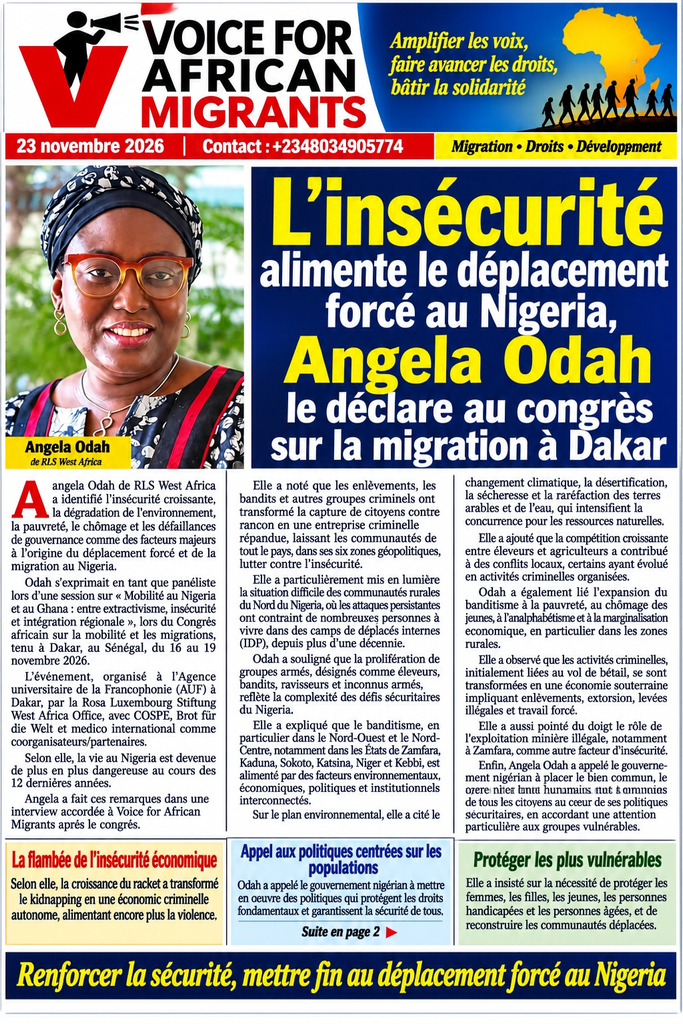
Angela Odah, du bureau Afrique de l’Ouest de la Fondation Rosa Luxemburg (RLS), a identifié la dégradation de la situation sécuritaire, la dégradation de l’environnement, la pauvreté, le chômage et les défaillances de la gouvernance comme étant les principaux facteurs à l’origine des déplacements forcés et des migrations au Nigeria.
Angela Odah intervenait en tant que panéliste lors d’une session intitulée « Mobilité au Nigeria et au Ghana : entre extractivisme, insécurité et intégration régionale », organisée dans le cadre du Congrès africain sur la mobilité et les migrations, qui s’est tenu à Dakar, au Sénégal, du 16 au 19 novembre 2026.
L’événement, organisé à l’Agence universitaire de la Francophonie (AUF) à Dakar, était organisé par le bureau Afrique de l’Ouest de la Fondation Rosa Luxemburg, avec COSPE, Brot für die Welt et medico international comme coorganisateurs et partenaires.
Selon elle, la vie au Nigeria est devenue de plus en plus dangereuse au cours des 12 dernières années.
Angela Odah a fait ces déclarations lors d’un entretien accordé à Voice for African Migrants à l’issue du congrès.
Elle a souligné que les ravisseurs, les bandits et d’autres groupes criminels ont transformé l’enlèvement de citoyens contre rançon en une activité criminelle largement répandue, plongeant les communautés des six zones géopolitiques du pays dans une insécurité persistante.
Elle a particulièrement attiré l’attention sur la situation des communautés rurales du nord du Nigeria, où les attaques répétées ont contraint de nombreux habitants à se réfugier dans des camps de personnes déplacées internes (PDI). Certaines familles vivent ainsi en situation de déplacement depuis plus de dix ans.
Odah a fait remarquer que la prolifération des groupes armés, désignés sous différentes appellations telles que éleveurs, bandits, ravisseurs et hommes armés non identifiés, reflétait la complexité des défis sécuritaires auxquels le Nigeria est confronté.
Elle a expliqué que le banditisme armé, particulièrement présent dans les régions du Nord-Ouest et du Centre-Nord, notamment dans les États de Zamfara, Kaduna, Sokoto, Katsina, Niger et Kebbi, était alimenté par des facteurs environnementaux, économiques, politiques et institutionnels étroitement liés.
Concernant les pressions environnementales, elle a identifié le changement climatique, la désertification, la sécheresse ainsi que la diminution de l’accès aux terres arables et aux ressources en eau comme des facteurs qui intensifient la concurrence autour des ressources naturelles.
Elle a indiqué que la concurrence croissante entre les éleveurs et les communautés agricoles avait contribué à des conflits locaux, dont certains ont progressivement évolué vers des activités criminelles organisées.
Odah a également établi un lien entre l’expansion du banditisme et la pauvreté généralisée, le chômage des jeunes, l’analphabétisme et la marginalisation économique, particulièrement dans les communautés rurales où les possibilités de moyens de subsistance légitimes restent limitées.
Elle a observé que les activités criminelles initialement associées au vol de bétail s’étaient transformées en une économie clandestine lucrative impliquant les enlèvements contre rançon, l’extorsion, les prélèvements illégaux et le travail forcé.
La panéliste de RLS Afrique de l’Ouest a également identifié l’exploitation aurifère illégale, particulièrement dans l’État de Zamfara, comme un autre facteur alimentant l’insécurité. Elle a expliqué que la concurrence autour des sites miniers, des voies de transport et des revenus générés par cette activité avait attiré des groupes armés et des réseaux criminels.
Sur le plan de la gouvernance, elle a dénoncé la faible présence de l’État, l’insuffisance des infrastructures rurales et les défaillances des services de police, qui favorisent la création de zones échappant au contrôle des autorités, notamment dans les forêts reculées où les groupes armés installent leurs camps et opèrent avec peu de résistance.
Elle a également exprimé des inquiétudes concernant les difficultés opérationnelles auxquelles sont confrontées les agences nigérianes de sécurité, notamment le manque d’équipements, l’insuffisance des ressources et la mauvaise coordination, autant de facteurs qui, selon elle, affaiblissent leur capacité à lutter contre les groupes criminels opérant dans des zones difficiles d’accès.
Odah a identifié la prolifération des armes légères et de petit calibre, facilitée par la porosité des frontières internationales et les réseaux de contrebande à travers le Sahel, comme un autre facteur majeur de l’insécurité.
Elle a en outre évoqué l’émergence de nombreux groupes armés opérant de manière indépendante ou au sein de réseaux criminels informels, dont les activités sont financées par les rançons, le trafic de drogue et d’autres activités illicites.
La panéliste a également critiqué la dimension politique de l’insécurité, soulignant que certains acteurs politiques avaient, par le passé, recruté et armé des groupes de jeunes pendant les périodes électorales avant de les abandonner sans procéder à leur désarmement ni à leur réintégration dans la société.
Elle a indiqué que les réseaux criminels s’appuyaient également sur des informateurs et des complices locaux qui leur fournissaient des renseignements sur les opérations des forces de sécurité et les cibles potentielles.
Selon elle, le développement de l’économie des rançons a transformé les enlèvements en une activité criminelle autonome et durable, générant des ressources financières utilisées pour acquérir des armes, recruter de nouveaux membres et organiser d’autres attaques.
Odah a appelé le gouvernement nigérian à placer l’intérêt général, le respect des droits humains fondamentaux et la protection des citoyens au cœur de la gouvernance et des politiques nationales de sécurité.
Elle a souligné que cette protection devait s’étendre à toutes les personnes, sans distinction d’âge, de genre, de race, de religion ou de statut social, en accordant une attention particulière aux groupes vulnérables, notamment les femmes, les filles, les jeunes, les personnes handicapées et les personnes âgées.
Elle a également exhorté le gouvernement à renforcer les capacités, le professionnalisme, la responsabilité et l’efficacité opérationnelle des institutions de sécurité afin de lutter contre le terrorisme, le banditisme et les autres menaces sécuritaires.
Odah a par ailleurs appelé à accorder la priorité à la réinstallation, à la réintégration et à la protection des communautés déplacées. Elle a insisté sur le fait que la lutte contre l’insécurité ne devait pas se limiter aux opérations militaires, mais devait également inclure le rétablissement des moyens de subsistance, la reconstruction des communautés touchées ainsi que la garantie des droits et de la sécurité des personnes déplacées.
Son intervention a mis en évidence les liens entre l’insécurité, la concurrence autour des ressources, l’exclusion économique et les déplacements forcés, soulignant ainsi la nécessité d’une gouvernance fondée sur les droits humains et de solutions durables au problème des déplacements de population au Nigeria.









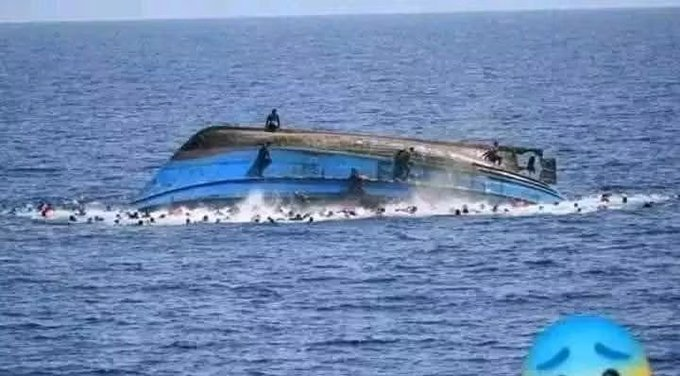
Dozens of Egyptian and other migrants are feared dead or missing after a boat carrying them sank off the Libyan coast while attempting to cross the Mediterranean to Europe, according to Egyptian media reports.
The vessel reportedly departed from the eastern Libyan city of Tobruk on Thursday evening but began sinking just a few kilometres into the journey, prompting passengers to send distress signals.
Sources cited by Egypt’s Al-Masry Al-Youm newspaper said strong winds and darkness hampered rescue operations. Six people were rescued, while the fate of the other passengers remained unknown.
Search teams continued operations along the Libyan coast in an effort to locate survivors, find missing migrants and recover bodies.
The exact number of passengers aboard the boat and the confirmed death toll were not immediately known.
According to the report, the migrants had allegedly travelled to Libya through human trafficking networks, which reportedly held them in warehouses before arranging sea crossings to Europe in exchange for money.
Residents of Sindbis village in Egypt’s Qalyubia Governorate told Al-Masry Al-Youm that between 22 and 27 young men from their community were believed to have been aboard the vessel. Young men from neighbouring villages were also reportedly among those who joined the journey.
One resident said the group had left the village about a month earlier, travelling by bus to Alexandria before proceeding towards Libya by sea. Their families reportedly lost contact with them several hours after they boarded the boat.
Most of the missing young men were reportedly under the age of 20 and had been seeking employment opportunities abroad, the resident added.
The latest shipwreck underscores the continuing dangers faced by migrants attempting to reach Europe through irregular Mediterranean crossings from Libya, where dangerous sea journeys and trafficking networks continue to expose migrants to exploitation and loss of life.
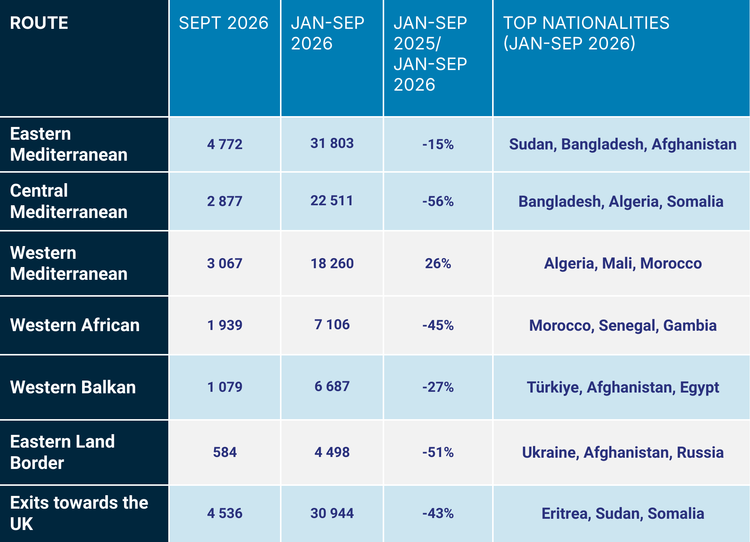
Irregular migration to the European Union declined on most major migratory routes in the first nine months of 2026, although crossings along the Western Mediterranean route increased by 26 per cent, according to figures released by the European Border and Coast Guard Agency (Frontex).
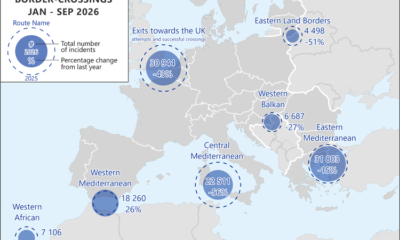
Data covering January to September 2026 showed that the Eastern Mediterranean route recorded the highest number of irregular border crossings, with 31,803 detections, representing a 15 per cent decrease compared with the same period in 2025.
The Central Mediterranean route followed with 22,511 detections, marking a 56 per cent decline, while the Western Mediterranean route recorded 18,260 crossings, an increase of 26 per cent.
The Western African route registered 7,106 crossings, down 45 per cent, while the Western Balkans recorded 6,687, representing a 27 per cent decrease.
Meanwhile, detections along the Eastern Land Border fell by 51 per cent to 4,498.
Exits towards the United Kingdom also declined, with 30,944 detections recorded during the nine-month period, a 43 per cent decrease compared with the corresponding period in 2025.
September figures
In September alone, the Eastern Mediterranean route recorded 4,772 irregular crossings, the highest among the routes monitored by Frontex.
The Western Mediterranean followed with 3,067 crossings, while the Central Mediterranean recorded 2,877.
The Western African route registered 1,939 crossings, compared with 1,079 along the Western Balkans and 584 at the Eastern Land Border.
Meanwhile, 4,536 exits towards the United Kingdom were recorded during the month.
Top nationalities
Sudanese, Bangladeshi and Afghan nationals were the leading nationalities detected along the Eastern Mediterranean route during the first nine months of 2026.
Bangladeshis, Algerians and Somalis topped the list along the Central Mediterranean route, while Algerians, Malians and Moroccans were the most frequently detected nationalities along the Western Mediterranean route.
On the Western African route, the leading nationalities were Moroccans, Senegalese and Gambians.
Turkish, Afghan and Egyptian nationals were the most frequently detected along the Western Balkans route, while Ukrainians, Afghans and Russians topped the list at the Eastern Land Border.
For exits towards the United Kingdom, Eritreans, Sudanese and Somalis were the leading nationalities.
The figures highlight the varying migration trends across Europe’s external borders, with most routes recording substantial declines while the Western Mediterranean experienced an increase during the period under review.
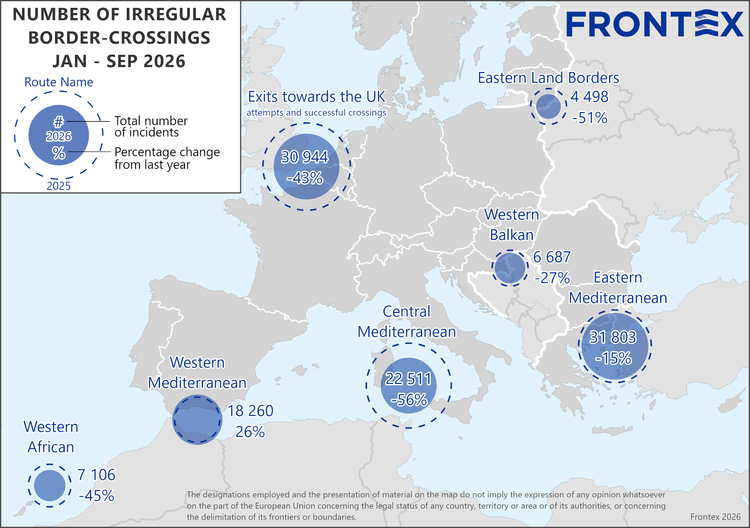
The number of irregular border crossings into the European Union (EU) fell by almost one-third in the first nine months of 2026 compared with the same period last year, according to preliminary data released by the European Border and Coast Guard Agency (Frontex).
The agency said just over 91,000 irregular crossings were detected between January and September, attributing the decline across most major migration routes to sustained cooperation with partner countries and preventive measures in key departure states.
In September alone, approximately 14,300 crossings were recorded, representing a 28 per cent decrease compared with September 2025, although the figure was 11 per cent higher than in August.
According to Frontex, the period also marked the first full summer under the EU Pact on Migration and Asylum, which introduces a standardised screening process at the bloc’s external borders.
Frontex officers are supporting member states with key aspects of the new system, including identifying the nationalities of arrivals, collecting biometric information and verifying travel documents.
Frontex Executive Director Hans Leijtens said fewer people were attempting to reach Europe through most migration routes, although he warned that the situation could change rapidly.
“On most routes into Europe, fewer people are attempting the journey, and that has held through the summer and into the autumn. But things can turn quickly,” Leijtens said.
He cited the Atlantic route towards the Canary Islands, where detections in September were four times higher than in August, warning that human smuggling networks remained active despite the overall decline in crossings.
The Eastern and Central Mediterranean routes remained the busiest corridors, accounting for almost 60 per cent of all irregular entries into the EU during the nine-month period.
The Central Mediterranean recorded the sharpest decline, with crossings falling by 56 per cent, while the Western Mediterranean was the only major route to register an increase, with detections rising by 26 per cent.
On the Eastern Mediterranean route, approximately 31,800 crossings were recorded, representing a 15 per cent decline compared with the same period in 2025.
The corridor from Libya to Crete was the busiest section, followed by the eastern Aegean islands and the land border with Türkiye. Sudanese, Bangladeshi and Afghan nationals were the main nationalities detected.
The Central Mediterranean recorded approximately 22,500 arrivals, down by 56 per cent year-on-year. Libya remained the main departure point, accounting for about three-quarters of crossings along the route, followed by Tunisia and Algeria.
Bangladeshi, Algerian and Somali nationals were the main groups detected on the route.
Meanwhile, the Western Mediterranean recorded around 18,300 crossings, an increase of 26 per cent compared with the first nine months of 2025.
The increase was mainly driven by crossings at land borders, where detections more than doubled, while sea arrivals rose by eight per cent.
Algeria remained the principal departure country for sea crossings, with the Balearic Islands and mainland Spain serving as the main destinations. Algerian, Malian and Moroccan nationals accounted for the largest groups detected.
On the Western African route, approximately 7,100 crossings were recorded, representing a 45 per cent decline.
Frontex attributed the reduction to preventive measures introduced by Mauritania and, more recently, Senegal and The Gambia, in cooperation with Spain and the EU.
However, the agency warned that migration movements along the route remained unpredictable, with detections rising sharply to approximately 1,900 in September, four times the August figure.
Departures were reported from Morocco and The Gambia towards the Canary Islands, while Moroccan, Senegalese and Gambian nationals were the main groups detected.
Attempts to cross the English Channel towards the United Kingdom also declined, falling by 43 per cent to approximately 30,900 during the nine-month period. The figure includes both people who reached the UK and those prevented from departing.
Around 4,500 attempts were recorded in September, with Eritrean, Sudanese and Somali nationals accounting for the main nationalities detected.
Frontex noted that smuggling networks increasingly relied on larger inflatable boats, known as mega dinghies. In August, a record 230 people, including more than 20 children, reportedly reached the UK in a single inflatable boat.
The agency said an agreement signed between the UK and France in April was expected to strengthen patrols along the French coast in the coming months.
Despite the overall decline in irregular crossings, Frontex warned that the human cost of migration remained high.
Citing the International Organization for Migration (IOM), the agency said nearly 2,000 people had died in the Mediterranean so far in 2026, highlighting the dangers faced by migrants travelling in overcrowded and unseaworthy boats.
It added that developments outside the EU’s borders, including the large-scale return of Afghan nationals from Iran and Pakistan and instability across the Sahel, could influence future migration movements towards Europe.
Although these developments had not yet resulted in a significant change in arrivals at the EU’s external borders, Frontex said it was closely monitoring the situation.
The agency added that approximately 3,800 officers were currently deployed at the EU’s external borders to support national authorities in border management and search-and-rescue operations.

L’insécurité, facteur de déplacement forcé au Nigeria, affirme Angela Odah au congrès de Dakar sur les migrations

Insecurity driving forced displacement in Nigeria, Angela Odah tells Dakar migration congress

La loi égyptienne sur l’asile expose les réfugiés aux expulsions et aux violations de leurs droits – ONG

Egypt’s asylum law exposes refugees to deportation, rights violations – Rights group

Extraction des ressources, fardeau de la dette alimentant la migration forcée depuis l’Afrique, selon un journaliste lors du congrès de Dakar
-
 News2 weeks ago
Sea-Watch condemns proposed EU plan to expand Frontex powers
-
 News3 weeks ago
Refugees continue protest at UNHCR centre in Niger’s Agadez
-
 News Extra2 weeks ago
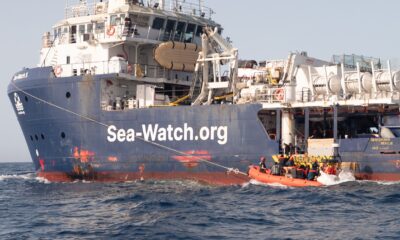
Sea-Watch renouvelle son appel à mettre fin au financement européen des garde-côtes libyens
-
 Interviews13 hours ago
Extraction des ressources, fardeau de la dette alimentant la migration forcée depuis l’Afrique, selon un journaliste lors du congrès de Dakar
-
News Extra2 weeks ago
Sea-Watch condamne le projet de l’UE visant à étendre les pouvoirs de Frontex
-
 News Extra2 weeks ago
Frontex celebrates drop in irregular crossings into EU
-
 Interviews14 hours ago
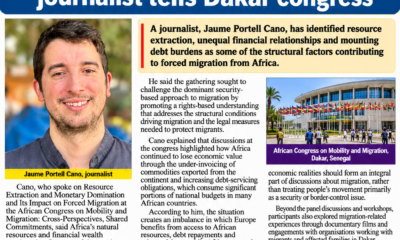
Resource extraction, debt burden fuelling forced migration from Africa, journalist tells Dakar congress
-
 News3 weeks ago
Jeff Crisp questions IOM’s involvement in US third-country deportation programme