
News Extra
UK-Nigeria migration agreement: Lawyer faults deal, explains why pact not enforceable


Frontline legal practitioner a Senior Advocate of Nigeria, Femi Falana, has picked holes in the migration agreement Nigeria signed with the UK when President Bola Tinubu travelled for a state visit.
The text reads unedited:
During the State Visit of President Bola Tinubu to the United Kingdom last week, it was announced that some Agreements were signed by Nigeria and the United Kingdom.
In particular, the Migration Partnership Agreement is aimed at fast-tracking the return of Nigerians with no legal right to remain in the UK, including failed asylum seekers and foreign criminals.
The agreement simplifies identification using “UK letters” instead of passports for returns, and offers reintegration support.
While the ‘Agreement’ is being presented as a win for border control and bilateral cooperation, it clearly risks sacrificing due process, constitutional safeguards, and human rights in the name of administrative convenience. In the first place, the use of the “UK letters” to return Nigerians is not and cannot be a substitute for proper travel documents. While the use of such letters may theoretically remove bureaucratic delays, it is fundamentally at odds with international human rights standards, as it for example lowers the threshold for deportation—potentially allowing individuals to be removed without proper verification of their identity or nationality.
This raises the risk of wrongful or arbitrary deportations.
The Agreement also lacks fair trial guarantees and is inconsistent and incompatible with the provisions of the Nigerian Constitution 1999 [as amended] which the right to a fair hearing, as it appears to facilitate removals without ensuring that affected individuals have had a meaningful opportunity to challenge their deportation. It also sidesteps established processes for verifying citizenship, raising the possibility that individuals could be wrongly identified and returned.
Apart from offending the provisions of the Nigerian Constitution, the Agreement is also contrary to the country’s international human rights obligations, including under the African Charter on Human and Peoples’ Rights and the International Covenant on Civil and Political Rights to which Nigeria is a state party. Nigeria is bound by obligations under these human rights treaties to protect human dignity, ensure access to remedies, and prevent wrongful return to harm. Any system that accelerates deportations without adequate safeguards risks violating these commitments.
The Agreement also risks violating the right to family life of Nigerians in the UK, as many of those targeted by the Agreement have clearly built lives in the UK—raising children, supporting partners, and contributing to their communities. UK courts have in several cases warned against such outcomes. For example, in ZH (Tanzania) v Secretary of State for the Home Department, the Supreme Court made clear that the best interests of children must come first in immigration decisions. In Huang v Secretary of State for the Home Department
[2011] UKSC 4, it was held that deportation must be proportionate and carefully balanced against the right to family life.
There is also no clear evidence that the purported Agreement has undergone legislative scrutiny or public debate in Nigeria. In a constitutional democracy, agreements that affect fundamental rights cannot be implemented solely at the discretion of the executive.
Any perceived efficiency as suggested by the Agreement cannot come at the expense of due process of law, fairness, justice, and accountability.
In Nigeria, the Agreement may be declared illegal by a domestic court on the ground that under the Criminal Code Act and Nigerian Correctional Service Act, no person may be admitted to any correctional centre in Nigeria without a court order or warrant issued and signed by a judge. To that extent, the provision of the Agreement that permits persons convicted in the UK to serve or complete jail terms in Nigerian prisons is illegal in every material particular. In other words, a person awaiting trial in a Nigerian court may be ordered to be remanded in prison custody while a convicted person may be committed to prison by a trial judge. The law never envisaged that Nigeria would be a dumping ground for persons convicted in the UK!
The Agreement must, therefore, be revisited, reviewed in accordance with the country’s international human rights obligations. It must be domesticated in line with section 12(1) of the Nigerian Constitution, which stipulates that
“No treaty between the Federation and any other country shall have the force of law to the extent to which any such treaty has been enacted into law by the National Assembly.”
Until then, no Nigerian citizen should be arbitrarily returned to the country on the ground of serving the UK’s objective of migration control








News Extra
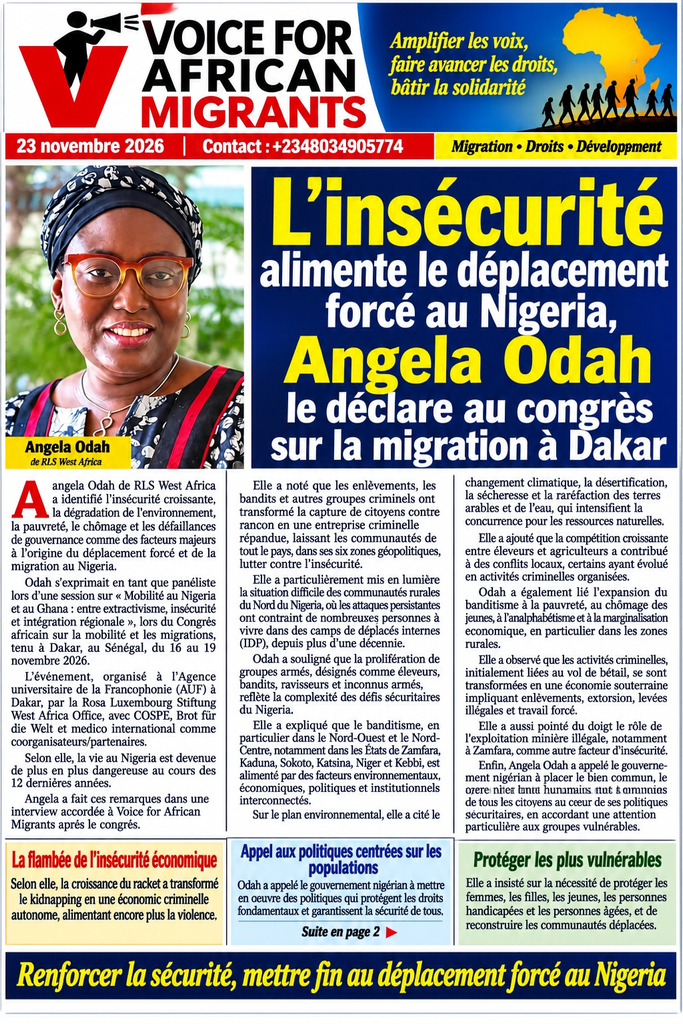
L’insécurité, facteur de déplacement forcé au Nigeria, affirme Angela Odah au congrès de Dakar sur les migrations

Angela Odah, du bureau Afrique de l’Ouest de la Fondation Rosa Luxemburg (RLS), a identifié la dégradation de la situation sécuritaire, la dégradation de l’environnement, la pauvreté, le chômage et les défaillances de la gouvernance comme étant les principaux facteurs à l’origine des déplacements forcés et des migrations au Nigeria.
Angela Odah intervenait en tant que panéliste lors d’une session intitulée « Mobilité au Nigeria et au Ghana : entre extractivisme, insécurité et intégration régionale », organisée dans le cadre du Congrès africain sur la mobilité et les migrations, qui s’est tenu à Dakar, au Sénégal, du 16 au 19 novembre 2026.
L’événement, organisé à l’Agence universitaire de la Francophonie (AUF) à Dakar, était organisé par le bureau Afrique de l’Ouest de la Fondation Rosa Luxemburg, avec COSPE, Brot für die Welt et medico international comme coorganisateurs et partenaires.
Selon elle, la vie au Nigeria est devenue de plus en plus dangereuse au cours des 12 dernières années.
Angela Odah a fait ces déclarations lors d’un entretien accordé à Voice for African Migrants à l’issue du congrès.
Elle a souligné que les ravisseurs, les bandits et d’autres groupes criminels ont transformé l’enlèvement de citoyens contre rançon en une activité criminelle largement répandue, plongeant les communautés des six zones géopolitiques du pays dans une insécurité persistante.
Elle a particulièrement attiré l’attention sur la situation des communautés rurales du nord du Nigeria, où les attaques répétées ont contraint de nombreux habitants à se réfugier dans des camps de personnes déplacées internes (PDI). Certaines familles vivent ainsi en situation de déplacement depuis plus de dix ans.
Odah a fait remarquer que la prolifération des groupes armés, désignés sous différentes appellations telles que éleveurs, bandits, ravisseurs et hommes armés non identifiés, reflétait la complexité des défis sécuritaires auxquels le Nigeria est confronté.
Elle a expliqué que le banditisme armé, particulièrement présent dans les régions du Nord-Ouest et du Centre-Nord, notamment dans les États de Zamfara, Kaduna, Sokoto, Katsina, Niger et Kebbi, était alimenté par des facteurs environnementaux, économiques, politiques et institutionnels étroitement liés.
Concernant les pressions environnementales, elle a identifié le changement climatique, la désertification, la sécheresse ainsi que la diminution de l’accès aux terres arables et aux ressources en eau comme des facteurs qui intensifient la concurrence autour des ressources naturelles.
Elle a indiqué que la concurrence croissante entre les éleveurs et les communautés agricoles avait contribué à des conflits locaux, dont certains ont progressivement évolué vers des activités criminelles organisées.
Odah a également établi un lien entre l’expansion du banditisme et la pauvreté généralisée, le chômage des jeunes, l’analphabétisme et la marginalisation économique, particulièrement dans les communautés rurales où les possibilités de moyens de subsistance légitimes restent limitées.
Elle a observé que les activités criminelles initialement associées au vol de bétail s’étaient transformées en une économie clandestine lucrative impliquant les enlèvements contre rançon, l’extorsion, les prélèvements illégaux et le travail forcé.
La panéliste de RLS Afrique de l’Ouest a également identifié l’exploitation aurifère illégale, particulièrement dans l’État de Zamfara, comme un autre facteur alimentant l’insécurité. Elle a expliqué que la concurrence autour des sites miniers, des voies de transport et des revenus générés par cette activité avait attiré des groupes armés et des réseaux criminels.
Sur le plan de la gouvernance, elle a dénoncé la faible présence de l’État, l’insuffisance des infrastructures rurales et les défaillances des services de police, qui favorisent la création de zones échappant au contrôle des autorités, notamment dans les forêts reculées où les groupes armés installent leurs camps et opèrent avec peu de résistance.
Elle a également exprimé des inquiétudes concernant les difficultés opérationnelles auxquelles sont confrontées les agences nigérianes de sécurité, notamment le manque d’équipements, l’insuffisance des ressources et la mauvaise coordination, autant de facteurs qui, selon elle, affaiblissent leur capacité à lutter contre les groupes criminels opérant dans des zones difficiles d’accès.
Odah a identifié la prolifération des armes légères et de petit calibre, facilitée par la porosité des frontières internationales et les réseaux de contrebande à travers le Sahel, comme un autre facteur majeur de l’insécurité.
Elle a en outre évoqué l’émergence de nombreux groupes armés opérant de manière indépendante ou au sein de réseaux criminels informels, dont les activités sont financées par les rançons, le trafic de drogue et d’autres activités illicites.
La panéliste a également critiqué la dimension politique de l’insécurité, soulignant que certains acteurs politiques avaient, par le passé, recruté et armé des groupes de jeunes pendant les périodes électorales avant de les abandonner sans procéder à leur désarmement ni à leur réintégration dans la société.
Elle a indiqué que les réseaux criminels s’appuyaient également sur des informateurs et des complices locaux qui leur fournissaient des renseignements sur les opérations des forces de sécurité et les cibles potentielles.
Selon elle, le développement de l’économie des rançons a transformé les enlèvements en une activité criminelle autonome et durable, générant des ressources financières utilisées pour acquérir des armes, recruter de nouveaux membres et organiser d’autres attaques.
Odah a appelé le gouvernement nigérian à placer l’intérêt général, le respect des droits humains fondamentaux et la protection des citoyens au cœur de la gouvernance et des politiques nationales de sécurité.
Elle a souligné que cette protection devait s’étendre à toutes les personnes, sans distinction d’âge, de genre, de race, de religion ou de statut social, en accordant une attention particulière aux groupes vulnérables, notamment les femmes, les filles, les jeunes, les personnes handicapées et les personnes âgées.
Elle a également exhorté le gouvernement à renforcer les capacités, le professionnalisme, la responsabilité et l’efficacité opérationnelle des institutions de sécurité afin de lutter contre le terrorisme, le banditisme et les autres menaces sécuritaires.
Odah a par ailleurs appelé à accorder la priorité à la réinstallation, à la réintégration et à la protection des communautés déplacées. Elle a insisté sur le fait que la lutte contre l’insécurité ne devait pas se limiter aux opérations militaires, mais devait également inclure le rétablissement des moyens de subsistance, la reconstruction des communautés touchées ainsi que la garantie des droits et de la sécurité des personnes déplacées.
Son intervention a mis en évidence les liens entre l’insécurité, la concurrence autour des ressources, l’exclusion économique et les déplacements forcés, soulignant ainsi la nécessité d’une gouvernance fondée sur les droits humains et de solutions durables au problème des déplacements de population au Nigeria.

Dozens of Egyptian and other migrants are feared dead or missing after a boat carrying them sank off the Libyan coast while attempting to cross the Mediterranean to Europe, according to Egyptian media reports.
The vessel reportedly departed from the eastern Libyan city of Tobruk on Thursday evening but began sinking just a few kilometres into the journey, prompting passengers to send distress signals.
Sources cited by Egypt’s Al-Masry Al-Youm newspaper said strong winds and darkness hampered rescue operations. Six people were rescued, while the fate of the other passengers remained unknown.
Search teams continued operations along the Libyan coast in an effort to locate survivors, find missing migrants and recover bodies.
The exact number of passengers aboard the boat and the confirmed death toll were not immediately known.
According to the report, the migrants had allegedly travelled to Libya through human trafficking networks, which reportedly held them in warehouses before arranging sea crossings to Europe in exchange for money.
Residents of Sindbis village in Egypt’s Qalyubia Governorate told Al-Masry Al-Youm that between 22 and 27 young men from their community were believed to have been aboard the vessel. Young men from neighbouring villages were also reportedly among those who joined the journey.
One resident said the group had left the village about a month earlier, travelling by bus to Alexandria before proceeding towards Libya by sea. Their families reportedly lost contact with them several hours after they boarded the boat.
Most of the missing young men were reportedly under the age of 20 and had been seeking employment opportunities abroad, the resident added.
The latest shipwreck underscores the continuing dangers faced by migrants attempting to reach Europe through irregular Mediterranean crossings from Libya, where dangerous sea journeys and trafficking networks continue to expose migrants to exploitation and loss of life.
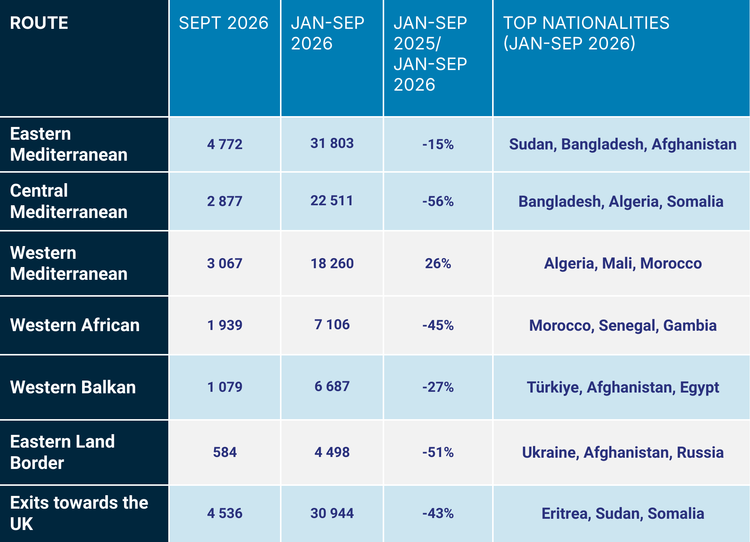
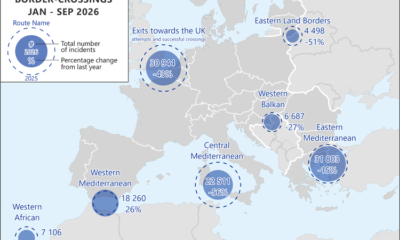
Irregular migration to the European Union declined on most major migratory routes in the first nine months of 2026, although crossings along the Western Mediterranean route increased by 26 per cent, according to figures released by the European Border and Coast Guard Agency (Frontex).
Data covering January to September 2026 showed that the Eastern Mediterranean route recorded the highest number of irregular border crossings, with 31,803 detections, representing a 15 per cent decrease compared with the same period in 2025.
The Central Mediterranean route followed with 22,511 detections, marking a 56 per cent decline, while the Western Mediterranean route recorded 18,260 crossings, an increase of 26 per cent.
The Western African route registered 7,106 crossings, down 45 per cent, while the Western Balkans recorded 6,687, representing a 27 per cent decrease.
Meanwhile, detections along the Eastern Land Border fell by 51 per cent to 4,498.
Exits towards the United Kingdom also declined, with 30,944 detections recorded during the nine-month period, a 43 per cent decrease compared with the corresponding period in 2025.
September figures
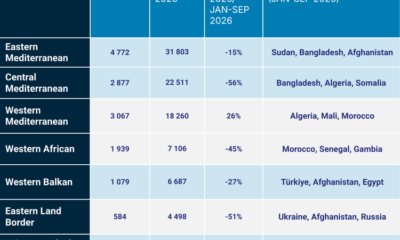
In September alone, the Eastern Mediterranean route recorded 4,772 irregular crossings, the highest among the routes monitored by Frontex.
The Western Mediterranean followed with 3,067 crossings, while the Central Mediterranean recorded 2,877.
The Western African route registered 1,939 crossings, compared with 1,079 along the Western Balkans and 584 at the Eastern Land Border.
Meanwhile, 4,536 exits towards the United Kingdom were recorded during the month.
Top nationalities
Sudanese, Bangladeshi and Afghan nationals were the leading nationalities detected along the Eastern Mediterranean route during the first nine months of 2026.
Bangladeshis, Algerians and Somalis topped the list along the Central Mediterranean route, while Algerians, Malians and Moroccans were the most frequently detected nationalities along the Western Mediterranean route.
On the Western African route, the leading nationalities were Moroccans, Senegalese and Gambians.
Turkish, Afghan and Egyptian nationals were the most frequently detected along the Western Balkans route, while Ukrainians, Afghans and Russians topped the list at the Eastern Land Border.
For exits towards the United Kingdom, Eritreans, Sudanese and Somalis were the leading nationalities.
The figures highlight the varying migration trends across Europe’s external borders, with most routes recording substantial declines while the Western Mediterranean experienced an increase during the period under review.

Congrès de Dakar : L’Afrique doit aller au-delà des traités sur la migration et passer à leur mise en œuvre effective – Expert juridique
Dakar congress: Africa must move beyond migration treaties to practical implementation- Legal expert

L’insécurité, facteur de déplacement forcé au Nigeria, affirme Angela Odah au congrès de Dakar sur les migrations

Insecurity driving forced displacement in Nigeria, Angela Odah tells Dakar migration congress

La loi égyptienne sur l’asile expose les réfugiés aux expulsions et aux violations de leurs droits – ONG
-
 News2 weeks ago
Sea-Watch condemns proposed EU plan to expand Frontex powers
-
 News3 weeks ago
Refugees continue protest at UNHCR centre in Niger’s Agadez
-

 Interviews2 days ago
Extraction des ressources, fardeau de la dette alimentant la migration forcée depuis l’Afrique, selon un journaliste lors du congrès de Dakar
-
 News Extra2 weeks ago
Sea-Watch renouvelle son appel à mettre fin au financement européen des garde-côtes libyens
-
News Extra2 weeks ago
Sea-Watch condamne le projet de l’UE visant à étendre les pouvoirs de Frontex
-
 Interviews2 days ago
Resource extraction, debt burden fuelling forced migration from Africa, journalist tells Dakar congress
-
 News Extra2 weeks ago
Frontex celebrates drop in irregular crossings into EU
-
 News Extra2 weeks ago
Western Mediterranean crossings rise by 26%