
Investigation
Over 5,000 migrants smuggled from Cuba via Serbia into EU for EUR9 000 per person

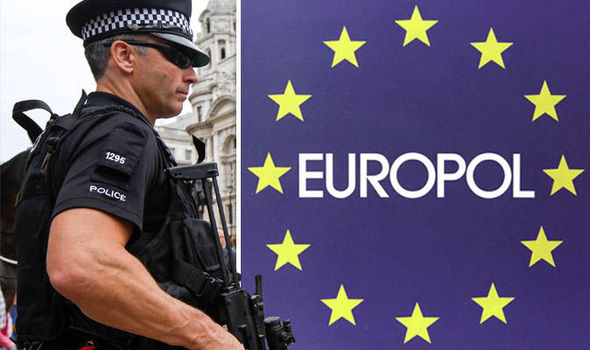
No fewer than 5,000 migrants have been smuggled from Cuba via Serbia into the European Union for EUR 9 000 per person. Europol disclosed this while announcing the arrest of transcontinental migrant smugglers.
Europol in a statement said : “law enforcement from five countries have disrupted an intercontinental criminal network smuggling migrants from Cuba to the European Union. The investigation, coordinated by Europol and INTERPOL, led to the arrest of 62 persons, 25 of which were Cuban nationals. Members of the migrant smuggling network used a well-known messaging application to advertise their illicit services to Cuban clients in vulnerable situations.
“ For a payment of around EUR 9 000, they would organise the trip, transfers, and provide false documentation. The criminals flew in persons from Cuba to Serbia, taking advantage of the lack of visa requirements to enter Serbia at the time. Migrants would then be smuggled to Greece, from where they flew into Spain. In total, it is suspected that the criminal network successfully smuggled around 5 000 Cuban nationals into the EU, generating a profit of around EUR 45 million.”
The investigation revealed a complex criminal infrastructure set up in many cities across Spain, Greece and in Serbia, flexible and able to adapt to changing circumstances in order to keep their illicit business going. On the action day in June 2023, police officers from all three countries seized a variety of criminal assets including hundreds of forged documents and forgery equipment. In total, 18 pieces of real estate, 33 vehicles and 144 bank accounts, alongside vast sums of cash in various currencies, were seized.
Unusually long and expensive smuggling route
The investigation was triggered in October 2021 after Serbian, Greek, North Macedonian and Finnish authorities reported an increased number of Cuban citizens attempting to enter Europe with falsified documentation. In January 2023, a Joint Intelligence Notification depicting this trend was issued by Europol, the European Union Agency for Asylum, and Frontex. The notification with the subject “Cuban nationals smuggled into the EU: shifting routes and modi operandi in a changed geo-political landscape” reported on the effect the Russian war of aggression in Ukraine had on migrant smuggling routes.
Initially, Cuban nationals used to fly commercially to Russia from Cuba. There, smugglers offered them the opportunity to either cross the Finnish-Russian border irregularly in order to enter EU territory, or to fly to Serbia to continue their journey into Central or Southern Europe through the Western Balkan region. Since the beginning of the war unleashed by Russia against Ukraine, the route was changed. Cuban nationals were flown to Serbia via Frankfurt airport, Germany. Upon the Cuban nationals’ arrival in Serbia, members of the criminal network would facilitate their irregular entry to North Macedonia and Greece by land. Using a variety of routes, the smugglers would direct large groups of migrants and make them walk in the dark without supplies for hours. In addition to these arduous conditions, the criminals would take advantage of the most vulnerable migrants, including minors, and subject them to scams, robberies, and extortion. In some cases, women were transferred to other criminal groups for sexual exploitation.
Upon their arrival in Greece, the migrants would either apply for asylum or use further transport to other EU countries organised by the criminals, such as flights to Spain or sea transport to Italy. In order to travel within the EU, the criminal network provided migrants with forged documents or utilised the so-called lookalike method, in which genuine travel documents are stolen and distributed to a migrant closely resembling the real passport holder.
—




.
- Come rain or shine, Patrick A. Njok, has been ensuring patients in need of essential medical care get to the hospital in time for two years as a driver with Médecins Sans Frontières (MSF). Patrick manoeuvres across remote and rural terrain in the Cross River region of southern Nigeria, an area where many communities, including an estimated 15,000 refugees from Cameroon, do not have clean water or phone service.
“I’m a driver by profession and I love the job. The primary aspect of my job is to drive emergency patients from the MSF facility to the referral hospital.”
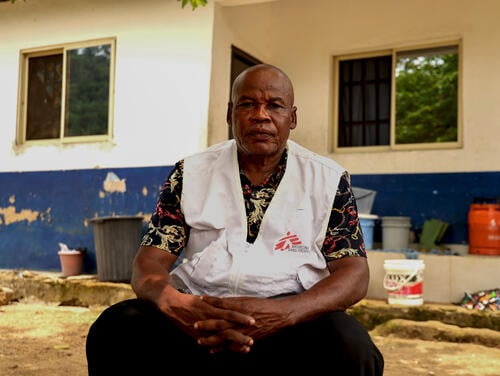
Patrick A. Njok, MSF driver, sits under a tree after driving through the long journey on a difficult terrain. Nigeria, April 2024.
While people can receive basic healthcare at MSF’s facilities in the area, more serious cases need to be referred to hospitals. That is where Patrick comes in, bringing patients to hospital no matter the obstacles on the road. He shares four challenges he often overcomes on his journeys.
1. Fallen trees
When rainy season comes, there are windstorms, and these knock down the trees. It can happen suddenly, even when you are already out on the road. The rain can come at any time.
If you don’t take a machete, a cutlass, or a chainsaw with you, you can end up getting blocked by the fallen trees until the villagers can help you remove them. This can seriously delay patients getting to hospitals, which can have potentially life-threatening consequences.
2. Muddy roads
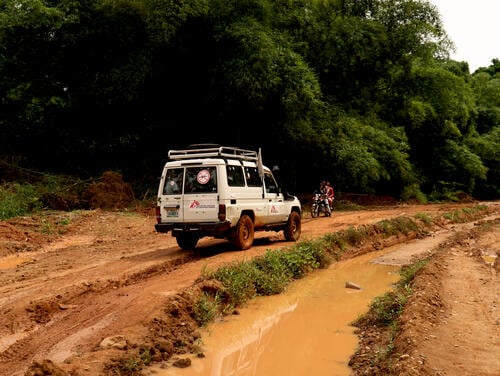
From May to October, when it is raining very heavily, the soil texture is very difficult to drive on. Hilly, muddy and slippery. I know some of my colleagues who have spent almost half of the day trying to dig out the car when we get stuck.
Even the off-road vehicles we use sometimes struggle in the mud and you become stuck, wheels spinning but not moving anywhere! We have to make sure all cars come with all-terrain tires and an electrical winch so that the driver can get himself out.
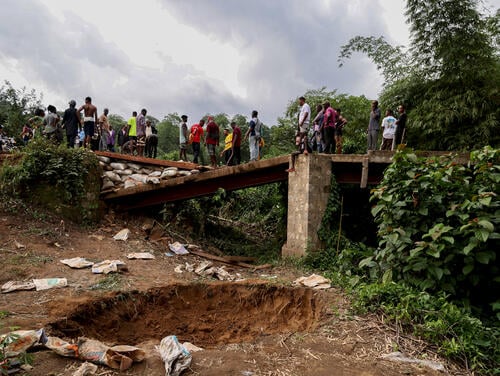
3. Broken bridges
Just today, two bridges have collapsed. These bridges were constructed in 1973, when I was still in primary school. To this date, those bridges are still the same ones we are driving over now.
These are simple wooden bridges, and you have vehicles that are crossing with a load of more than 30 tonnes. Sometimes when we drive over these delicate bridges, all the passengers have to get out and walk across to reduce weight.”
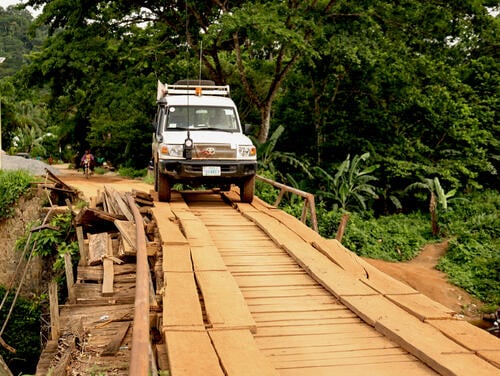
4. High cost of transportation
In the rainy season, the price of taxis and transportation goes up. It can be around four times more. If people don’t come to the clinic, then we cannot refer them, and I cannot drive them to other hospitals.
Drivers are often the number one advertiser for MSF, the vehicle is the first thing people see. I would encourage people to go to the MSF clinic. If you are sick, you come to the facility and MSF will treat you.

Official investigations into credible allegations that the Hellenic Coast Guard’s actions and omissions contributed to the shipwreck and loss of life off Pylos, Greece six months ago have made little meaningful progress, a report by Amnesty International says.
A full accounting of what happened is paramount to securing truth and justice for survivors and families of the victims and to help avoid future deaths.
Authorities should ensure that the allegations against Hellenic Coast Guard officers and other Greek officials are thoroughly investigated and prosecute any officials for whom there is sufficient evidence of wrongdoing.
(Athens, December 14, 2023) – Official investigations into credible allegations that the Hellenic Coast Guard’s actions and omissions contributed to the catastrophic shipwreck and loss of life off Pylos, Greece six months ago have made little meaningful progress, Amnesty International and Human Rights Watch said today.
The Adriana, a severely overcrowded fishing trawler, capsized in the early morning of June 14, 2023, leading to the death of more than 600 people. It had started its journey from Libya five days earlier with an estimated 750 migrants and asylum seekers, including children, mainly from Syria, Pakistan, and Egypt. Only 104 of those onboard survived, and 82 bodies were recovered.
“The Pylos shipwreck appears to be another tragic example of Greek authorities’ abdication of responsibility for saving lives at sea,” said Judith Sunderland, associate Europe and Central Asia director at Human Rights Watch. “A full accounting of what happened is paramount to securing truth and justice for survivors and families of the victims and to help avoid future deaths.”
Amnesty International and Human Rights Watch interviewed 21 survivors, 5 relatives of 5 people still missing, and representatives of the Hellenic Coast Guard, the Greek police, nongovernmental organizations, United Nations and international agencies and organizations.
They found that in the 15 hours between receiving the first alert that the Adriana was in their search-and-rescue region, and when it capsized, Greek authorities failed to mobilize appropriate resources for a rescue. The authorities were clearly aware of indicators of distress, such as overcrowding and insufficient food and water, on the Adriana, and, survivors said, knew about corpses on board and requests for rescue. Survivors’ testimonies also challenge the authorities’ claim that people on the Adriana did not want to be rescued, which in any event would not have relieved the Hellenic Coast Guard of its obligation to take all measures necessary to ensure safety at sea. Survivors consistently said that they pleaded repeatedly for rescue, including to the Coast Guard itself.
Survivors said that a Coast Guard patrol boat attached a rope to the Adriana and pulled, causing the boat to capsize. They also alleged that, after the boat capsized, the Coast Guard boat was slow to activate rescue operations, failed to maximize the number of people rescued, and engaged in dangerous maneuvers.
Among others, separate investigations by the independent group Solomon, the interdisciplinary investigative platform Forensis, the New York Times, Der Spiegel, El País, Lighthouse Reports, and the Washington Post documented similar allegations.
The nature of ongoing judicial investigations in Greece raises concerns about the prospects for accountability for the shipwreck, the organizations said. Nine survivors, currently under arrest, are facing serious charges before the Criminal Court of Kalamata in Greece, including for causing a shipwreck. In parallel, the Naval Court opened an investigation in June into the potential responsibility of the Coast Guard and in September, 40 survivors filed a complaint with the same court alleging that Greek authorities were responsible for the shipwreck. It is unclear how a finding by one court might affect the other.
Survivors’ testimony points to potential serious procedural shortcomings that might affect both investigations, including the confiscation of survivors’ mobile phones, some of which may contain key evidence of the events. The Naval Court prosecutor only in late September requested Hellenic Coast Guard officers’ phones, which could also contain evidence, and as of early December, only 13 survivors had been summoned to provide statements.
In November, the Greek Ombudsman opened an inquiry into the Coast Guard’s actions, citing its refusal to conduct an internal disciplinary investigation. The European Ombudsman opened an inquiry into the role of the EU border agency Frontex, whose aircraft initially sighted the vessel, while the agency’s Fundamental Rights Officer is pursuing his own investigation. In contributions to the European Ombudsman’s inquiry, Amnesty International and Human Rights Watch contend that Frontex should have continued its monitoring of the Adriana and issued a mayday call. Frontex told the organizations that it is the responsibility of national authorities to coordinate search and rescue operations and that it did not issue a mayday alert because it did not assess an “imminent risk to human life.”
The Greek Ministry of Maritime Affairs and Insular Policy replied to the organizations’ letters, saying that protecting human life at sea constitutes its “highest professional and moral obligation” and that the Coast Guard and the Joint Rescue Coordination Center Piraeus, abide by the legal and operational frameworks in place in search and rescue operations. However, citing ongoing judicial and nonjudicial investigations, the Coast Guard declined to answer the organizations’ questions or respond to their findings.
The historic failures in Greece’s investigations of shipwrecks involving people on the move and the widespread impunity for systemic human rights violations at its borders raise concerns about the adequacy of the ongoing judicial inquiries into the Pylos tragedy, Human Rights Watch and Amnesty International said. In 2022, the European Court of Human Rights condemned Greece for the shortcomings in its rescue efforts and in its subsequent investigations in the 2014 Farmakonisi shipwreck in which 11 people died.
“Almost 10 years since the deadly Farmakonisi shipwreck, the Greek authorities’ response to the Pylos tragedy is a crucial test of their willingness to investigate human rights violations against racialized people on the move at the country’s border,” said Adriana Tidona, migration researcher at Amnesty International. “Greece must ensure that survivors and families’ of the hundreds who lost their lives can safely and effectively participate in proceedings to the highest degree possible and ensure that investigations are carried out in a timely manner, guaranteeing the completeness and integrity of evidence admitted.”

The Malawian government is jeopardizing refugee rights at Dzaleka refugee camp by expelling an important refugee rights group, Human Rights Watch said in a report. INUA Advocacy had been providing independent scrutiny of the human rights situation at the camp, which is about 40 kilometers from Lilongwe, the capital.
The media reported that the Malawian Ministry of Homeland Security wrote to INUA Advocacy in November 2023 to terminate its partnership with the group, ordering it to vacate Dzaleka camp. The partnership had permitted INUA Advocacy to have offices within the camp.
“Malawi authorities should stop targeting those exposing abuses against refugees and advocating for refugee rights,” said Idriss Ali Nassah, senior Africa researcher at Human Rights Watch. “INUA Advocacy and other organizations demanding respect for human rights and accountability in the treatment of refugees should be allowed to operate without fear of being deregistered or targeted by the authorities.”
The chief executive officer of INUA Advocacy, Innocent Magambi, told Human Rights Watch that the Homeland Security Ministry did not give a reason for ending the partnership. He believes the authorities acted because of the organization’s advocacy around human rights violations that refugees and asylum seekers have suffered during and after the forced relocations to Dzaleka camp in 2023.
In May, the police, aided by the military, began rounding up thousands of refugees and asylum seekers across Malawi, temporarily detaining them in prisons, then relocating them to Dzaleka camp. This followed a March 27 government directive to enforce its encampment policy, which restricts the freedom of movement of refugees and asylum seekers by requiring them to live in the camp.
Some of those arrested reported beatings and destruction or theft of their property. INUA Advocacy and other groups published a statement in August demanding a halt to the forced relocations and deportations of refugees and asylum seekers. The groups called for accountability, including the arrest and prosecution of those involved in stealing or other abuses.
INUA Advocacy has also spotlighted the dire living conditions inside Dzaleka camp, which is run by the government with support from the United Nations Refugee Agency (UNHCR). In May, UNHCR had asked the authorities in Malawi to rescind the relocation decision, noting the insufficient health services, water, shelter, and sanitation facilities in the camp, as well as the overcrowded schools. UNHCR also noted that Dzaleka camp currently hosted more than 50,000 people, though it was originally designed for a capacity of 12,000.
In June, President Lazarus Chakwera committed to improving the living conditions and overall well-being of refugees in the country. The government also pledged to uphold human rights in its treatment of refugees and asylum seekers.
However, the hardships brought about by the encampment policy have resulted in some refugees opting to leave Malawi. In October, over 100 Burundians had left Malawi in what UNHCR said were voluntary repatriations. The community leader of the Burundian refugees told the media that some of those leaving had decided to do so due to limited resources at Dzaleka camp.
A 26-year-old Rwandan woman with two children, all recognized refugees, told Human Rights Watch that she and her husband, also a Rwandan refugee, had moved out of Dzaleka camp about eight years ago to set up a grocery shop and agriculture business in Lilongwe. When armed police raided their home in May during the enforcement of the encampment policy, the family lost their business and their home.
At Dzaleka camp, where the family arrived empty handed, she was separated from her husband and housed in a tent with her children and several other women. Her children, ages 5 and 7, are out of school because the classrooms in the camp are full.
Despite their destitute living situation, the woman said she had no option but to stay in Malawi, where she had lived virtually her entire life. She said she was only 3 years old when her mother fled Rwanda and brought her to Malawi.
“I don’t know anything about the country where I was born,” she said. “My mother died in this camp, leaving just my brother and me. So, tell me, where will I go? The authorities are saying we could return to our countries if we wish, but even if I returned to Rwanda, who would show me where to go? I don’t know anyone there and wouldn’t even know where to start from.”
Malawi is party to both the 1951 UN Refugee Convention and the 1969 OAU Refugee Convention. Malawi expressed reservations when it ratified the 1951 Convention, stating it considered certain provisions “as recommendations only and not legally binding,” including refugees’ rights to freedom of movement, employment, property, and public education.
Malawi is also party to the UN Convention on the Rights of the Child and the African Charter on the Rights and Welfare of the Child, both of which uphold the right of refugee children to an education as well as other rights.
In 2018, Malawi endorsed the UN Global Compact on Refugees, which builds on the Comprehensive Refugee Response Framework. These instruments recognize the importance of integrating refugees into the population and the respect for their socioeconomic rights, also highlighting that access to education and labor markets promotes refugee self-reliance and contributes to local economies.
Malawi’s 1989 Refugee Act provides for procedures to determine refugee status but does not address the rights of refugees. INUA Advocacy has lobbied for amending the law requiring refugees to live in the camp indefinitely and to enshrine refugees’ rights to freedom of movement, work, and education.
“The Malawian government should fulfill its expressed commitment to respect refugee rights and improve their living conditions, and not obstruct the important work of civil society groups defending these rights,” Nassah said. “The government should collaborate with local and international rights organizations, ensure their access to Dzaleka refugee camp, and end its encampment policy.”

Soudan : les attaques de drones perturbent les cours à El-Obeid, alerte le NRC

Sudan: Drone attacks disrupt school lessons in El Obeid- NRC

Sea-Watch secourt 227 migrants en Méditerranée en 48 heures

Sea-Watch rescues 227 migrants in Mediterranean within 48 hours

Un avocat ougandais exhorte l’UA à rejeter les accords migratoires avec l’Europe
-
 Features2 weeks ago
Gaza : Près de deux millions de personnes ont besoin d’une aide d’urgence en matière d’hébergement
-

 News Extra2 weeks ago
NACTAL conteste le rapport américain sur la traite des personnes et exige la reconnaissance des contributions des organisations de la société civile nigérianes
-
 News Extra2 weeks ago
Un avocat ougandais exhorte l’UA à rejeter les accords migratoires avec l’Europe
-
 News Extra1 week ago
Sudan: Drone attacks disrupt school lessons in El Obeid- NRC
-
 Features2 weeks ago
Nigerian immigrants face hidden mental health challenges despite success, expert warns
-
 Features2 weeks ago
Gaza: About two million need urgent shelter assistance
-

 News Extra2 weeks ago
NACTAL faults US trafficking report, demands recognition of Nigerian CSOs’ contributions
-

 News Extra2 weeks ago
US to deport fresh set of Nigerians over alleged criminal offences