
News
Harnessing the potential of remittance flows and diaspora investments for international development: more than $600 billion is sent home annually


-Despite the global economic turmoil triggered by the pandemic and ripple effects of the war in Ukraine, the hard-earned money sent by migrant workers to their families continues to be one of the most reliable sources of income for rural people in low and middle-income countries. Even in times of crisis, remittance flows have allowed people in developing countries to be resilient and even prosper. Last year, the money sent home exceeded US$600 billion annually, half of which went to poor rural areas.
“This phenomenon remains hidden in plain sight despite its magnitude and relevance to achieving the Sustainable Development Goals (SDGs). We know that the Official Development Assistance (ODA) and foreign direct investment to these countries is a smaller total amount than what migrants send to their loved ones back home,” says Pedro de Vasconcelos, Manager of the Financing Facility for Remittances at the UN’s International Fund for Agricultural Development (IFAD).
Co-organized by IFAD, the UN Office of the Special Adviser on Africa (OSAA), and the World Bank Group, the Global Forum on Remittances, Investment and Development (GFRID) sets out to change mindsets of stakeholders, to fully recognize and harness the enormous potential of remittances and diaspora investments towards achieving the SDGs.
Global experts will discuss how to make sending money home cheaper, safer and faster, as well as how to build bridges to facilitate diaspora investments in the countries of origin. The digital remittance revolution will be a hot topic in lead up to 2030, as digital channels offer a vast array of possibilities to connect remittance flows to rural finance. This means boosting access to savings, credit and insurance, basic financial products that can be life-changing in poor rural areas.
Launch of the new RemitSCOPE Africa outcome report
The 2023 GFRID Summit will have a special focus on Africa, where 17 of its 54 countries rely on remittances for at least 4 per cent of GDP. The new RemitSCOPE Africa outcome report will be launched at the Forum (14 June, 11.30-12.00). Compiling the most up-to-date and trusted remittance and remittance-related data across 54 countries in Africa, and covering up to 140 different indicators per country, the RemitScope Africa report looks at the drivers, trends, impact and potential of remittances, and provides background information on details such as migration, remittance flows, pricing trends, financial inclusion, access, and the competitive environment.
WHAT
Global Forum on Remittances, Investment and Development Summit– GFRID SUMMIT
Full agenda
WHEN
Wednesday, 14 June 2023, 09:00
WHERE
United Nations Complex (UNON), Gigiri, Nairobi, Kenya
WHO
Alvaro Lario, President of IFAD
Cristina Duarte, United Nations Secretary-General Special Adviser for Africa
Henriette Geiger, EU Ambassador to Kenya
Ugochi Daniels, Deputy Director General for Operations, IOM
Dr Patrick Ngugi Njoroge, Governor, Central Bank of Kenya
VIRTUAL
Webcast link will be sent on 13 June for journalists that have registered.
Media is kindly invited to cover the GFRID 2023 Summit. IFAD experts are available for interviews.
To facilitate access to the UN Complex, media houses are requested to RSVP to Linda Odhiambo l.odhiambo@ifad.org or 0780 320 073.
Journalists will be expected to present their Press cards at the gate to gain entry.
Media Alert No: IFAD/05/2023
IFAD is an international financial institution and a United Nations specialized agency. Based in Rome – the United Nations food and agriculture hub – IFAD invests in rural people, empowering them to reduce poverty, increase food security, improve nutrition and strengthen resilience. Since 1978, we have provided more than US$24 billion in grants and low-interest loans to fund projects in developing countries.





News
Des migrants égyptiens et d’autres nationalités portés disparus ou présumés morts après le naufrage d’une embarcation au large de la Libye

Des dizaines de migrants égyptiens et d’autres nationalités sont présumés morts ou portés disparus après le naufrage d’une embarcation au large des côtes libyennes, alors qu’ils tentaient de traverser la Méditerranée pour rejoindre l’Europe, selon des médias égyptiens.
L’embarcation aurait quitté la ville de Tobrouk, dans l’est de la Libye, jeudi soir, mais aurait commencé à sombrer quelques kilomètres seulement après son départ, poussant les passagers à lancer des appels de détresse.
Des sources citées par le journal égyptien Al-Masry Al-Youm ont indiqué que des vents violents et l’obscurité avaient entravé les opérations de sauvetage. Six personnes ont été secourues, tandis que le sort des autres passagers demeure inconnu.
Les équipes de recherche ont poursuivi leurs opérations le long des côtes libyennes afin de retrouver d’éventuels survivants, de localiser les migrants portés disparus et de récupérer les corps.
Le nombre exact de passagers à bord de l’embarcation ainsi que le bilan humain confirmé n’étaient pas immédiatement connus.
Selon le média, les migrants auraient rejoint la Libye par l’intermédiaire de réseaux de traite des êtres humains, qui les auraient retenus dans des entrepôts avant d’organiser leur traversée maritime vers l’Europe en échange d’argent.
Des habitants du village de Sindbis, situé dans le gouvernorat égyptien de Qalyubia, ont déclaré à Al-Masry Al-Youm qu’entre 22 et 27 jeunes hommes de leur localité auraient été à bord de l’embarcation. Des jeunes originaires de villages voisins auraient également participé à cette traversée.
Un habitant a indiqué que le groupe avait quitté le village environ un mois auparavant, en prenant un bus pour Alexandrie avant de poursuivre son voyage vers la Libye par voie maritime. Leurs familles auraient perdu tout contact avec eux plusieurs heures après leur embarquement.
La plupart des jeunes hommes portés disparus auraient moins de 20 ans et étaient à la recherche d’opportunités d’emploi à l’étranger, a ajouté cet habitant.
Ce nouveau naufrage met en évidence les dangers persistants auxquels sont confrontés les migrants qui tentent de rejoindre l’Europe par les voies migratoires irrégulières en Méditerranée depuis la Libye, où les traversées maritimes périlleuses et les réseaux de traite des êtres humains continuent d’exposer les migrants à l’exploitation et aux pertes en vies humaines.
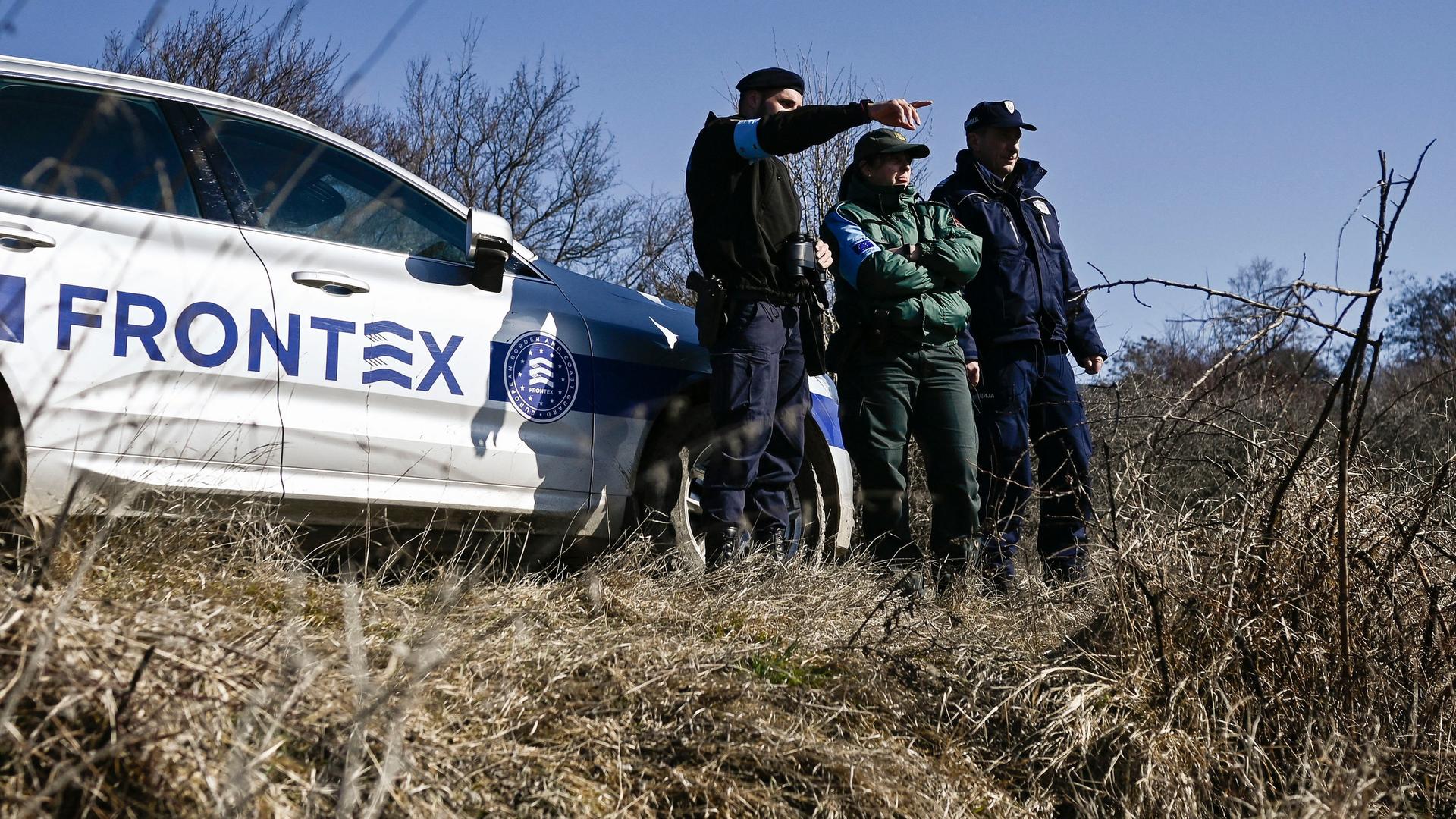
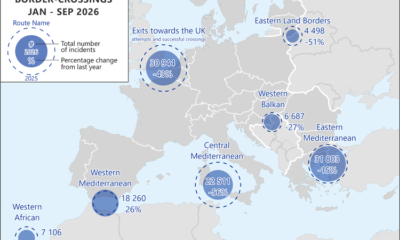
Les arrivées irrégulières dans l’Union européenne ont diminué sur la plupart des principales routes migratoires au cours des neuf premiers mois de 2026, bien que les traversées sur la route de la Méditerranée occidentale aient augmenté de 26 %, selon les chiffres publiés par l’Agence européenne de garde-frontières et de garde-côtes (Frontex).
Les données couvrant la période de janvier à septembre 2026 montrent que la route de la Méditerranée orientale a enregistré le plus grand nombre de franchissements irréguliers des frontières, avec 31 803 détections, soit une baisse de 15 % par rapport à la même période en 2025.
La route de la Méditerranée centrale arrive en deuxième position avec 22 511 détections, marquant une baisse de 56 %, tandis que celle de la Méditerranée occidentale a enregistré 18 260 traversées, soit une augmentation de 26 %.
La route de l’Afrique de l’Ouest a enregistré 7 106 traversées, en baisse de 45 %, tandis que celle des Balkans occidentaux a comptabilisé 6 687 franchissements, soit une diminution de 27 %.
Par ailleurs, les détections le long de la frontière terrestre orientale ont chuté de 51 %, pour s’établir à 4 498.
Les départs en direction du Royaume-Uni ont également diminué, avec 30 944 détections enregistrées au cours de cette période de neuf mois, soit une baisse de 43 % par rapport à la période correspondante en 2025.
Chiffres du mois de septembre
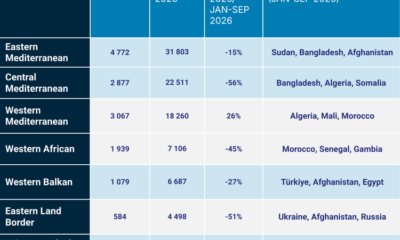
Pour le seul mois de septembre, la route de la Méditerranée orientale a enregistré 4 772 traversées irrégulières, le chiffre le plus élevé parmi les routes surveillées par Frontex.
La Méditerranée occidentale arrive ensuite avec 3 067 traversées, tandis que la Méditerranée centrale en a enregistré 2 877.
La route de l’Afrique de l’Ouest a comptabilisé 1 939 traversées, contre 1 079 dans les Balkans occidentaux et 584 à la frontière terrestre orientale.
Par ailleurs, 4 536 départs en direction du Royaume-Uni ont été enregistrés au cours du mois.
Principales nationalités
Les ressortissants soudanais, bangladais et afghans ont constitué les principales nationalités détectées sur la route de la Méditerranée orientale au cours des neuf premiers mois de 2026.
Sur la route de la Méditerranée centrale, les Bangladais, les Algériens et les Somaliens arrivaient en tête, tandis que les Algériens, les Maliens et les Marocains étaient les nationalités les plus fréquemment détectées sur la route de la Méditerranée occidentale.
Sur la route de l’Afrique de l’Ouest, les principales nationalités étaient les Marocains, les Sénégalais et les Gambiens.
Les ressortissants turcs, afghans et égyptiens étaient les plus fréquemment détectés sur la route des Balkans occidentaux, tandis que les Ukrainiens, les Afghans et les Russes arrivaient en tête à la frontière terrestre orientale.
Concernant les départs vers le Royaume-Uni, les Érythréens, les Soudanais et les Somaliens constituaient les principales nationalités recensées.
Ces chiffres mettent en évidence les différentes tendances migratoires aux frontières extérieures de l’Europe. Alors que la plupart des routes ont enregistré des baisses importantes, la Méditerranée occidentale a connu une augmentation des traversées au cours de la période étudiée.
Sea-Watch, a German-based sea rescue organisation, has criticised a proposed European Union regulation to expand the powers and operations of Frontex, warning that the plan could increase border violence, surveillance and deportations of migrants and asylum seekers.
In a series of posts on X on October 27, the organisation condemned the proposal presented by the European Commission and European Commissioner for Migration, Magnus Brunner, arguing that it would transform Frontex, the EU border agency, into a more powerful force capable of pushing back people seeking international protection, including beyond EU borders.
Sea-Watch said the proposed regulation would significantly expand Frontex’s operations through the deployment of more armed border officials, increased surveillance and expanded deportation activities.
The organisation also raised concerns over the financial implications of the proposal, stating that the European Commission intends to allocate €12 billion to Frontex between 2028 and 2034.
It contrasted the proposed funding with the €26 million allocated annually to the EU Agency for Fundamental Rights, arguing that the spending priorities placed greater emphasis on border enforcement than on protecting people’s rights and welfare.
Sea-Watch further criticised the language used by the European Commission to justify the proposed changes, particularly references to external threats, security crises and dangerous migration.
According to the organisation, such descriptions reflect narratives promoted by far-right political movements and parties, which it said are increasingly influencing EU migration policies.
The rescue organisation also recalled allegations of human rights violations involving Frontex, including illegal pushbacks and cooperation with Libyan actors accused of crimes against humanity.
It noted that a case concerning Frontex’s alleged role in pushbacks to Libya is currently before the Court of Justice of the European Union.
Sea-Watch argued that security should not be defined solely by border protection and migration control, but should also include affordable housing, functioning public services, freedom from violence and respect for fundamental rights.
” We must not sacrifice human rights in the name of protecting them,” the organisation said.
It stressed that the proposed regulation has not yet become law, as negotiations are expected to take place between the European Parliament and the Council of the European Union.
However, Sea-Watch warned that increasing border controls, surveillance and deportations would not create a safer or more inclusive Europe.
The organisation called for opposition to the proposed expansion of Frontex’s powers, reiterating its campaign slogan, #AbolishFrontex.

Extraction des ressources, fardeau de la dette alimentant la migration forcée depuis l’Afrique, selon un journaliste lors du congrès de Dakar

Resource extraction, debt burden fuelling forced migration from Africa, journalist tells Dakar congress

Des migrants égyptiens et d’autres nationalités portés disparus ou présumés morts après le naufrage d’une embarcation au large de la Libye

Egyptian migrants, others feared dead, missing after boat sinks off Libya

Les traversées en Méditerranée occidentale augmentent de 26 %
-
 News2 weeks ago
Sea-Watch condemns proposed EU plan to expand Frontex powers
-

 News3 weeks ago
Refugees continue protest at UNHCR centre in Niger’s Agadez
-
 News Extra2 weeks ago
Sea-Watch renouvelle son appel à mettre fin au financement européen des garde-côtes libyens
-
News Extra2 weeks ago
Sea-Watch condamne le projet de l’UE visant à étendre les pouvoirs de Frontex
-
 News Extra2 weeks ago
Frontex celebrates drop in irregular crossings into EU
-
 News3 weeks ago
Jeff Crisp questions IOM’s involvement in US third-country deportation programme
-
 News Extra2 weeks ago
Western Mediterranean crossings rise by 26%
-

 News Extra2 weeks ago
Sea-Watch renews calls to end EU funding for Libyan Coast Guard