Interviews
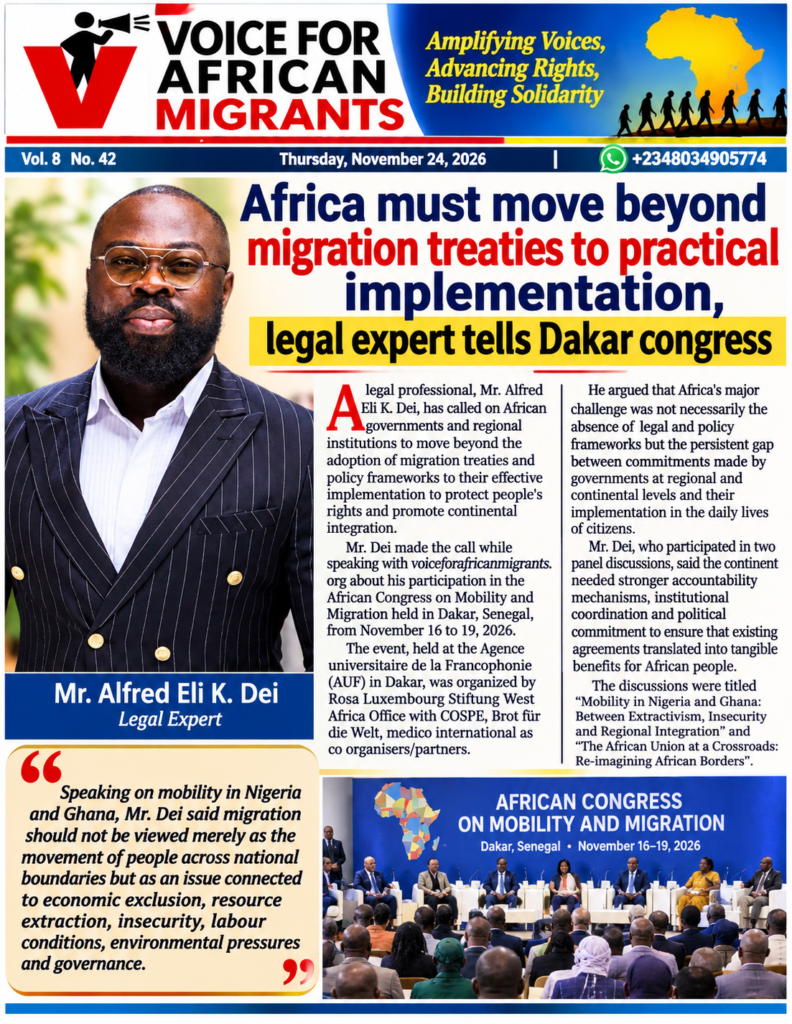
Dakar congress: Africa must move beyond migration treaties to practical implementation- Legal expert

A legal professional, Mr. Alfred Eli K. Dei, has called on African governments and regional institutions to move beyond the adoption of migration treaties and policy frameworks to their effective implementation to protect people’s rights and promote continental integration.
Mr. Dei made the call while speaking with voiceforafricanmigrants.org about his participation in the African Congress on Mobility and Migration held in Dakar, Senegal, from November 16 to 19, 2026.
The event, held at the Agence universitaire de la Francophonie (AUF) in Dakar, was organized by Rosa Luxembourg Stiftung West Africa Office with COSPE, Brot für die Welt, medico international as co organisers/partners.
He argued that Africa’s major challenge was not necessarily the absence of legal and policy frameworks but the persistent gap between commitments made by governments at regional and continental levels and their implementation in the daily lives of citizens.
Mr. Dei, who participated in two panel discussions, said the continent needed stronger accountability mechanisms, institutional coordination and political commitment to ensure that existing agreements translated into tangible benefits for African people.
The discussions were titled “Mobility in Nigeria and Ghana: Between Extractivism, Insecurity and Regional Integration” and “The African Union at a Crossroads: Re-imagining African Borders”.
Speaking on mobility in Nigeria and Ghana, Mr. Dei said migration should not be viewed merely as the movement of people across national boundaries but as an issue connected to economic exclusion, resource extraction, insecurity, labour conditions, environmental pressures and governance.
He explained that in both countries, economic hardship, livelihood insecurity, conflict and the consequences of resource exploitation were among the factors influencing people’s decisions to move.
From a legal perspective, he said these challenges raised questions about state responsibility, protection of migrant workers and vulnerable communities, access to justice and accountability where corporate or government activities contributed to displacement or livelihood losses

The legal expert also highlighted the importance of the Economic Community of West African States (ECOWAS) framework on free movement, particularly the 1979 Protocol on the Free Movement of Persons, Residence and Establishment.
He, however, warned that the benefits of the protocol were undermined by border restrictions, inconsistent administrative practices, insecurity and weak enforcement.
According to him, regional integration should not be measured merely by the existence of agreements but by whether ordinary citizens can effectively enjoy the rights and opportunities guaranteed by them.
On the future of African borders, Mr. Dei said there was a need to distinguish between protecting the territorial integrity and sovereignty of African states and maintaining restrictive practices that perpetuate economic fragmentation and restrict the movement of people.
He noted that the African Union’s Constitutive Act, the African Continental Free Trade Area (AfCFTA), the AU Protocol on Free Movement of Persons and the Niamey Convention on Cross-Border Cooperation provided important foundations for continental integration.
However, he observed that the AU Free Movement Protocol continued to face ratification challenges, while effective cross-border cooperation required national legislation, institutional coordination, administrative capacity and political commitment.
He urged African governments to move beyond declarations and treaty adoption towards measurable implementation and stronger mechanisms for monitoring compliance.
“Re-imagining African borders should not mean erasing the boundaries of sovereign states; rather, it should mean transforming borders from barriers to human and economic development into gateways for trade, cooperation, opportunity and shared prosperity,” he said.
Reflecting on the four-day congress, Mr. Dei described it as an intellectually engaging platform that brought together experts and stakeholders from different African regions and professional backgrounds, including lawyers, academics, civil society organisations, journalists, social movements and people directly affected by migration policies.
He said the discussions demonstrated that migration could not be adequately understood without considering colonial legacies, international power relations, extractivism, labour exploitation, climate change, racialisation and the externalisation of border control.
He also welcomed the congress’s emphasis on African-centred research, advocacy and knowledge production, as well as its inclusion of feminist perspectives, student engagements and interactions with Senegalese civil society organisations.
According to him, such engagements were important in ensuring that migration policies reflected the lived experiences of affected communities rather than being limited to government and institutional perspectives.
One of the major outcomes he identified was the proposal to establish an informal network on migration and mobility to sustain discussions, deepen collaboration and translate shared analysis into coordinated advocacy and practical action.
Mr. Dei stressed that the African Union, Regional Economic Communities and national governments must strengthen implementation mechanisms for existing human rights, refugee protection, internal displacement, free movement, cross-border cooperation and economic integration frameworks.
He said this would require adequate funding, harmonisation of national laws, institutional coordination, accessible remedies and consistent monitoring of compliance.
“The task before us is not merely to develop more frameworks, but to ensure that the frameworks we already have work for the people they were designed to serve,” he said.
He added that Africa could not achieve meaningful continental integration while its citizens continued to face unnecessary restrictions on movement, border communities remained marginalised and the economic and political conditions driving displacement were left inadequately addressed.