Features
Sierra Leonean activist decries govt’s secretive third-country deportation agreements

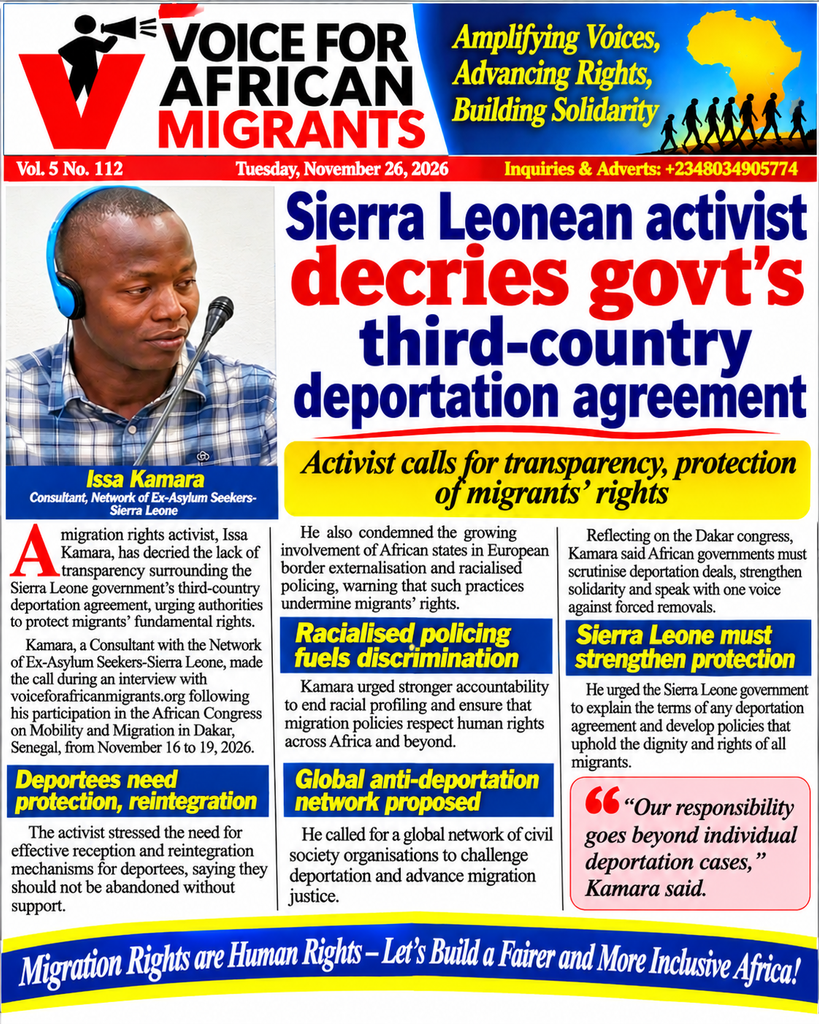
A migration rights activist, Issa Kamara, has criticised the lack of transparency and accountability surrounding third-country deportation arrangements involving African countries and the United States, calling on governments to ensure that migrants’ fundamental rights are protected.
Kamara, a Consultant with the Network of Ex-Asylum Seekers-Sierra Leone, raised the concerns during an interview with voiceforafricanmigrants.org following his participation in the African Congress on Mobility and Migration held in Dakar, Senegal, from November 16 to 19, 2026.
The congress was held at the Agence universitaire de la Francophonie (AUF) in Dakar. It was organised by the Rosa Luxemburg Stiftung West Africa Office, with COSPE, Brot für die Welt and medico international as co-organisers and partners.
Speaking with voiceforafricanmigrants.org, Kamara expressed particular concern about the Sierra Leone government’s handling of a deportation agreement, alleging that the authorities had failed to adequately explain its terms and implications to the public or provide a proper account of the arrangement.
According to him, the absence of transparency and meaningful consultation with civil society organisations raises serious questions about government accountability, national sovereignty and the protection of people transferred to countries of which they may not be nationals.
Kamara spoke against the backdrop of discussions at the congress, particularly a panel session held on Tuesday, November 17, under the theme, “Anti-Deportation Struggles and Racialised Policing in Africa and Beyond.”
The session brought together civil society representatives and migration activists from different African countries to examine deportation practices, migration control, European border externalisation and racial discrimination against migrants.
He explained that the interactive discussion provided participants with an opportunity to share experiences and examine the challenges confronting organisations involved in migration justice and human rights advocacy.
Kamara noted that anti-deportation activism should not be limited to challenging individual deportation cases but must also address the wider political and institutional structures that expose migrants to discrimination, detention, forced removal and restrictions on freedom of movement.
Deportees need protection and reintegration support
On the treatment of deportees, the Sierra Leonean activist stressed the need for African governments to establish effective reception and reintegration mechanisms for people returned from foreign countries.
He said deportees should not simply be received and abandoned without adequate assistance, noting that many returnees require psychosocial support, legal assistance and sustainable reintegration programmes to rebuild their lives.
He argued that governments must recognise the immediate and long-term challenges faced by deported migrants and develop policies that protect their dignity and fundamental human rights.
European border externalisation raises concerns
Kamara also highlighted concerns about the growing involvement of African governments in implementing European migration control policies, sometimes at the expense of migrants’ rights and freedom of movement.
He recalled contributions from a Senegalese civil society activist who questioned Frontex-supported migration-control training for Senegalese police officers.
Similarly, a participant from The Gambia raised concerns about reported restrictions on access to certain beaches after 7 p.m., allegedly involving security personnel associated with Frontex-related activities.
Kamara said the contributions demonstrated the need for African countries to scrutinise their partnerships with European migration-control institutions and ensure that such arrangements do not undermine citizens’ rights.
He also said participants questioned the role of the International Organization for Migration (IOM) in implementing voluntary return programmes.
According to him, some activists argued that such initiatives could indirectly advance the European Union’s migration-control agenda by discouraging migrants from reaching Europe.
The discussions, he explained, raised questions about whether migrants can genuinely make free and informed decisions to return when they are operating under restrictive migration conditions.
Racialised policing and discrimination against migrants
Another major issue discussed was the discriminatory treatment of people of colour and migrant communities by law enforcement authorities in Europe, America and North Africa.
Kamara recalled the contribution of an activist living in Spain who shared personal experiences of repeated harassment and what he described as unjustified encounters with Spanish police officers.
He said the experience illustrated how racialised policing extends beyond border enforcement into the everyday lives of migrants and other racialised communities.
He stressed the need for stronger accountability mechanisms to address racial profiling, discrimination and police misconduct.
The panel also examined the political and legal implications of migration-related terms such as deportation, expulsion, removal and voluntary return.
Participants emphasised that the terminology used by governments and migration institutions must not conceal coercive practices or misrepresent the circumstances surrounding migrants’ return.
Activists propose global anti-deportation network
Kamara further disclosed that a Germany-based Nigerian civil society activist, Mr. Rex Osa challenged participants to move beyond identifying common problems and develop practical strategies for addressing deportation and other migration-related injustices.
Rex proposed the establishment of a global network of civil society organisations working on migration justice and anti-deportation campaigns.
He called for stronger cooperation among organisations across different countries to develop common advocacy strategies and hold both sending and receiving governments accountable.
He also advocated the creation of platforms that would enable young activists to participate meaningfully in migration justice campaigns and decision-making processes.

According to Kamara, Rex emphasised that experienced activists must trust younger generations, provide them with opportunities and encourage their contributions to the movement.
The Nigerian activist also called for expanded awareness campaigns in both migrants’ countries of origin and destination, stressing the importance of involving migrants directly in advocacy discussions.
He argued that migration policies and advocacy initiatives would be more effective when informed by the lived experiences of migrants rather than being driven exclusively by institutional and organisational perspectives.
Sierra Leone must strengthen protection for deportees
Reflecting on his participation, Kamara said the congress provided an important opportunity to exchange experiences with activists and civil society organisations confronting similar migration challenges across Africa.
He said one of his major takeaways was the need for African governments to critically examine their growing involvement in European migration-control strategies, particularly where such partnerships are implemented without transparency, accountability and adequate safeguards for migrants’ rights.
He added that the discussions were particularly relevant to Sierra Leone, where civil society organisations continue to advocate stronger policies to protect the fundamental rights of deported individuals.
Kamara called on migration-focused civil society organisations in Africa and beyond to strengthen solidarity, coordinate their advocacy efforts and speak with one voice against forced deportations, discriminatory policing and restrictive migration policies.
He maintained that the struggle against deportation cannot be separated from the broader campaign against racialised border regimes, the criminalisation of human mobility and discriminatory law enforcement practices.
“Our responsibility goes beyond responding to individual deportation cases; it also requires confronting the structural policies, political arrangements and systems of power that make these injustices possible,” he said in his reflections.
He urged civil society organisations to work collectively towards ending human rights violations against migrants and ensuring that governments respect their obligations to protect human dignity.
Kamara expressed appreciation to medico international for supporting and facilitating his participation in the conference.