
News
366 Nigerians deported from Canada in 10 months

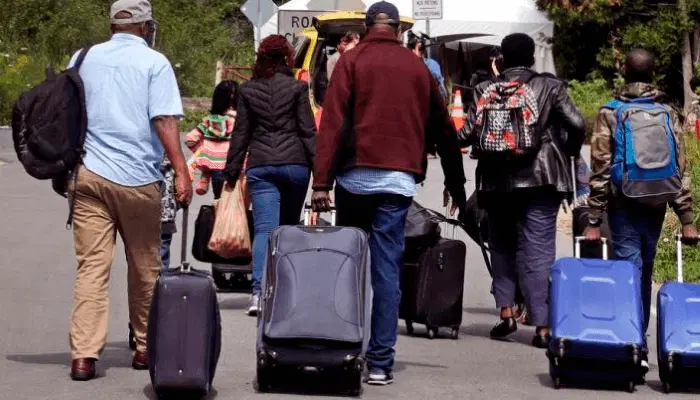
A total of 366 Nigerians were deported from Canada in the first 10 months of 2025- between January and October as immigration authorities intensified enforcement at a pace not seen in more than a decade.
The information is according to official data obtained over the weekend.
Figures from the Canada Border Services Agency (CBSA) removals programme also show that 974 Nigerians are currently listed under “removal in progress,” indicating they are awaiting deportation.
The statistics, last updated on November 25, 2025, placed Nigeria ninth among the top 10 nationalities deported from Canada during the period under review. Nigeria also ranked fifth among countries with the highest number of individuals awaiting removal.
Historical data revealed fluctuating deportation numbers over recent years. In 2019, Canada removed 339 Nigerians, a figure that declined to 302 in 2020, 242 in 2021, and 199 in 2022. Nigeria did not appear among the top 10 deported nationalities in 2023 and 2024 but re-entered the list in 2025, with 366 removals recorded within just 10 months—an increase of eight per cent compared with 2019.
The removals are occurring amid a broader immigration enforcement push by Canadian authorities. The CBSA is now deporting nearly 400 foreign nationals each week, marking the highest weekly removal rate in over a decade. In the 2024–2025 fiscal year alone, Canada removed 18,048 individuals, spending about $78m on the exercise.
Under the Immigration and Refugee Protection Act, the CBSA is required by law to remove any foreign national subject to an enforceable removal order. Individuals may be deemed inadmissible on several grounds, including security concerns, human or international rights violations, criminal activity, organised crime, health or financial reasons, misrepresentation and failure to comply with immigration regulations.
Data show that failed refugee claimants make up the bulk of removals, accounting for approximately 83 per cent of cases. Criminality-related removals represent about four per cent.
Canadian law recognises three categories of removal orders: departure orders, which mandate exit within 30 days; exclusion orders, which prohibit re-entry for one to five years; and deportation orders, which permanently bar return unless special authorisation is granted.
The Canadian government has said the intensified deportation drive is part of efforts to meet tighter immigration targets and respond to challenges such as housing shortages, labour market strain, and border security concerns. To support this, Ottawa has earmarked an additional $30.5m over three years for removals, alongside a $1.3bn commitment to strengthen border security.
President of the Canadian Association of Refugee Lawyers, Aisling Bondy, warned that deportations could increase further if Bill C-12—commonly referred to as the ‘border bill’—is passed.
“One of the clauses in that bill is that a lot of people will be permanently banned from filing a refugee claim in Canada,” Bondy said.
An analysis of CBSA data indicated that Nigeria is the only African country listed among the top 10 nationalities deported in 2025. Other African countries fall under the category of “remaining nationals,” which together accounted for 6,233 removals during the year.
The top 10 countries for deportations in 2025 are Mexico (3,972), India (2,831), Haiti (2,012), Colombia (737), Romania (672), the United States (656), Venezuela (562), China (385), Nigeria (366), and Pakistan (359).
A similar pattern appears in the removal-in-progress inventory, where Nigeria, with 974 individuals awaiting deportation, is again the only African country in the top 10. India leads the list with 6,515 cases, followed by Mexico (4,650), the United States (1,704), China (1,430), Nigeria (974), Colombia (895), Pakistan (863), Haiti (741), Brazil (650), and Chile (621).
Despite the rising deportation figures, Canada remains a major destination for Nigerians seeking improved economic and educational opportunities. The 2021 Canadian census showed that more than 40,000 Nigerians migrated to Canada between 2016 and 2021, making them the fifth-largest group of recent immigrants and the largest African migrant population in the country.
Further data from Immigration, Refugees and Citizenship Canada revealed that 6,600 Nigerians became new permanent residents within the first four months of 2024 alone, ranking them fourth after India, the Philippines, and China. Between 2005 and 2024, a total of 71,459 Nigerians acquired Canadian citizenship, placing Nigeria 10th among countries of origin for new Canadian citizens.
Canada’s ageing population and persistent labour shortages continue to make the country an attractive option for skilled Nigerian professionals and students, even as immigration enforcement tightens.










News
Des migrants égyptiens et d’autres nationalités portés disparus ou présumés morts après le naufrage d’une embarcation au large de la Libye

Des dizaines de migrants égyptiens et d’autres nationalités sont présumés morts ou portés disparus après le naufrage d’une embarcation au large des côtes libyennes, alors qu’ils tentaient de traverser la Méditerranée pour rejoindre l’Europe, selon des médias égyptiens.
L’embarcation aurait quitté la ville de Tobrouk, dans l’est de la Libye, jeudi soir, mais aurait commencé à sombrer quelques kilomètres seulement après son départ, poussant les passagers à lancer des appels de détresse.
Des sources citées par le journal égyptien Al-Masry Al-Youm ont indiqué que des vents violents et l’obscurité avaient entravé les opérations de sauvetage. Six personnes ont été secourues, tandis que le sort des autres passagers demeure inconnu.
Les équipes de recherche ont poursuivi leurs opérations le long des côtes libyennes afin de retrouver d’éventuels survivants, de localiser les migrants portés disparus et de récupérer les corps.
Le nombre exact de passagers à bord de l’embarcation ainsi que le bilan humain confirmé n’étaient pas immédiatement connus.
Selon le média, les migrants auraient rejoint la Libye par l’intermédiaire de réseaux de traite des êtres humains, qui les auraient retenus dans des entrepôts avant d’organiser leur traversée maritime vers l’Europe en échange d’argent.
Des habitants du village de Sindbis, situé dans le gouvernorat égyptien de Qalyubia, ont déclaré à Al-Masry Al-Youm qu’entre 22 et 27 jeunes hommes de leur localité auraient été à bord de l’embarcation. Des jeunes originaires de villages voisins auraient également participé à cette traversée.
Un habitant a indiqué que le groupe avait quitté le village environ un mois auparavant, en prenant un bus pour Alexandrie avant de poursuivre son voyage vers la Libye par voie maritime. Leurs familles auraient perdu tout contact avec eux plusieurs heures après leur embarquement.
La plupart des jeunes hommes portés disparus auraient moins de 20 ans et étaient à la recherche d’opportunités d’emploi à l’étranger, a ajouté cet habitant.
Ce nouveau naufrage met en évidence les dangers persistants auxquels sont confrontés les migrants qui tentent de rejoindre l’Europe par les voies migratoires irrégulières en Méditerranée depuis la Libye, où les traversées maritimes périlleuses et les réseaux de traite des êtres humains continuent d’exposer les migrants à l’exploitation et aux pertes en vies humaines.

Les arrivées irrégulières dans l’Union européenne ont diminué sur la plupart des principales routes migratoires au cours des neuf premiers mois de 2026, bien que les traversées sur la route de la Méditerranée occidentale aient augmenté de 26 %, selon les chiffres publiés par l’Agence européenne de garde-frontières et de garde-côtes (Frontex).
Les données couvrant la période de janvier à septembre 2026 montrent que la route de la Méditerranée orientale a enregistré le plus grand nombre de franchissements irréguliers des frontières, avec 31 803 détections, soit une baisse de 15 % par rapport à la même période en 2025.
La route de la Méditerranée centrale arrive en deuxième position avec 22 511 détections, marquant une baisse de 56 %, tandis que celle de la Méditerranée occidentale a enregistré 18 260 traversées, soit une augmentation de 26 %.
La route de l’Afrique de l’Ouest a enregistré 7 106 traversées, en baisse de 45 %, tandis que celle des Balkans occidentaux a comptabilisé 6 687 franchissements, soit une diminution de 27 %.
Par ailleurs, les détections le long de la frontière terrestre orientale ont chuté de 51 %, pour s’établir à 4 498.
Les départs en direction du Royaume-Uni ont également diminué, avec 30 944 détections enregistrées au cours de cette période de neuf mois, soit une baisse de 43 % par rapport à la période correspondante en 2025.
Chiffres du mois de septembre
Pour le seul mois de septembre, la route de la Méditerranée orientale a enregistré 4 772 traversées irrégulières, le chiffre le plus élevé parmi les routes surveillées par Frontex.
La Méditerranée occidentale arrive ensuite avec 3 067 traversées, tandis que la Méditerranée centrale en a enregistré 2 877.
La route de l’Afrique de l’Ouest a comptabilisé 1 939 traversées, contre 1 079 dans les Balkans occidentaux et 584 à la frontière terrestre orientale.
Par ailleurs, 4 536 départs en direction du Royaume-Uni ont été enregistrés au cours du mois.
Principales nationalités
Les ressortissants soudanais, bangladais et afghans ont constitué les principales nationalités détectées sur la route de la Méditerranée orientale au cours des neuf premiers mois de 2026.
Sur la route de la Méditerranée centrale, les Bangladais, les Algériens et les Somaliens arrivaient en tête, tandis que les Algériens, les Maliens et les Marocains étaient les nationalités les plus fréquemment détectées sur la route de la Méditerranée occidentale.
Sur la route de l’Afrique de l’Ouest, les principales nationalités étaient les Marocains, les Sénégalais et les Gambiens.
Les ressortissants turcs, afghans et égyptiens étaient les plus fréquemment détectés sur la route des Balkans occidentaux, tandis que les Ukrainiens, les Afghans et les Russes arrivaient en tête à la frontière terrestre orientale.
Concernant les départs vers le Royaume-Uni, les Érythréens, les Soudanais et les Somaliens constituaient les principales nationalités recensées.
Ces chiffres mettent en évidence les différentes tendances migratoires aux frontières extérieures de l’Europe. Alors que la plupart des routes ont enregistré des baisses importantes, la Méditerranée occidentale a connu une augmentation des traversées au cours de la période étudiée.
Sea-Watch, a German-based sea rescue organisation, has criticised a proposed European Union regulation to expand the powers and operations of Frontex, warning that the plan could increase border violence, surveillance and deportations of migrants and asylum seekers.
In a series of posts on X on October 27, the organisation condemned the proposal presented by the European Commission and European Commissioner for Migration, Magnus Brunner, arguing that it would transform Frontex, the EU border agency, into a more powerful force capable of pushing back people seeking international protection, including beyond EU borders.
Sea-Watch said the proposed regulation would significantly expand Frontex’s operations through the deployment of more armed border officials, increased surveillance and expanded deportation activities.
The organisation also raised concerns over the financial implications of the proposal, stating that the European Commission intends to allocate €12 billion to Frontex between 2028 and 2034.
It contrasted the proposed funding with the €26 million allocated annually to the EU Agency for Fundamental Rights, arguing that the spending priorities placed greater emphasis on border enforcement than on protecting people’s rights and welfare.
Sea-Watch further criticised the language used by the European Commission to justify the proposed changes, particularly references to external threats, security crises and dangerous migration.
According to the organisation, such descriptions reflect narratives promoted by far-right political movements and parties, which it said are increasingly influencing EU migration policies.
The rescue organisation also recalled allegations of human rights violations involving Frontex, including illegal pushbacks and cooperation with Libyan actors accused of crimes against humanity.
It noted that a case concerning Frontex’s alleged role in pushbacks to Libya is currently before the Court of Justice of the European Union.
Sea-Watch argued that security should not be defined solely by border protection and migration control, but should also include affordable housing, functioning public services, freedom from violence and respect for fundamental rights.
” We must not sacrifice human rights in the name of protecting them,” the organisation said.
It stressed that the proposed regulation has not yet become law, as negotiations are expected to take place between the European Parliament and the Council of the European Union.
However, Sea-Watch warned that increasing border controls, surveillance and deportations would not create a safer or more inclusive Europe.
The organisation called for opposition to the proposed expansion of Frontex’s powers, reiterating its campaign slogan, #AbolishFrontex.

Des migrants égyptiens et d’autres nationalités portés disparus ou présumés morts après le naufrage d’une embarcation au large de la Libye

Egyptian migrants, others feared dead, missing after boat sinks off Libya

Les traversées en Méditerranée occidentale augmentent de 26 %

Western Mediterranean crossings rise by 26%
Frontex se félicite de la baisse des franchissements irréguliers aux frontières de l’UE
-

 News Extra2 weeks ago
IOM’s Displacement Tracking Matrix monitors 97.2 million people in 2025
-

 News Extra1 week ago
SOS Humanity accuses Frontex of aiding migrant pushbacks to Libya
-

 News2 weeks ago
Libya repatriates hundreds of migrants, deploys reinforcements to Tobruk
-
News2 weeks ago
Libye : des centaines de migrants rapatriés, des renforts déployés à Tobrouk
-
 News2 days ago
Sea-Watch condemns proposed EU plan to expand Frontex powers
-

 News Extra2 weeks ago
La Matrice de suivi des déplacements de l’OIM a suivi 97,2 millions de personnes en 2025
-
 News2 weeks ago
Ebola:DRC confirms 10,000 cases, NRC seeks scale-up
-

 Features2 weeks ago
League of Arab States, IOM launch Arab Migration Data Network