Features
Externalisation of borders: Latin American activist Paulo Illes calls for global alliance to defend migrants

The President of the No Borders Network, Paulo Illes, has called for the creation of an international alliance against the externalisation of borders, warning that governments across the world are increasingly shifting migration-control responsibilities beyond their own territories.
Illes made the call while speaking at the just-concluded World Social Forum held in Benin Republic.

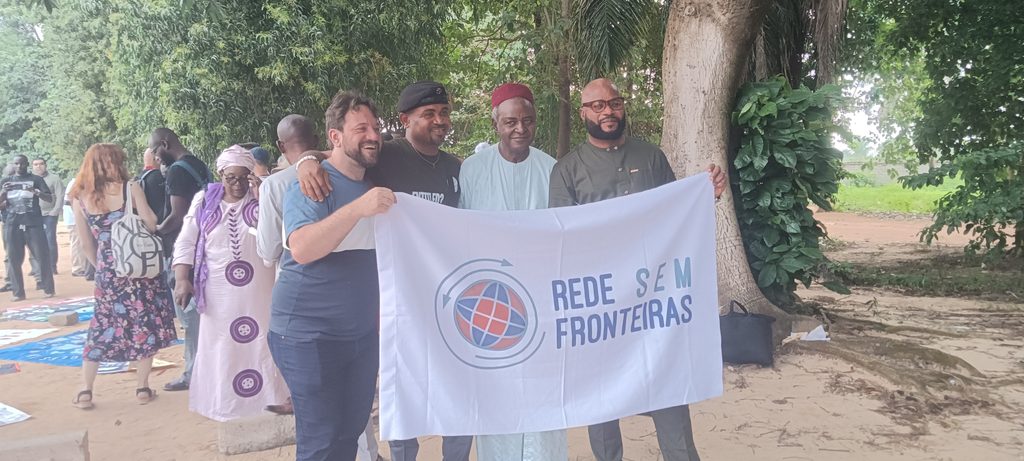
He featured on a panel discussion on the externalisation of borders.
Illes presented the Latin American perspective on migration governance and its implications for Africa, Latin America and Europe.
He said although migration routes differed across regions, countries were experiencing a similar political trend involving the expansion of policies designed to prevent migrants from reaching their intended destinations.
According to him, the growing globalisation of border externalisation requires an equally coordinated response from civil society organisations, migrant communities and human rights advocates.
Illes described the No Borders Network as an international civil society network linking organisations across Latin America and the Iberian Peninsula to defend the rights of migrants and refugees.
He said externalisation in Latin America had evolved beyond conventional border controls into a broader system of managing human mobility.
“In Latin America, the externalisation of borders takes on particular characteristics. More than simply a migration policy, it represents a change in the way states govern human mobility,” he said.
Illes explained that borders were increasingly becoming networks of control mechanisms distributed across several countries rather than simply geographical boundaries.
He identified two major dimensions of the policy in Latin America: efforts to control migration flows towards the United States and measures designed to anticipate European migration controls.
According to him, several countries along migration routes have assumed containment responsibilities, making it increasingly difficult for migrants to reach their countries of destination.
He added that externalisation was also taking place through international airports, visa regimes, consular procedures, migration-information sharing and administrative measures that could restrict access to asylum and international protection.
Illes argued that what was being externalised was not only border control but also the responsibility for international protection.
He said destination countries were increasingly transferring to other states the responsibility of preventing migrants from moving onward and, in some cases, receiving people who would otherwise seek protection through international asylum systems.
He cited Brazil as an example of the contradictions surrounding migration governance, noting that the country had human-rights-oriented migration legislation, humanitarian visa programmes and community sponsorship initiatives, while simultaneously experiencing pressure from the international trend towards migration containment.
“Externalisation takes different forms in different regions of the world, but its objectives remain the same: to push borders further away, make access to protection more difficult, and shift international responsibilities,” he said.
Civil society resistance
Illes said organised civil society remained a major source of resistance to the expansion of externalisation policies.
He listed social movements, universities, churches, trade unions, migrant organisations and civil society groups among those developing alternative responses to restrictive migration policies.
He said the No Borders Network was working to connect organisations across countries, share information, develop common positions, engage in political advocacy and strengthen practical alternatives for migrant reception and integration.
According to him, resistance should go beyond exposing human rights violations to include the development of workable alternatives.
“Our strategy is not simply to resist. It is to build another model of migration governance, based on human rights, solidarity and international shared responsibility,” he said.
He called for stronger international civil society networks, reliable information on emerging forms of border externalisation, continuous monitoring of human rights violations and joint engagement with governments and international organisations.
He also advocated stronger reception and integration policies and greater involvement of migrants in decisions affecting their lives.
Call for international alliance
Illes proposed that the World Social Forum should produce a concrete legacy by strengthening an International Alliance Against the Externalisation of Borders.
He said such an alliance could connect civil society organisations, coordinate political advocacy, share information, respond rapidly to human rights violations and develop alternatives to migration containment policies.
“Governments have already built an international architecture to control human mobility. Now it is our turn to build an international architecture of solidarity, cooperation and the defence of human rights,” he said.
He also invited participants to an international conference scheduled for November 26 and 27 in São Paulo, Brazil, to mark the 10th anniversary of the World Social Forum on Migration.
Illes said the conference would seek to strengthen cooperation among civil society organisations, social movements, researchers and migrant leaders committed to promoting migration policies based on human rights and solidarity.
He warned that criminalisation of human mobility was spreading across different parts of the world, with migrants increasingly portrayed as threats and containment replacing solidarity.
According to him, the debate should ultimately go beyond migration policy to address the fundamental question of human mobility and the protection of human dignity.
“If we accept that migration is a threat, externalisation will always appear legitimate,” he said.
“But if we reaffirm that migration is a human right and that protecting lives is a shared international obligation, then another form of migration governance is not only possible: it is necessary.”